

3.3 Asymmetric C–C Bond-Forming Reaction
3.3.1 Palladium Nanoparticle Catalysis
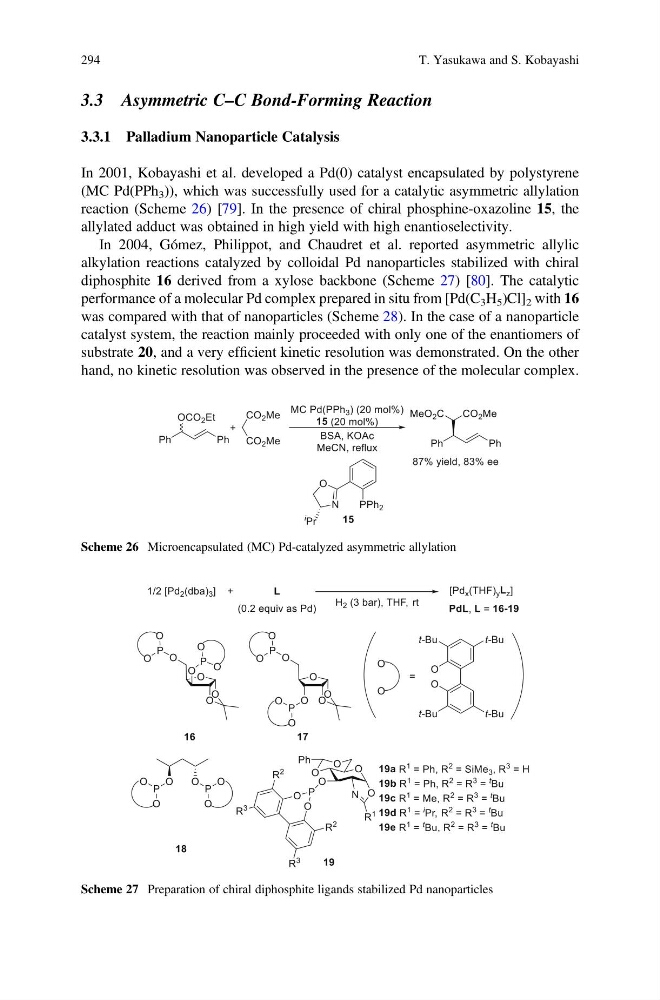
In 2001, Kobayashi et al. developed a Pd(0) catalyst encapsulated by polystyrene
(MC Pd(PPh 3 )), which was successfully used for a catalytic asymmetric allylation
reaction (Scheme 26) [79]. In the presence of chiral phosphine-oxazoline 15, the
allylated adduct was obtained in high yield with high enantioselectivity.
In 2004, Gómez, Philippot, and Chaudret et al. reported asymmetric allylic
alkylation reactions catalyzed by colloidal Pd nanoparticles stabilized with chiral
diphosphite 16 derived from a xylose backbone (Scheme 27) [80]. The catalytic
performance of a molecular Pd complex prepared in situ from [Pd(C 3 H 5 )Cl] 2 with 16
was compared with that of nanoparticles (Scheme 28). In the case of a nanoparticle
catalyst system, the reaction mainly proceeded with only one of the enantiomers of
substrate 20, and a very efficient kinetic resolution was demonstrated. On the other
hand, no kinetic resolution was observed in the presence of the molecular complex.
Scheme 26 Microencapsulated (MC) Pd-catalyzed asymmetric allylation
Scheme 27 Preparation of chiral diphosphite ligands stabilized Pd nanoparticles
294
T. Yasukawa and S. Kobayashi
3.3.1 Palladium Nanoparticle Catalysis
In 2001, Kobayashi et al. developed a Pd(0) catalyst encapsulated by polystyrene
(MC Pd(PPh 3 )), which was successfully used for a catalytic asymmetric allylation
reaction (Scheme 26) [79]. In the presence of chiral phosphine-oxazoline 15, the
allylated adduct was obtained in high yield with high enantioselectivity.
In 2004, Gómez, Philippot, and Chaudret et al. reported asymmetric allylic
alkylation reactions catalyzed by colloidal Pd nanoparticles stabilized with chiral
diphosphite 16 derived from a xylose backbone (Scheme 27) [80]. The catalytic
performance of a molecular Pd complex prepared in situ from [Pd(C 3 H 5 )Cl] 2 with 16
was compared with that of nanoparticles (Scheme 28). In the case of a nanoparticle
catalyst system, the reaction mainly proceeded with only one of the enantiomers of
substrate 20, and a very efficient kinetic resolution was demonstrated. On the other
hand, no kinetic resolution was observed in the presence of the molecular complex.
Scheme 26 Microencapsulated (MC) Pd-catalyzed asymmetric allylation
Scheme 27 Preparation of chiral diphosphite ligands stabilized Pd nanoparticles
294
T. Yasukawa and S. Kobayashi