

active species were not leached out. XPS analysis revealed that both +2 and +1
oxidation states of Cu were observed after treatment with BINAP 12 and silane,
while the fresh catalyst and the used catalyst showed the peak corresponding to +2
oxidation state. In 2009, the same group reported copper ferrite nanoparticles
(CuFe 2 O 4 ) for asymmetric hydrosilylation of aromatic ketones with
polymethylhydrosiloxane (PMHS) as an inexpensive, nontoxic, and air-stable
hydride source [77]. In the presence of the nanoparticles and BINAP 12, various
aromatic ketones and ketoesters were converted to the corresponding alcohols in
moderate to excellent enantioselectivities at room temperature. The Cu catalyst
could be magnetically separable and could be reused for three times without
significant loss of activity and selectivity.
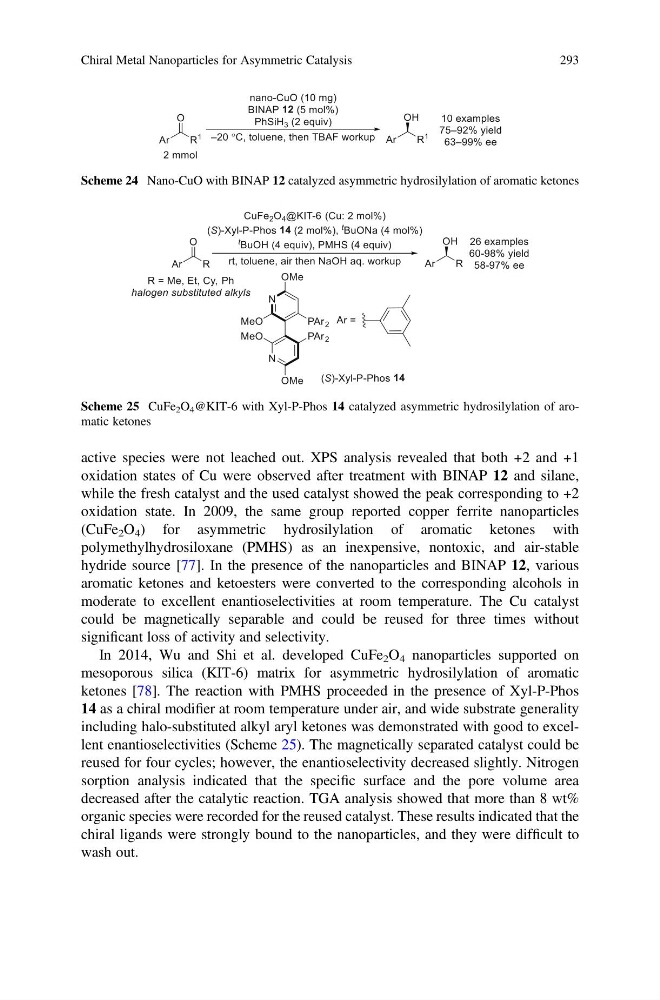
In 2014, Wu and Shi et al. developed CuFe 2 O 4 nanoparticles supported on
mesoporous silica (KIT-6) matrix for asymmetric hydrosilylation of aromatic
ketones [78]. The reaction with PMHS proceeded in the presence of Xyl-P-Phos
14 as a chiral modifier at room temperature under air, and wide substrate generality
including halo-substituted alkyl aryl ketones was demonstrated with good to excellent enantioselectivities (Scheme 25). The magnetically separated catalyst could be
reused for four cycles; however, the enantioselectivity decreased slightly. Nitrogen
sorption analysis indicated that the specific surface and the pore volume area
decreased after the catalytic reaction. TGA analysis showed that more than 8 wt%
organic species were recorded for the reused catalyst. These results indicated that the
chiral ligands were strongly bound to the nanoparticles, and they were difficult to
wash out.
Scheme 24 Nano-CuO with BINAP 12 catalyzed asymmetric hydrosilylation of aromatic ketones
Scheme 25 CuFe 2 O 4 @KIT-6 with Xyl-P-Phos 14 catalyzed asymmetric hydrosilylation of aromatic ketones
Chiral Metal Nanoparticles for Asymmetric Catalysis
293
oxidation states of Cu were observed after treatment with BINAP 12 and silane,
while the fresh catalyst and the used catalyst showed the peak corresponding to +2
oxidation state. In 2009, the same group reported copper ferrite nanoparticles
(CuFe 2 O 4 ) for asymmetric hydrosilylation of aromatic ketones with
polymethylhydrosiloxane (PMHS) as an inexpensive, nontoxic, and air-stable
hydride source [77]. In the presence of the nanoparticles and BINAP 12, various
aromatic ketones and ketoesters were converted to the corresponding alcohols in
moderate to excellent enantioselectivities at room temperature. The Cu catalyst
could be magnetically separable and could be reused for three times without
significant loss of activity and selectivity.
In 2014, Wu and Shi et al. developed CuFe 2 O 4 nanoparticles supported on
mesoporous silica (KIT-6) matrix for asymmetric hydrosilylation of aromatic
ketones [78]. The reaction with PMHS proceeded in the presence of Xyl-P-Phos
14 as a chiral modifier at room temperature under air, and wide substrate generality
including halo-substituted alkyl aryl ketones was demonstrated with good to excellent enantioselectivities (Scheme 25). The magnetically separated catalyst could be
reused for four cycles; however, the enantioselectivity decreased slightly. Nitrogen
sorption analysis indicated that the specific surface and the pore volume area
decreased after the catalytic reaction. TGA analysis showed that more than 8 wt%
organic species were recorded for the reused catalyst. These results indicated that the
chiral ligands were strongly bound to the nanoparticles, and they were difficult to
wash out.
Scheme 24 Nano-CuO with BINAP 12 catalyzed asymmetric hydrosilylation of aromatic ketones
Scheme 25 CuFe 2 O 4 @KIT-6 with Xyl-P-Phos 14 catalyzed asymmetric hydrosilylation of aromatic ketones
Chiral Metal Nanoparticles for Asymmetric Catalysis
293