

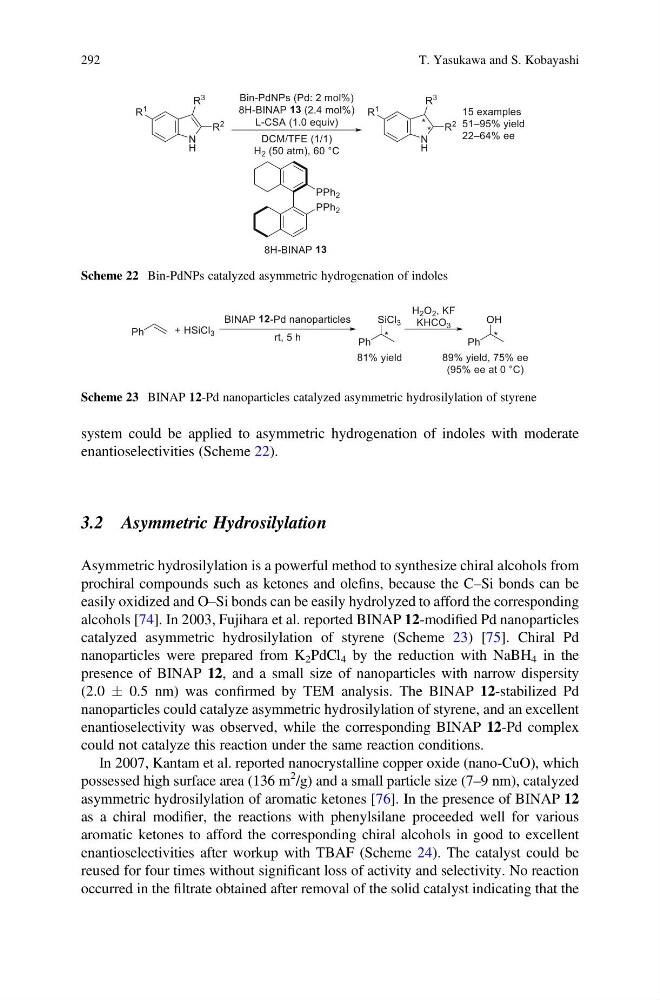
system could be applied to asymmetric hydrogenation of indoles with moderate
enantioselectivities (Scheme 22).
3.2 Asymmetric Hydrosilylation
Asymmetric hydrosilylation is a powerful method to synthesize chiral alcohols from
prochiral compounds such as ketones and olefins, because the C–Si bonds can be
easily oxidized and O–Si bonds can be easily hydrolyzed to afford the corresponding
alcohols [74]. In 2003, Fujihara et al. reported BINAP 12-modified Pd nanoparticles
catalyzed asymmetric hydrosilylation of styrene (Scheme 23) [75]. Chiral Pd
nanoparticles were prepared from K 2 PdCl 4 by the reduction with NaBH 4 in the
presence of BINAP 12, and a small size of nanoparticles with narrow dispersity
(2.0 Æ 0.5 nm) was confirmed by TEM analysis. The BINAP 12-stabilized Pd
nanoparticles could catalyze asymmetric hydrosilylation of styrene, and an excellent
enantioselectivity was observed, while the corresponding BINAP 12-Pd complex
could not catalyze this reaction under the same reaction conditions.
In 2007, Kantam et al. reported nanocrystalline copper oxide (nano-CuO), which
possessed high surface area (136 m
2 /g) and a small particle size (7–9 nm), catalyzed
asymmetric hydrosilylation of aromatic ketones [76]. In the presence of BINAP 12
as a chiral modifier, the reactions with phenylsilane proceeded well for various
aromatic ketones to afford the corresponding chiral alcohols in good to excellent
enantioselectivities after workup with TBAF (Scheme 24). The catalyst could be
reused for four times without significant loss of activity and selectivity. No reaction
occurred in the filtrate obtained after removal of the solid catalyst indicating that the
Scheme 22 Bin-PdNPs catalyzed asymmetric hydrogenation of indoles
Scheme 23 BINAP 12-Pd nanoparticles catalyzed asymmetric hydrosilylation of styrene
292
T. Yasukawa and S. Kobayashi
enantioselectivities (Scheme 22).
3.2 Asymmetric Hydrosilylation
Asymmetric hydrosilylation is a powerful method to synthesize chiral alcohols from
prochiral compounds such as ketones and olefins, because the C–Si bonds can be
easily oxidized and O–Si bonds can be easily hydrolyzed to afford the corresponding
alcohols [74]. In 2003, Fujihara et al. reported BINAP 12-modified Pd nanoparticles
catalyzed asymmetric hydrosilylation of styrene (Scheme 23) [75]. Chiral Pd
nanoparticles were prepared from K 2 PdCl 4 by the reduction with NaBH 4 in the
presence of BINAP 12, and a small size of nanoparticles with narrow dispersity
(2.0 Æ 0.5 nm) was confirmed by TEM analysis. The BINAP 12-stabilized Pd
nanoparticles could catalyze asymmetric hydrosilylation of styrene, and an excellent
enantioselectivity was observed, while the corresponding BINAP 12-Pd complex
could not catalyze this reaction under the same reaction conditions.
In 2007, Kantam et al. reported nanocrystalline copper oxide (nano-CuO), which
possessed high surface area (136 m
2 /g) and a small particle size (7–9 nm), catalyzed
asymmetric hydrosilylation of aromatic ketones [76]. In the presence of BINAP 12
as a chiral modifier, the reactions with phenylsilane proceeded well for various
aromatic ketones to afford the corresponding chiral alcohols in good to excellent
enantioselectivities after workup with TBAF (Scheme 24). The catalyst could be
reused for four times without significant loss of activity and selectivity. No reaction
occurred in the filtrate obtained after removal of the solid catalyst indicating that the
Scheme 22 Bin-PdNPs catalyzed asymmetric hydrogenation of indoles
Scheme 23 BINAP 12-Pd nanoparticles catalyzed asymmetric hydrosilylation of styrene
292
T. Yasukawa and S. Kobayashi