

basic conditions. Broad substrate generality was achieved with good to excellent
enantioselectivities. Several mechanistic observations indicated that active species in
the Fe catalyst system might be heterogeneous with 10-modified Fe particles. For
examples, dynamic light scattering confirmed the existence of Fe particles, and a
significant poisoning effect was observed.
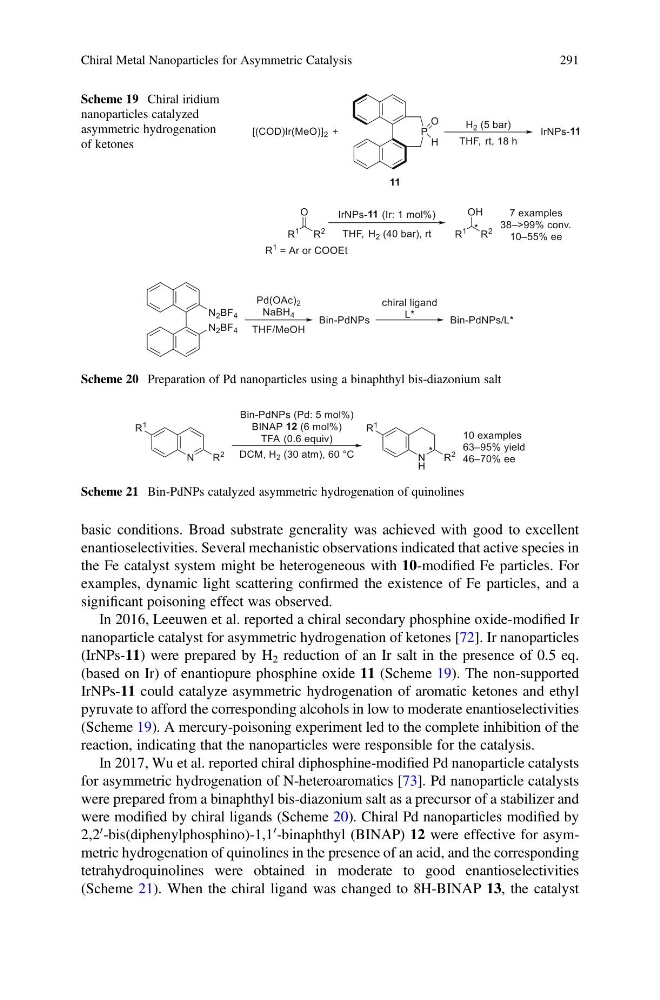
In 2016, Leeuwen et al. reported a chiral secondary phosphine oxide-modified Ir
nanoparticle catalyst for asymmetric hydrogenation of ketones [72]. Ir nanoparticles
(IrNPs-11) were prepared by H 2 reduction of an Ir salt in the presence of 0.5 eq.
(based on Ir) of enantiopure phosphine oxide 11 (Scheme 19). The non-supported
IrNPs-11 could catalyze asymmetric hydrogenation of aromatic ketones and ethyl
pyruvate to afford the corresponding alcohols in low to moderate enantioselectivities
(Scheme 19). A mercury-poisoning experiment led to the complete inhibition of the
reaction, indicating that the nanoparticles were responsible for the catalysis.
In 2017, Wu et al. reported chiral diphosphine-modified Pd nanoparticle catalysts
for asymmetric hydrogenation of N-heteroaromatics [73]. Pd nanoparticle catalysts
were prepared from a binaphthyl bis-diazonium salt as a precursor of a stabilizer and
were modified by chiral ligands (Scheme 20). Chiral Pd nanoparticles modified by
2,2
0 -bis(diphenylphosphino)-1,1
0 -binaphthyl (BINAP) 12 were effective for asymmetric hydrogenation of quinolines in the presence of an acid, and the corresponding
tetrahydroquinolines were obtained in moderate to good enantioselectivities
(Scheme 21). When the chiral ligand was changed to 8H-BINAP 13, the catalyst
Scheme 19 Chiral iridium
nanoparticles catalyzed
asymmetric hydrogenation
of ketones
Scheme 20 Preparation of Pd nanoparticles using a binaphthyl bis-diazonium salt
Scheme 21 Bin-PdNPs catalyzed asymmetric hydrogenation of quinolines
Chiral Metal Nanoparticles for Asymmetric Catalysis
291
enantioselectivities. Several mechanistic observations indicated that active species in
the Fe catalyst system might be heterogeneous with 10-modified Fe particles. For
examples, dynamic light scattering confirmed the existence of Fe particles, and a
significant poisoning effect was observed.
In 2016, Leeuwen et al. reported a chiral secondary phosphine oxide-modified Ir
nanoparticle catalyst for asymmetric hydrogenation of ketones [72]. Ir nanoparticles
(IrNPs-11) were prepared by H 2 reduction of an Ir salt in the presence of 0.5 eq.
(based on Ir) of enantiopure phosphine oxide 11 (Scheme 19). The non-supported
IrNPs-11 could catalyze asymmetric hydrogenation of aromatic ketones and ethyl
pyruvate to afford the corresponding alcohols in low to moderate enantioselectivities
(Scheme 19). A mercury-poisoning experiment led to the complete inhibition of the
reaction, indicating that the nanoparticles were responsible for the catalysis.
In 2017, Wu et al. reported chiral diphosphine-modified Pd nanoparticle catalysts
for asymmetric hydrogenation of N-heteroaromatics [73]. Pd nanoparticle catalysts
were prepared from a binaphthyl bis-diazonium salt as a precursor of a stabilizer and
were modified by chiral ligands (Scheme 20). Chiral Pd nanoparticles modified by
2,2
0 -bis(diphenylphosphino)-1,1
0 -binaphthyl (BINAP) 12 were effective for asymmetric hydrogenation of quinolines in the presence of an acid, and the corresponding
tetrahydroquinolines were obtained in moderate to good enantioselectivities
(Scheme 21). When the chiral ligand was changed to 8H-BINAP 13, the catalyst
Scheme 19 Chiral iridium
nanoparticles catalyzed
asymmetric hydrogenation
of ketones
Scheme 20 Preparation of Pd nanoparticles using a binaphthyl bis-diazonium salt
Scheme 21 Bin-PdNPs catalyzed asymmetric hydrogenation of quinolines
Chiral Metal Nanoparticles for Asymmetric Catalysis
291