

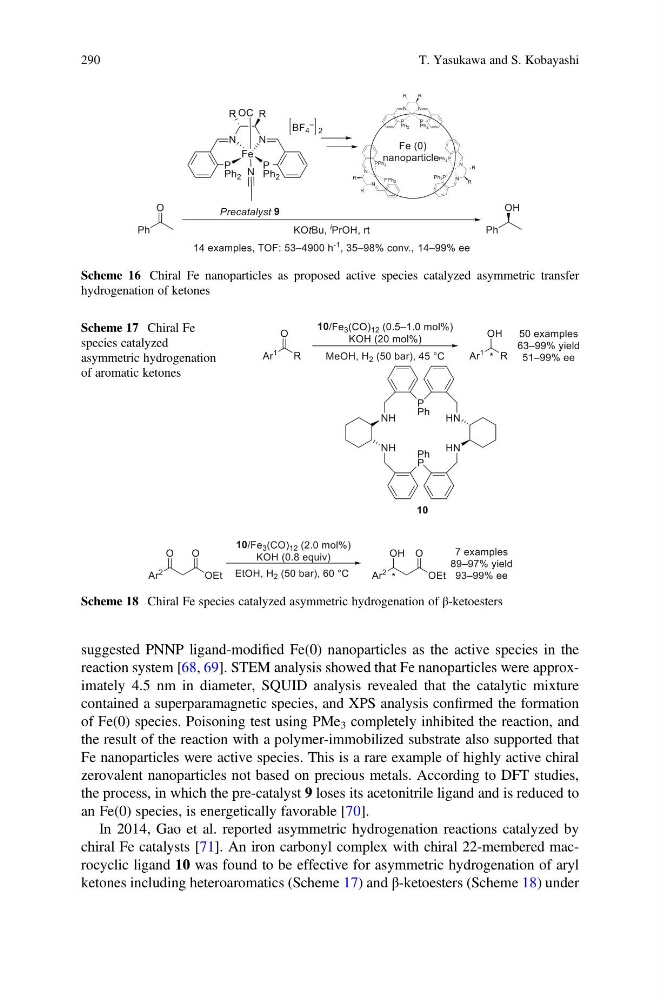
suggested PNNP ligand-modified Fe(0) nanoparticles as the active species in the
reaction system [68, 69]. STEM analysis showed that Fe nanoparticles were approximately 4.5 nm in diameter, SQUID analysis revealed that the catalytic mixture
contained a superparamagnetic species, and XPS analysis confirmed the formation
of Fe(0) species. Poisoning test using PMe 3 completely inhibited the reaction, and
the result of the reaction with a polymer-immobilized substrate also supported that
Fe nanoparticles were active species. This is a rare example of highly active chiral
zerovalent nanoparticles not based on precious metals. According to DFT studies,
the process, in which the pre-catalyst 9 loses its acetonitrile ligand and is reduced to
an Fe(0) species, is energetically favorable [70].
In 2014, Gao et al. reported asymmetric hydrogenation reactions catalyzed by
chiral Fe catalysts [71]. An iron carbonyl complex with chiral 22-membered macrocyclic ligand 10 was found to be effective for asymmetric hydrogenation of aryl
ketones including heteroaromatics (Scheme 17) and β-ketoesters (Scheme 18) under
Scheme 16 Chiral Fe nanoparticles as proposed active species catalyzed asymmetric transfer
hydrogenation of ketones
Scheme 17 Chiral Fe
species catalyzed
asymmetric hydrogenation
of aromatic ketones
Scheme 18 Chiral Fe species catalyzed asymmetric hydrogenation of β-ketoesters
290
T. Yasukawa and S. Kobayashi
reaction system [68, 69]. STEM analysis showed that Fe nanoparticles were approximately 4.5 nm in diameter, SQUID analysis revealed that the catalytic mixture
contained a superparamagnetic species, and XPS analysis confirmed the formation
of Fe(0) species. Poisoning test using PMe 3 completely inhibited the reaction, and
the result of the reaction with a polymer-immobilized substrate also supported that
Fe nanoparticles were active species. This is a rare example of highly active chiral
zerovalent nanoparticles not based on precious metals. According to DFT studies,
the process, in which the pre-catalyst 9 loses its acetonitrile ligand and is reduced to
an Fe(0) species, is energetically favorable [70].
In 2014, Gao et al. reported asymmetric hydrogenation reactions catalyzed by
chiral Fe catalysts [71]. An iron carbonyl complex with chiral 22-membered macrocyclic ligand 10 was found to be effective for asymmetric hydrogenation of aryl
ketones including heteroaromatics (Scheme 17) and β-ketoesters (Scheme 18) under
Scheme 16 Chiral Fe nanoparticles as proposed active species catalyzed asymmetric transfer
hydrogenation of ketones
Scheme 17 Chiral Fe
species catalyzed
asymmetric hydrogenation
of aromatic ketones
Scheme 18 Chiral Fe species catalyzed asymmetric hydrogenation of β-ketoesters
290
T. Yasukawa and S. Kobayashi