

heterogeneous support, 0.1 equiv. of an oxidizer was used for the reaction. The
desired product 6 was obtained in good diastereoselectivity and moderate
enantioselectivity, when peptide 8 was immobilized on the surface of the
mesoporous silica. The corresponding homogeneous system using AuCl 3 and
unsupported diproline in the intermolecular reaction showed low yield and no
enantioselection. While no leaching of Au complexes to a solution phase was
confirmed by ICP analysis, in situ near-edge X-ray adsorption fine structure
(NEXAFS) measurements under the reaction conditions proved the formation of
Au(III) ions as active species, which were generated from Au(0) nanoparticles by
oxidation with an externally added oxidant, PhICl 2 . The same catalyst could be also
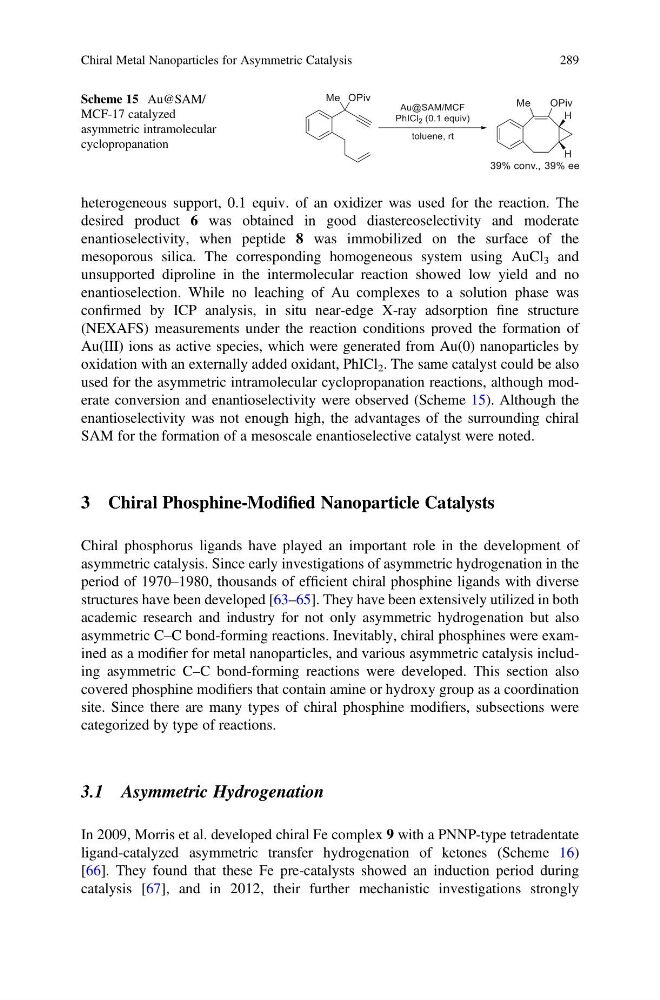
used for the asymmetric intramolecular cyclopropanation reactions, although moderate conversion and enantioselectivity were observed (Scheme 15). Although the
enantioselectivity was not enough high, the advantages of the surrounding chiral
SAM for the formation of a mesoscale enantioselective catalyst were noted.
3 Chiral Phosphine-Modified Nanoparticle Catalysts
Chiral phosphorus ligands have played an important role in the development of
asymmetric catalysis. Since early investigations of asymmetric hydrogenation in the
period of 1970–1980, thousands of efficient chiral phosphine ligands with diverse
structures have been developed [63–65]. They have been extensively utilized in both
academic research and industry for not only asymmetric hydrogenation but also
asymmetric C–C bond-forming reactions. Inevitably, chiral phosphines were examined as a modifier for metal nanoparticles, and various asymmetric catalysis including asymmetric C–C bond-forming reactions were developed. This section also
covered phosphine modifiers that contain amine or hydroxy group as a coordination
site. Since there are many types of chiral phosphine modifiers, subsections were
categorized by type of reactions.
3.1 Asymmetric Hydrogenation
In 2009, Morris et al. developed chiral Fe complex 9 with a PNNP-type tetradentate
ligand-catalyzed asymmetric transfer hydrogenation of ketones (Scheme 16)
[66]. They found that these Fe pre-catalysts showed an induction period during
catalysis [67], and in 2012, their further mechanistic investigations strongly
Scheme 15 Au@SAM/
MCF-17 catalyzed
asymmetric intramolecular
cyclopropanation
Chiral Metal Nanoparticles for Asymmetric Catalysis
289
desired product 6 was obtained in good diastereoselectivity and moderate
enantioselectivity, when peptide 8 was immobilized on the surface of the
mesoporous silica. The corresponding homogeneous system using AuCl 3 and
unsupported diproline in the intermolecular reaction showed low yield and no
enantioselection. While no leaching of Au complexes to a solution phase was
confirmed by ICP analysis, in situ near-edge X-ray adsorption fine structure
(NEXAFS) measurements under the reaction conditions proved the formation of
Au(III) ions as active species, which were generated from Au(0) nanoparticles by
oxidation with an externally added oxidant, PhICl 2 . The same catalyst could be also
used for the asymmetric intramolecular cyclopropanation reactions, although moderate conversion and enantioselectivity were observed (Scheme 15). Although the
enantioselectivity was not enough high, the advantages of the surrounding chiral
SAM for the formation of a mesoscale enantioselective catalyst were noted.
3 Chiral Phosphine-Modified Nanoparticle Catalysts
Chiral phosphorus ligands have played an important role in the development of
asymmetric catalysis. Since early investigations of asymmetric hydrogenation in the
period of 1970–1980, thousands of efficient chiral phosphine ligands with diverse
structures have been developed [63–65]. They have been extensively utilized in both
academic research and industry for not only asymmetric hydrogenation but also
asymmetric C–C bond-forming reactions. Inevitably, chiral phosphines were examined as a modifier for metal nanoparticles, and various asymmetric catalysis including asymmetric C–C bond-forming reactions were developed. This section also
covered phosphine modifiers that contain amine or hydroxy group as a coordination
site. Since there are many types of chiral phosphine modifiers, subsections were
categorized by type of reactions.
3.1 Asymmetric Hydrogenation
In 2009, Morris et al. developed chiral Fe complex 9 with a PNNP-type tetradentate
ligand-catalyzed asymmetric transfer hydrogenation of ketones (Scheme 16)
[66]. They found that these Fe pre-catalysts showed an induction period during
catalysis [67], and in 2012, their further mechanistic investigations strongly
Scheme 15 Au@SAM/
MCF-17 catalyzed
asymmetric intramolecular
cyclopropanation
Chiral Metal Nanoparticles for Asymmetric Catalysis
289