

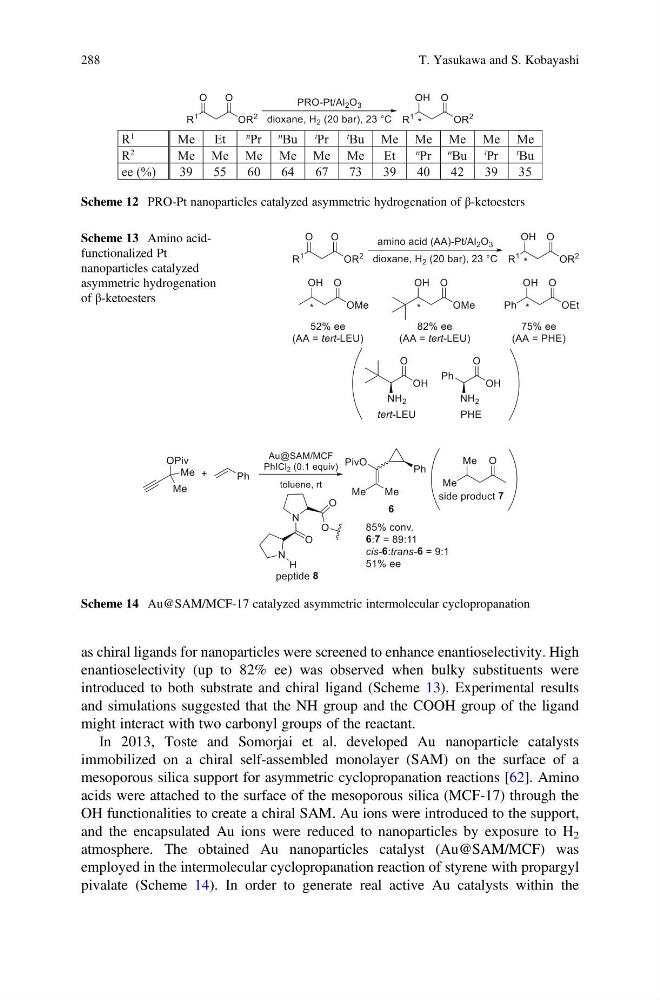
as chiral ligands for nanoparticles were screened to enhance enantioselectivity. High
enantioselectivity (up to 82% ee) was observed when bulky substituents were
introduced to both substrate and chiral ligand (Scheme 13). Experimental results
and simulations suggested that the NH group and the COOH group of the ligand
might interact with two carbonyl groups of the reactant.
In 2013, Toste and Somorjai et al. developed Au nanoparticle catalysts
immobilized on a chiral self-assembled monolayer (SAM) on the surface of a
mesoporous silica support for asymmetric cyclopropanation reactions [62]. Amino
acids were attached to the surface of the mesoporous silica (MCF-17) through the
OH functionalities to create a chiral SAM. Au ions were introduced to the support,
and the encapsulated Au ions were reduced to nanoparticles by exposure to H 2
atmosphere. The obtained Au nanoparticles catalyst (Au@SAM/MCF) was
employed in the intermolecular cyclopropanation reaction of styrene with propargyl
pivalate (Scheme 14). In order to generate real active Au catalysts within the
R
1
Me Et
n
Pr
n
Bu
i
Pr
t
Bu Me Me Me Me Me
R
2
Me Me Me Me Me Me Et
n
Pr
n
Bu
i
Pr
t
Bu
ee (%)
39
55
60
64
67
73
39
40
42
39
35
Scheme 12 PRO-Pt nanoparticles catalyzed asymmetric hydrogenation of β-ketoesters
Scheme 13 Amino acidfunctionalized Pt
nanoparticles catalyzed
asymmetric hydrogenation
of β-ketoesters
Scheme 14 Au@SAM/MCF-17 catalyzed asymmetric intermolecular cyclopropanation
288
T. Yasukawa and S. Kobayashi
enantioselectivity (up to 82% ee) was observed when bulky substituents were
introduced to both substrate and chiral ligand (Scheme 13). Experimental results
and simulations suggested that the NH group and the COOH group of the ligand
might interact with two carbonyl groups of the reactant.
In 2013, Toste and Somorjai et al. developed Au nanoparticle catalysts
immobilized on a chiral self-assembled monolayer (SAM) on the surface of a
mesoporous silica support for asymmetric cyclopropanation reactions [62]. Amino
acids were attached to the surface of the mesoporous silica (MCF-17) through the
OH functionalities to create a chiral SAM. Au ions were introduced to the support,
and the encapsulated Au ions were reduced to nanoparticles by exposure to H 2
atmosphere. The obtained Au nanoparticles catalyst (Au@SAM/MCF) was
employed in the intermolecular cyclopropanation reaction of styrene with propargyl
pivalate (Scheme 14). In order to generate real active Au catalysts within the
R
1
Me Et
n
Pr
n
Bu
i
Pr
t
Bu Me Me Me Me Me
R
2
Me Me Me Me Me Me Et
n
Pr
n
Bu
i
Pr
t
Bu
ee (%)
39
55
60
64
67
73
39
40
42
39
35
Scheme 12 PRO-Pt nanoparticles catalyzed asymmetric hydrogenation of β-ketoesters
Scheme 13 Amino acidfunctionalized Pt
nanoparticles catalyzed
asymmetric hydrogenation
of β-ketoesters
Scheme 14 Au@SAM/MCF-17 catalyzed asymmetric intermolecular cyclopropanation
288
T. Yasukawa and S. Kobayashi