

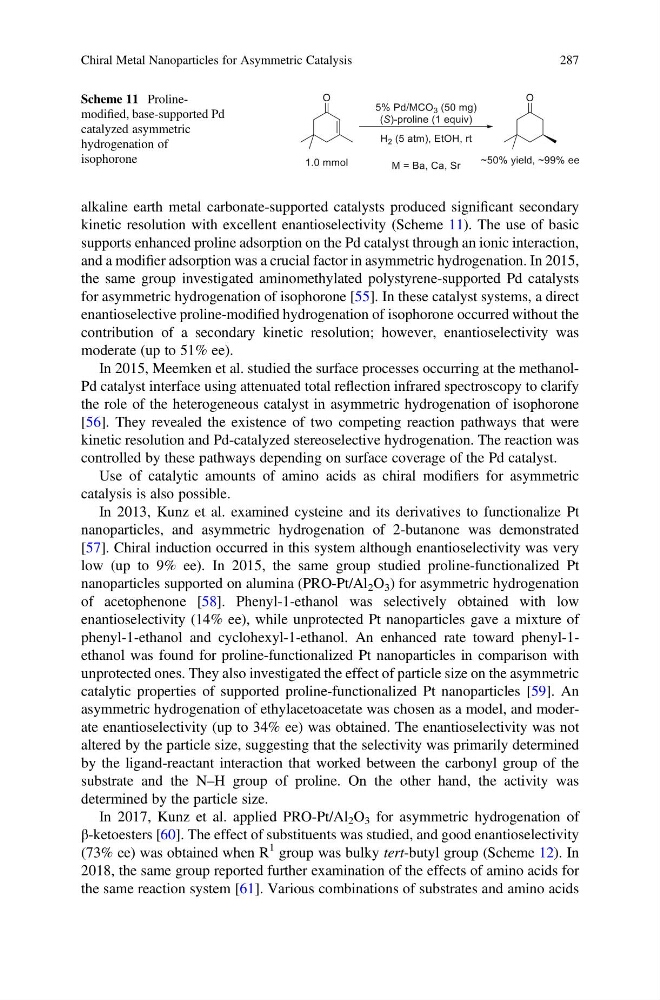
alkaline earth metal carbonate-supported catalysts produced significant secondary
kinetic resolution with excellent enantioselectivity (Scheme 11). The use of basic
supports enhanced proline adsorption on the Pd catalyst through an ionic interaction,
and a modifier adsorption was a crucial factor in asymmetric hydrogenation. In 2015,
the same group investigated aminomethylated polystyrene-supported Pd catalysts
for asymmetric hydrogenation of isophorone [55]. In these catalyst systems, a direct
enantioselective proline-modified hydrogenation of isophorone occurred without the
contribution of a secondary kinetic resolution; however, enantioselectivity was
moderate (up to 51% ee).
In 2015, Meemken et al. studied the surface processes occurring at the methanolPd catalyst interface using attenuated total reflection infrared spectroscopy to clarify
the role of the heterogeneous catalyst in asymmetric hydrogenation of isophorone
[56]. They revealed the existence of two competing reaction pathways that were
kinetic resolution and Pd-catalyzed stereoselective hydrogenation. The reaction was
controlled by these pathways depending on surface coverage of the Pd catalyst.
Use of catalytic amounts of amino acids as chiral modifiers for asymmetric
catalysis is also possible.
In 2013, Kunz et al. examined cysteine and its derivatives to functionalize Pt
nanoparticles, and asymmetric hydrogenation of 2-butanone was demonstrated
[57]. Chiral induction occurred in this system although enantioselectivity was very
low (up to 9% ee). In 2015, the same group studied proline-functionalized Pt
nanoparticles supported on alumina (PRO-Pt/Al 2 O 3 ) for asymmetric hydrogenation
of acetophenone [58]. Phenyl-1-ethanol was selectively obtained with low
enantioselectivity (14% ee), while unprotected Pt nanoparticles gave a mixture of
phenyl-1-ethanol and cyclohexyl-1-ethanol. An enhanced rate toward phenyl-1ethanol was found for proline-functionalized Pt nanoparticles in comparison with
unprotected ones. They also investigated the effect of particle size on the asymmetric
catalytic properties of supported proline-functionalized Pt nanoparticles [59]. An
asymmetric hydrogenation of ethylacetoacetate was chosen as a model, and moderate enantioselectivity (up to 34% ee) was obtained. The enantioselectivity was not
altered by the particle size, suggesting that the selectivity was primarily determined
by the ligand-reactant interaction that worked between the carbonyl group of the
substrate and the N–H group of proline. On the other hand, the activity was
determined by the particle size.
In 2017, Kunz et al. applied PRO-Pt/Al 2 O 3 for asymmetric hydrogenation of
β-ketoesters [60]. The effect of substituents was studied, and good enantioselectivity
(73% ee) was obtained when R
1 group was bulky tert-butyl group (Scheme 12). In
2018, the same group reported further examination of the effects of amino acids for
the same reaction system [61]. Various combinations of substrates and amino acids
Scheme 11 Prolinemodified, base-supported Pd
catalyzed asymmetric
hydrogenation of
isophorone
Chiral Metal Nanoparticles for Asymmetric Catalysis
287
kinetic resolution with excellent enantioselectivity (Scheme 11). The use of basic
supports enhanced proline adsorption on the Pd catalyst through an ionic interaction,
and a modifier adsorption was a crucial factor in asymmetric hydrogenation. In 2015,
the same group investigated aminomethylated polystyrene-supported Pd catalysts
for asymmetric hydrogenation of isophorone [55]. In these catalyst systems, a direct
enantioselective proline-modified hydrogenation of isophorone occurred without the
contribution of a secondary kinetic resolution; however, enantioselectivity was
moderate (up to 51% ee).
In 2015, Meemken et al. studied the surface processes occurring at the methanolPd catalyst interface using attenuated total reflection infrared spectroscopy to clarify
the role of the heterogeneous catalyst in asymmetric hydrogenation of isophorone
[56]. They revealed the existence of two competing reaction pathways that were
kinetic resolution and Pd-catalyzed stereoselective hydrogenation. The reaction was
controlled by these pathways depending on surface coverage of the Pd catalyst.
Use of catalytic amounts of amino acids as chiral modifiers for asymmetric
catalysis is also possible.
In 2013, Kunz et al. examined cysteine and its derivatives to functionalize Pt
nanoparticles, and asymmetric hydrogenation of 2-butanone was demonstrated
[57]. Chiral induction occurred in this system although enantioselectivity was very
low (up to 9% ee). In 2015, the same group studied proline-functionalized Pt
nanoparticles supported on alumina (PRO-Pt/Al 2 O 3 ) for asymmetric hydrogenation
of acetophenone [58]. Phenyl-1-ethanol was selectively obtained with low
enantioselectivity (14% ee), while unprotected Pt nanoparticles gave a mixture of
phenyl-1-ethanol and cyclohexyl-1-ethanol. An enhanced rate toward phenyl-1ethanol was found for proline-functionalized Pt nanoparticles in comparison with
unprotected ones. They also investigated the effect of particle size on the asymmetric
catalytic properties of supported proline-functionalized Pt nanoparticles [59]. An
asymmetric hydrogenation of ethylacetoacetate was chosen as a model, and moderate enantioselectivity (up to 34% ee) was obtained. The enantioselectivity was not
altered by the particle size, suggesting that the selectivity was primarily determined
by the ligand-reactant interaction that worked between the carbonyl group of the
substrate and the N–H group of proline. On the other hand, the activity was
determined by the particle size.
In 2017, Kunz et al. applied PRO-Pt/Al 2 O 3 for asymmetric hydrogenation of
β-ketoesters [60]. The effect of substituents was studied, and good enantioselectivity
(73% ee) was obtained when R
1 group was bulky tert-butyl group (Scheme 12). In
2018, the same group reported further examination of the effects of amino acids for
the same reaction system [61]. Various combinations of substrates and amino acids
Scheme 11 Prolinemodified, base-supported Pd
catalyzed asymmetric
hydrogenation of
isophorone
Chiral Metal Nanoparticles for Asymmetric Catalysis
287