

the case that R group was butyl. Control experiments using other modifiers such as
cinchonine, cinchonidine 1, and quinine indicated that the amine group in the
9-position of the modifier was essential.
2.3 Amino Acid-Modified Nanoparticle Catalysts
Direct use of amino acids for chiral induction is attractive because amino acids are
readily available chiral sources.
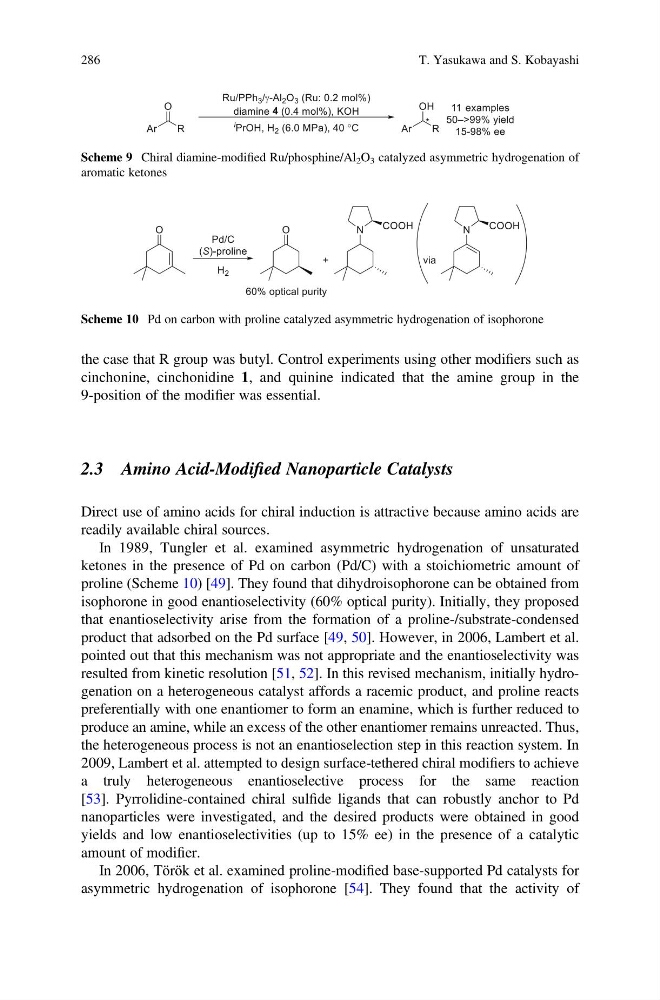
In 1989, Tungler et al. examined asymmetric hydrogenation of unsaturated
ketones in the presence of Pd on carbon (Pd/C) with a stoichiometric amount of
proline (Scheme 10) [49]. They found that dihydroisophorone can be obtained from
isophorone in good enantioselectivity (60% optical purity). Initially, they proposed
that enantioselectivity arise from the formation of a proline-/substrate-condensed
product that adsorbed on the Pd surface [49, 50]. However, in 2006, Lambert et al.
pointed out that this mechanism was not appropriate and the enantioselectivity was
resulted from kinetic resolution [51, 52]. In this revised mechanism, initially hydrogenation on a heterogeneous catalyst affords a racemic product, and proline reacts
preferentially with one enantiomer to form an enamine, which is further reduced to
produce an amine, while an excess of the other enantiomer remains unreacted. Thus,
the heterogeneous process is not an enantioselection step in this reaction system. In
2009, Lambert et al. attempted to design surface-tethered chiral modifiers to achieve
a truly heterogeneous enantioselective process for the same reaction
[53]. Pyrrolidine-contained chiral sulfide ligands that can robustly anchor to Pd
nanoparticles were investigated, and the desired products were obtained in good
yields and low enantioselectivities (up to 15% ee) in the presence of a catalytic
amount of modifier.
In 2006, Tӧrӧk et al. examined proline-modified base-supported Pd catalysts for
asymmetric hydrogenation of isophorone [54]. They found that the activity of
Scheme 9 Chiral diamine-modified Ru/phosphine/Al 2 O 3 catalyzed asymmetric hydrogenation of
aromatic ketones
Scheme 10 Pd on carbon with proline catalyzed asymmetric hydrogenation of isophorone
286
T. Yasukawa and S. Kobayashi
cinchonine, cinchonidine 1, and quinine indicated that the amine group in the
9-position of the modifier was essential.
2.3 Amino Acid-Modified Nanoparticle Catalysts
Direct use of amino acids for chiral induction is attractive because amino acids are
readily available chiral sources.
In 1989, Tungler et al. examined asymmetric hydrogenation of unsaturated
ketones in the presence of Pd on carbon (Pd/C) with a stoichiometric amount of
proline (Scheme 10) [49]. They found that dihydroisophorone can be obtained from
isophorone in good enantioselectivity (60% optical purity). Initially, they proposed
that enantioselectivity arise from the formation of a proline-/substrate-condensed
product that adsorbed on the Pd surface [49, 50]. However, in 2006, Lambert et al.
pointed out that this mechanism was not appropriate and the enantioselectivity was
resulted from kinetic resolution [51, 52]. In this revised mechanism, initially hydrogenation on a heterogeneous catalyst affords a racemic product, and proline reacts
preferentially with one enantiomer to form an enamine, which is further reduced to
produce an amine, while an excess of the other enantiomer remains unreacted. Thus,
the heterogeneous process is not an enantioselection step in this reaction system. In
2009, Lambert et al. attempted to design surface-tethered chiral modifiers to achieve
a truly heterogeneous enantioselective process for the same reaction
[53]. Pyrrolidine-contained chiral sulfide ligands that can robustly anchor to Pd
nanoparticles were investigated, and the desired products were obtained in good
yields and low enantioselectivities (up to 15% ee) in the presence of a catalytic
amount of modifier.
In 2006, Tӧrӧk et al. examined proline-modified base-supported Pd catalysts for
asymmetric hydrogenation of isophorone [54]. They found that the activity of
Scheme 9 Chiral diamine-modified Ru/phosphine/Al 2 O 3 catalyzed asymmetric hydrogenation of
aromatic ketones
Scheme 10 Pd on carbon with proline catalyzed asymmetric hydrogenation of isophorone
286
T. Yasukawa and S. Kobayashi