

n-hexane, while the catalyst and diamine 4 remained in ionic liquid and water, and
they were reused several times.
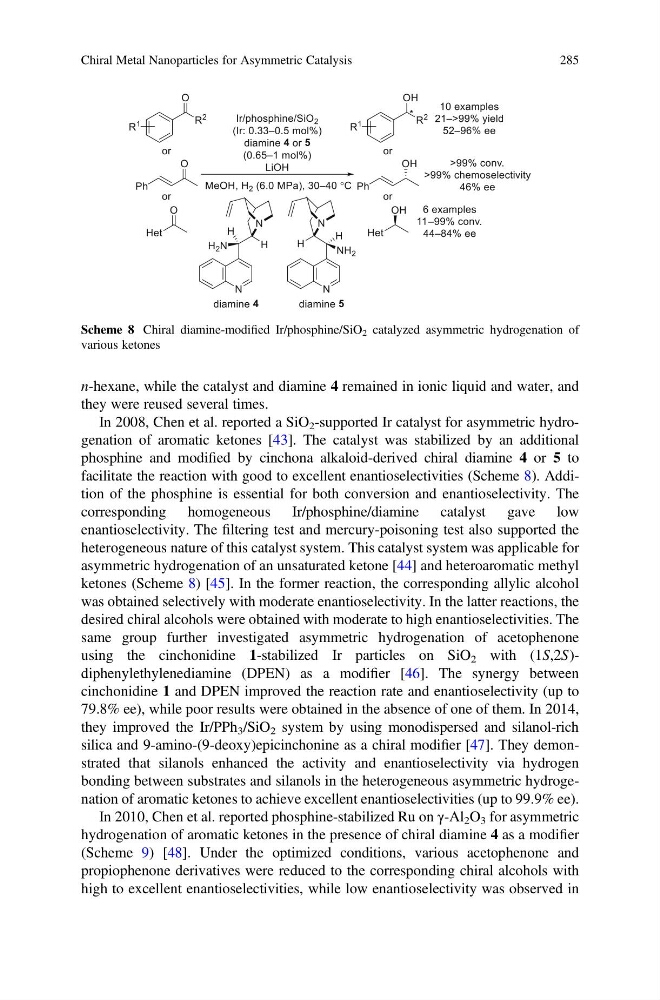
In 2008, Chen et al. reported a SiO 2 -supported Ir catalyst for asymmetric hydrogenation of aromatic ketones [43]. The catalyst was stabilized by an additional
phosphine and modified by cinchona alkaloid-derived chiral diamine 4 or 5 to
facilitate the reaction with good to excellent enantioselectivities (Scheme 8). Addition of the phosphine is essential for both conversion and enantioselectivity. The
corresponding homogeneous Ir/phosphine/diamine catalyst gave low
enantioselectivity. The filtering test and mercury-poisoning test also supported the
heterogeneous nature of this catalyst system. This catalyst system was applicable for
asymmetric hydrogenation of an unsaturated ketone [44] and heteroaromatic methyl
ketones (Scheme 8) [45]. In the former reaction, the corresponding allylic alcohol
was obtained selectively with moderate enantioselectivity. In the latter reactions, the
desired chiral alcohols were obtained with moderate to high enantioselectivities. The
same group further investigated asymmetric hydrogenation of acetophenone
using the cinchonidine 1-stabilized Ir particles on SiO 2 with (1S,2S)diphenylethylenediamine (DPEN) as a modifier [46]. The synergy between
cinchonidine 1 and DPEN improved the reaction rate and enantioselectivity (up to
79.8% ee), while poor results were obtained in the absence of one of them. In 2014,
they improved the Ir/PPh 3 /SiO 2 system by using monodispersed and silanol-rich
silica and 9-amino-(9-deoxy)epicinchonine as a chiral modifier [47]. They demonstrated that silanols enhanced the activity and enantioselectivity via hydrogen
bonding between substrates and silanols in the heterogeneous asymmetric hydrogenation of aromatic ketones to achieve excellent enantioselectivities (up to 99.9% ee).
In 2010, Chen et al. reported phosphine-stabilized Ru on γ-Al 2 O 3 for asymmetric
hydrogenation of aromatic ketones in the presence of chiral diamine 4 as a modifier
(Scheme 9) [48]. Under the optimized conditions, various acetophenone and
propiophenone derivatives were reduced to the corresponding chiral alcohols with
high to excellent enantioselectivities, while low enantioselectivity was observed in
Scheme 8 Chiral diamine-modified Ir/phosphine/SiO 2 catalyzed asymmetric hydrogenation of
various ketones
Chiral Metal Nanoparticles for Asymmetric Catalysis
285
they were reused several times.
In 2008, Chen et al. reported a SiO 2 -supported Ir catalyst for asymmetric hydrogenation of aromatic ketones [43]. The catalyst was stabilized by an additional
phosphine and modified by cinchona alkaloid-derived chiral diamine 4 or 5 to
facilitate the reaction with good to excellent enantioselectivities (Scheme 8). Addition of the phosphine is essential for both conversion and enantioselectivity. The
corresponding homogeneous Ir/phosphine/diamine catalyst gave low
enantioselectivity. The filtering test and mercury-poisoning test also supported the
heterogeneous nature of this catalyst system. This catalyst system was applicable for
asymmetric hydrogenation of an unsaturated ketone [44] and heteroaromatic methyl
ketones (Scheme 8) [45]. In the former reaction, the corresponding allylic alcohol
was obtained selectively with moderate enantioselectivity. In the latter reactions, the
desired chiral alcohols were obtained with moderate to high enantioselectivities. The
same group further investigated asymmetric hydrogenation of acetophenone
using the cinchonidine 1-stabilized Ir particles on SiO 2 with (1S,2S)diphenylethylenediamine (DPEN) as a modifier [46]. The synergy between
cinchonidine 1 and DPEN improved the reaction rate and enantioselectivity (up to
79.8% ee), while poor results were obtained in the absence of one of them. In 2014,
they improved the Ir/PPh 3 /SiO 2 system by using monodispersed and silanol-rich
silica and 9-amino-(9-deoxy)epicinchonine as a chiral modifier [47]. They demonstrated that silanols enhanced the activity and enantioselectivity via hydrogen
bonding between substrates and silanols in the heterogeneous asymmetric hydrogenation of aromatic ketones to achieve excellent enantioselectivities (up to 99.9% ee).
In 2010, Chen et al. reported phosphine-stabilized Ru on γ-Al 2 O 3 for asymmetric
hydrogenation of aromatic ketones in the presence of chiral diamine 4 as a modifier
(Scheme 9) [48]. Under the optimized conditions, various acetophenone and
propiophenone derivatives were reduced to the corresponding chiral alcohols with
high to excellent enantioselectivities, while low enantioselectivity was observed in
Scheme 8 Chiral diamine-modified Ir/phosphine/SiO 2 catalyzed asymmetric hydrogenation of
various ketones
Chiral Metal Nanoparticles for Asymmetric Catalysis
285