

methyl benzoylformate catalyzed by cinchonidine 1-modified Pt on carbon
(Scheme 1) [7, 8]. This reaction has attracted interests of many researchers in surface
chemistry as well as organic chemistry and catalytic chemistry and was extensively
studied even almost 40 years after the discovery to improve the catalyst system and
to clarify the reaction mechanism [9–15]. Since there are several excellent review
papers that summarize studies of Orito-type reactions and related reactions [16–20],
this chapter just briefly introduces it and does not explain more details.
Thanks to these pioneering studies, chiral ligand-modified nanoparticle catalysts,
called as chiral nanoparticles in this chapter, were gradually studied, and several
reactions including more challenging asymmetric C–C bond-forming reactions
could be achieved in high enantioselectivity. Undoubtedly, structures of chiral
modifiers are the most important factor, and their role is sometimes not just creation
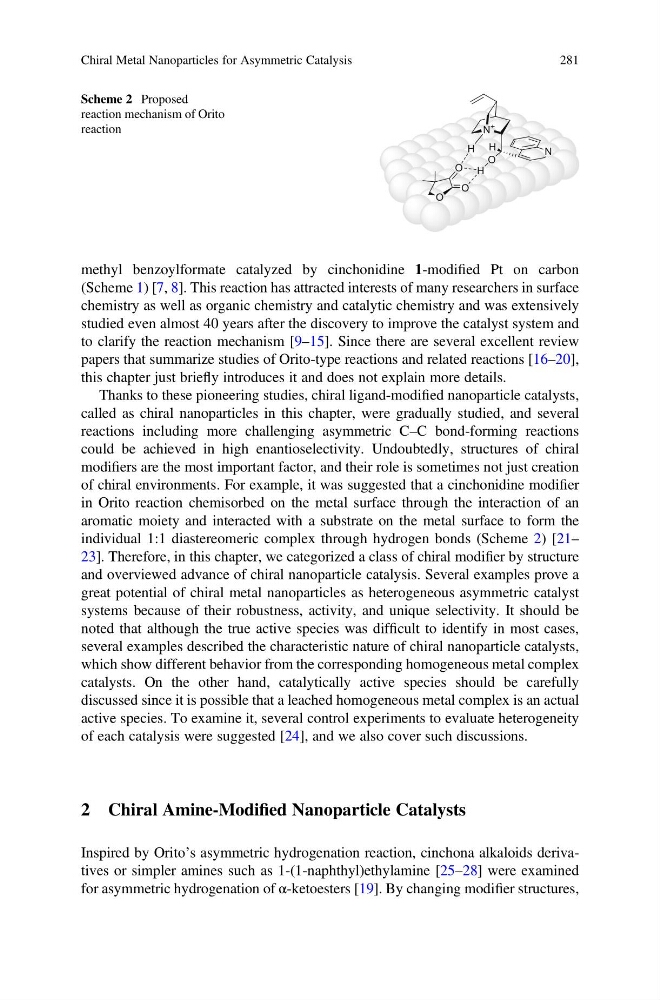
of chiral environments. For example, it was suggested that a cinchonidine modifier
in Orito reaction chemisorbed on the metal surface through the interaction of an
aromatic moiety and interacted with a substrate on the metal surface to form the
individual 1:1 diastereomeric complex through hydrogen bonds (Scheme 2) [21–
23]. Therefore, in this chapter, we categorized a class of chiral modifier by structure
and overviewed advance of chiral nanoparticle catalysis. Several examples prove a
great potential of chiral metal nanoparticles as heterogeneous asymmetric catalyst
systems because of their robustness, activity, and unique selectivity. It should be
noted that although the true active species was difficult to identify in most cases,
several examples described the characteristic nature of chiral nanoparticle catalysts,
which show different behavior from the corresponding homogeneous metal complex
catalysts. On the other hand, catalytically active species should be carefully
discussed since it is possible that a leached homogeneous metal complex is an actual
active species. To examine it, several control experiments to evaluate heterogeneity
of each catalysis were suggested [24], and we also cover such discussions.
2 Chiral Amine-Modified Nanoparticle Catalysts
Inspired by Orito’s asymmetric hydrogenation reaction, cinchona alkaloids derivatives or simpler amines such as 1-(1-naphthyl)ethylamine [25–28] were examined
for asymmetric hydrogenation of α-ketoesters [19]. By changing modifier structures,
Scheme 2 Proposed
reaction mechanism of Orito
reaction
Chiral Metal Nanoparticles for Asymmetric Catalysis
281
(Scheme 1) [7, 8]. This reaction has attracted interests of many researchers in surface
chemistry as well as organic chemistry and catalytic chemistry and was extensively
studied even almost 40 years after the discovery to improve the catalyst system and
to clarify the reaction mechanism [9–15]. Since there are several excellent review
papers that summarize studies of Orito-type reactions and related reactions [16–20],
this chapter just briefly introduces it and does not explain more details.
Thanks to these pioneering studies, chiral ligand-modified nanoparticle catalysts,
called as chiral nanoparticles in this chapter, were gradually studied, and several
reactions including more challenging asymmetric C–C bond-forming reactions
could be achieved in high enantioselectivity. Undoubtedly, structures of chiral
modifiers are the most important factor, and their role is sometimes not just creation
of chiral environments. For example, it was suggested that a cinchonidine modifier
in Orito reaction chemisorbed on the metal surface through the interaction of an
aromatic moiety and interacted with a substrate on the metal surface to form the
individual 1:1 diastereomeric complex through hydrogen bonds (Scheme 2) [21–
23]. Therefore, in this chapter, we categorized a class of chiral modifier by structure
and overviewed advance of chiral nanoparticle catalysis. Several examples prove a
great potential of chiral metal nanoparticles as heterogeneous asymmetric catalyst
systems because of their robustness, activity, and unique selectivity. It should be
noted that although the true active species was difficult to identify in most cases,
several examples described the characteristic nature of chiral nanoparticle catalysts,
which show different behavior from the corresponding homogeneous metal complex
catalysts. On the other hand, catalytically active species should be carefully
discussed since it is possible that a leached homogeneous metal complex is an actual
active species. To examine it, several control experiments to evaluate heterogeneity
of each catalysis were suggested [24], and we also cover such discussions.
2 Chiral Amine-Modified Nanoparticle Catalysts
Inspired by Orito’s asymmetric hydrogenation reaction, cinchona alkaloids derivatives or simpler amines such as 1-(1-naphthyl)ethylamine [25–28] were examined
for asymmetric hydrogenation of α-ketoesters [19]. By changing modifier structures,
Scheme 2 Proposed
reaction mechanism of Orito
reaction
Chiral Metal Nanoparticles for Asymmetric Catalysis
281