

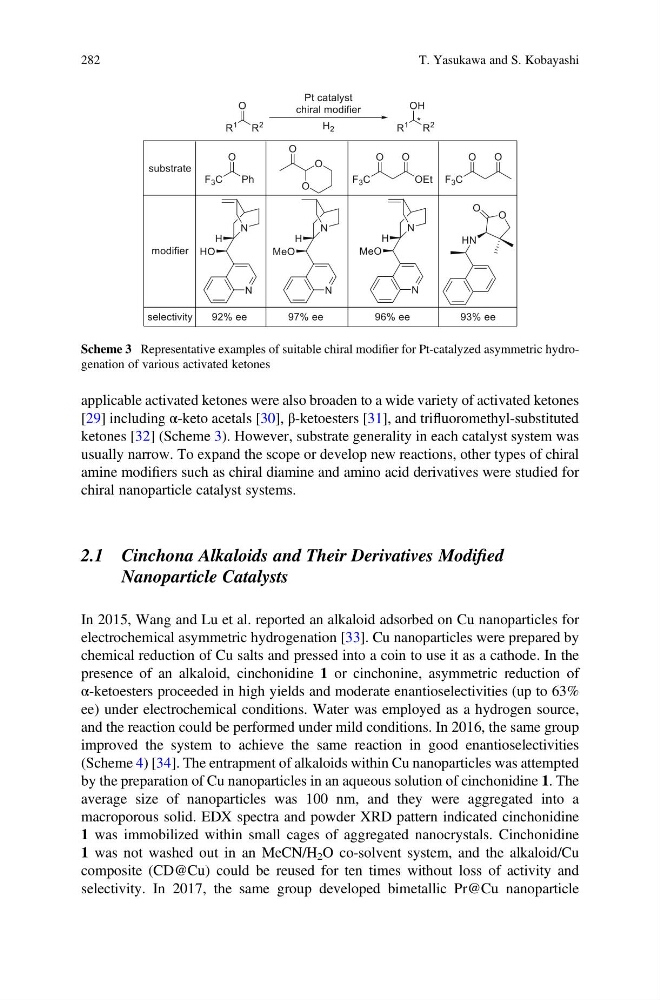
applicable activated ketones were also broaden to a wide variety of activated ketones
[29] including α-keto acetals [30], β-ketoesters [31], and trifluoromethyl-substituted
ketones [32] (Scheme 3). However, substrate generality in each catalyst system was
usually narrow. To expand the scope or develop new reactions, other types of chiral
amine modifiers such as chiral diamine and amino acid derivatives were studied for
chiral nanoparticle catalyst systems.
2.1 Cinchona Alkaloids and Their Derivatives Modified
Nanoparticle Catalysts
In 2015, Wang and Lu et al. reported an alkaloid adsorbed on Cu nanoparticles for
electrochemical asymmetric hydrogenation [33]. Cu nanoparticles were prepared by
chemical reduction of Cu salts and pressed into a coin to use it as a cathode. In the
presence of an alkaloid, cinchonidine 1 or cinchonine, asymmetric reduction of
α-ketoesters proceeded in high yields and moderate enantioselectivities (up to 63%
ee) under electrochemical conditions. Water was employed as a hydrogen source,
and the reaction could be performed under mild conditions. In 2016, the same group
improved the system to achieve the same reaction in good enantioselectivities
(Scheme 4) [34]. The entrapment of alkaloids within Cu nanoparticles was attempted
by the preparation of Cu nanoparticles in an aqueous solution of cinchonidine 1. The
average size of nanoparticles was 100 nm, and they were aggregated into a
macroporous solid. EDX spectra and powder XRD pattern indicated cinchonidine
1 was immobilized within small cages of aggregated nanocrystals. Cinchonidine
1 was not washed out in an MeCN/H 2 O co-solvent system, and the alkaloid/Cu
composite (CD@Cu) could be reused for ten times without loss of activity and
selectivity. In 2017, the same group developed bimetallic Pr@Cu nanoparticle
Scheme 3 Representative examples of suitable chiral modifier for Pt-catalyzed asymmetric hydrogenation of various activated ketones
282
T. Yasukawa and S. Kobayashi
[29] including α-keto acetals [30], β-ketoesters [31], and trifluoromethyl-substituted
ketones [32] (Scheme 3). However, substrate generality in each catalyst system was
usually narrow. To expand the scope or develop new reactions, other types of chiral
amine modifiers such as chiral diamine and amino acid derivatives were studied for
chiral nanoparticle catalyst systems.
2.1 Cinchona Alkaloids and Their Derivatives Modified
Nanoparticle Catalysts
In 2015, Wang and Lu et al. reported an alkaloid adsorbed on Cu nanoparticles for
electrochemical asymmetric hydrogenation [33]. Cu nanoparticles were prepared by
chemical reduction of Cu salts and pressed into a coin to use it as a cathode. In the
presence of an alkaloid, cinchonidine 1 or cinchonine, asymmetric reduction of
α-ketoesters proceeded in high yields and moderate enantioselectivities (up to 63%
ee) under electrochemical conditions. Water was employed as a hydrogen source,
and the reaction could be performed under mild conditions. In 2016, the same group
improved the system to achieve the same reaction in good enantioselectivities
(Scheme 4) [34]. The entrapment of alkaloids within Cu nanoparticles was attempted
by the preparation of Cu nanoparticles in an aqueous solution of cinchonidine 1. The
average size of nanoparticles was 100 nm, and they were aggregated into a
macroporous solid. EDX spectra and powder XRD pattern indicated cinchonidine
1 was immobilized within small cages of aggregated nanocrystals. Cinchonidine
1 was not washed out in an MeCN/H 2 O co-solvent system, and the alkaloid/Cu
composite (CD@Cu) could be reused for ten times without loss of activity and
selectivity. In 2017, the same group developed bimetallic Pr@Cu nanoparticle
Scheme 3 Representative examples of suitable chiral modifier for Pt-catalyzed asymmetric hydrogenation of various activated ketones
282
T. Yasukawa and S. Kobayashi