

Keywords Asymmetric catalysis · Chiral metal nanoparticles · Chiral modifier ·
Heterogeneous catalysts
1 Introduction
Development of enantioselective catalysis is an important subject as it is an effective
process to synthesize target chiral molecules that are further led to useful compounds
such as medicines and pesticides [1, 2]. Research using small chiral molecules
including metal complexes and organocatalysts as catalysts is a current mainstream
in the field of asymmetric catalysis. Numerous homogeneous small molecule catalysts were developed to date, and various transformations were achieved with
excellent enantioselectivity. On the other hand, use of chiral molecule-modified
surface of metal nanoparticles or supported metal species for asymmetric catalysis
was overwhelmingly less developed, though this strategy is attractive because
supported metal species are easily separated from a reaction mixture and reused.
Indeed, this concept was realized in the early stage of investigations for asymmetric
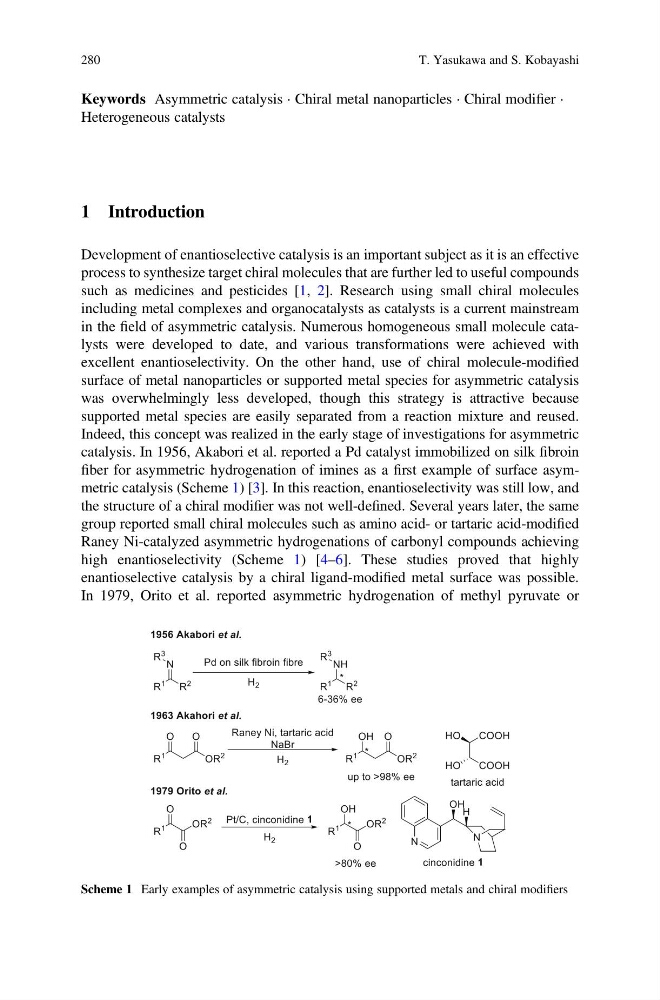
catalysis. In 1956, Akabori et al. reported a Pd catalyst immobilized on silk fibroin
fiber for asymmetric hydrogenation of imines as a first example of surface asymmetric catalysis (Scheme 1) [3]. In this reaction, enantioselectivity was still low, and
the structure of a chiral modifier was not well-defined. Several years later, the same
group reported small chiral molecules such as amino acid- or tartaric acid-modified
Raney Ni-catalyzed asymmetric hydrogenations of carbonyl compounds achieving
high enantioselectivity (Scheme 1) [4–6]. These studies proved that highly
enantioselective catalysis by a chiral ligand-modified metal surface was possible.
In 1979, Orito et al. reported asymmetric hydrogenation of methyl pyruvate or
Scheme 1 Early examples of asymmetric catalysis using supported metals and chiral modifiers
280
T. Yasukawa and S. Kobayashi
Heterogeneous catalysts
1 Introduction
Development of enantioselective catalysis is an important subject as it is an effective
process to synthesize target chiral molecules that are further led to useful compounds
such as medicines and pesticides [1, 2]. Research using small chiral molecules
including metal complexes and organocatalysts as catalysts is a current mainstream
in the field of asymmetric catalysis. Numerous homogeneous small molecule catalysts were developed to date, and various transformations were achieved with
excellent enantioselectivity. On the other hand, use of chiral molecule-modified
surface of metal nanoparticles or supported metal species for asymmetric catalysis
was overwhelmingly less developed, though this strategy is attractive because
supported metal species are easily separated from a reaction mixture and reused.
Indeed, this concept was realized in the early stage of investigations for asymmetric
catalysis. In 1956, Akabori et al. reported a Pd catalyst immobilized on silk fibroin
fiber for asymmetric hydrogenation of imines as a first example of surface asymmetric catalysis (Scheme 1) [3]. In this reaction, enantioselectivity was still low, and
the structure of a chiral modifier was not well-defined. Several years later, the same
group reported small chiral molecules such as amino acid- or tartaric acid-modified
Raney Ni-catalyzed asymmetric hydrogenations of carbonyl compounds achieving
high enantioselectivity (Scheme 1) [4–6]. These studies proved that highly
enantioselective catalysis by a chiral ligand-modified metal surface was possible.
In 1979, Orito et al. reported asymmetric hydrogenation of methyl pyruvate or
Scheme 1 Early examples of asymmetric catalysis using supported metals and chiral modifiers
280
T. Yasukawa and S. Kobayashi