

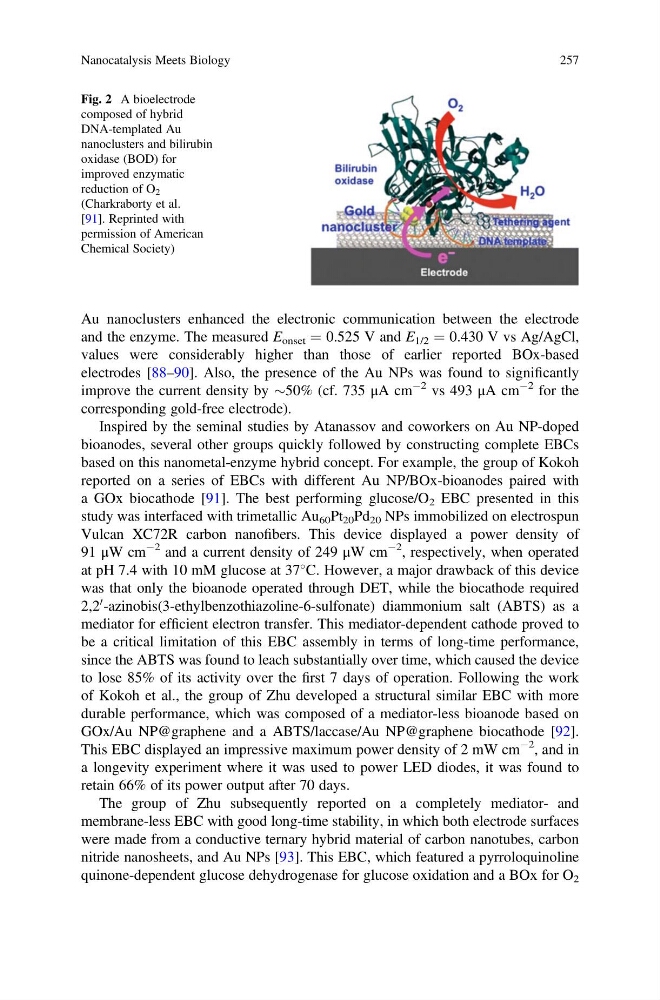
Au nanoclusters enhanced the electronic communication between the electrode
and the enzyme. The measured E onset ¼ 0.525 V and E 1/2 ¼ 0.430 V vs Ag/AgCl,
values were considerably higher than those of earlier reported BOx-based
electrodes [88–90]. Also, the presence of the Au NPs was found to significantly
improve the current density by $50% (cf. 735 μA cm
À2 vs 493 μA cm
À2 for the
corresponding gold-free electrode).
Inspired by the seminal studies by Atanassov and coworkers on Au NP-doped
bioanodes, several other groups quickly followed by constructing complete EBCs
based on this nanometal-enzyme hybrid concept. For example, the group of Kokoh
reported on a series of EBCs with different Au NP/BOx-bioanodes paired with
a GOx biocathode [91]. The best performing glucose/O 2 EBC presented in this
study was interfaced with trimetallic Au 60 Pt 20 Pd 20 NPs immobilized on electrospun
Vulcan XC72R carbon nanofibers. This device displayed a power density of
91 μW cm
À2 and a current density of 249 μW cm
À2 , respectively, when operated
at pH 7.4 with 10 mM glucose at 37
C. However, a major drawback of this device
was that only the bioanode operated through DET, while the biocathode required
2,2
0 -azinobis(3-ethylbenzothiazoline-6-sulfonate) diammonium salt (ABTS) as a
mediator for efficient electron transfer. This mediator-dependent cathode proved to
be a critical limitation of this EBC assembly in terms of long-time performance,
since the ABTS was found to leach substantially over time, which caused the device
to lose 85% of its activity over the first 7 days of operation. Following the work
of Kokoh et al., the group of Zhu developed a structural similar EBC with more
durable performance, which was composed of a mediator-less bioanode based on
GOx/Au NP@graphene and a ABTS/laccase/Au NP@graphene biocathode [92].
This EBC displayed an impressive maximum power density of 2 mW cm
À2 , and in
a longevity experiment where it was used to power LED diodes, it was found to
retain 66% of its power output after 70 days.
The group of Zhu subsequently reported on a completely mediator- and
membrane-less EBC with good long-time stability, in which both electrode surfaces
were made from a conductive ternary hybrid material of carbon nanotubes, carbon
nitride nanosheets, and Au NPs [93]. This EBC, which featured a pyrroloquinoline
quinone-dependent glucose dehydrogenase for glucose oxidation and a BOx for O 2
Fig. 2 A bioelectrode
composed of hybrid
DNA-templated Au
nanoclusters and bilirubin
oxidase (BOD) for
improved enzymatic
reduction of O 2
(Charkraborty et al.
[91]. Reprinted with
permission of American
Chemical Society)
Nanocatalysis Meets Biology
257
and the enzyme. The measured E onset ¼ 0.525 V and E 1/2 ¼ 0.430 V vs Ag/AgCl,
values were considerably higher than those of earlier reported BOx-based
electrodes [88–90]. Also, the presence of the Au NPs was found to significantly
improve the current density by $50% (cf. 735 μA cm
À2 vs 493 μA cm
À2 for the
corresponding gold-free electrode).
Inspired by the seminal studies by Atanassov and coworkers on Au NP-doped
bioanodes, several other groups quickly followed by constructing complete EBCs
based on this nanometal-enzyme hybrid concept. For example, the group of Kokoh
reported on a series of EBCs with different Au NP/BOx-bioanodes paired with
a GOx biocathode [91]. The best performing glucose/O 2 EBC presented in this
study was interfaced with trimetallic Au 60 Pt 20 Pd 20 NPs immobilized on electrospun
Vulcan XC72R carbon nanofibers. This device displayed a power density of
91 μW cm
À2 and a current density of 249 μW cm
À2 , respectively, when operated
at pH 7.4 with 10 mM glucose at 37
C. However, a major drawback of this device
was that only the bioanode operated through DET, while the biocathode required
2,2
0 -azinobis(3-ethylbenzothiazoline-6-sulfonate) diammonium salt (ABTS) as a
mediator for efficient electron transfer. This mediator-dependent cathode proved to
be a critical limitation of this EBC assembly in terms of long-time performance,
since the ABTS was found to leach substantially over time, which caused the device
to lose 85% of its activity over the first 7 days of operation. Following the work
of Kokoh et al., the group of Zhu developed a structural similar EBC with more
durable performance, which was composed of a mediator-less bioanode based on
GOx/Au NP@graphene and a ABTS/laccase/Au NP@graphene biocathode [92].
This EBC displayed an impressive maximum power density of 2 mW cm
À2 , and in
a longevity experiment where it was used to power LED diodes, it was found to
retain 66% of its power output after 70 days.
The group of Zhu subsequently reported on a completely mediator- and
membrane-less EBC with good long-time stability, in which both electrode surfaces
were made from a conductive ternary hybrid material of carbon nanotubes, carbon
nitride nanosheets, and Au NPs [93]. This EBC, which featured a pyrroloquinoline
quinone-dependent glucose dehydrogenase for glucose oxidation and a BOx for O 2
Fig. 2 A bioelectrode
composed of hybrid
DNA-templated Au
nanoclusters and bilirubin
oxidase (BOD) for
improved enzymatic
reduction of O 2
(Charkraborty et al.
[91]. Reprinted with
permission of American
Chemical Society)
Nanocatalysis Meets Biology
257