

reduction, was capable of reaching an open current voltage of 0.55 V and a high
maximum power density of 249 μW cm
À2 , when subjected to an O 2 -saturated PBS
solution containing 5 mM glucose at pH 7.4. This work by the group of Zhu was
not only an important contribution because it presented a DET device that rivalled
the performance of EBCs relying on electron transfer mediators, i.e., MET devices.
Their work was also important because it demonstrated how new nanomaterials
can enable the development of new and highly efficient EBCs. Shortly after this
study, the group of Zhou reported on the development of another mediator-less
glucose/O 2 EBC in which the electrodes had been fabricated from a carbon
nanofiber/Fe 3 O 4 /Au NP hybrid material [94]. Also this DET device exhibited
a respectable performance and a good long-time durability.
However, when it comes to the highest power outputs of DET devices, the groups
of Lee and Cho have certainly pushed the boundaries of what is possible with their
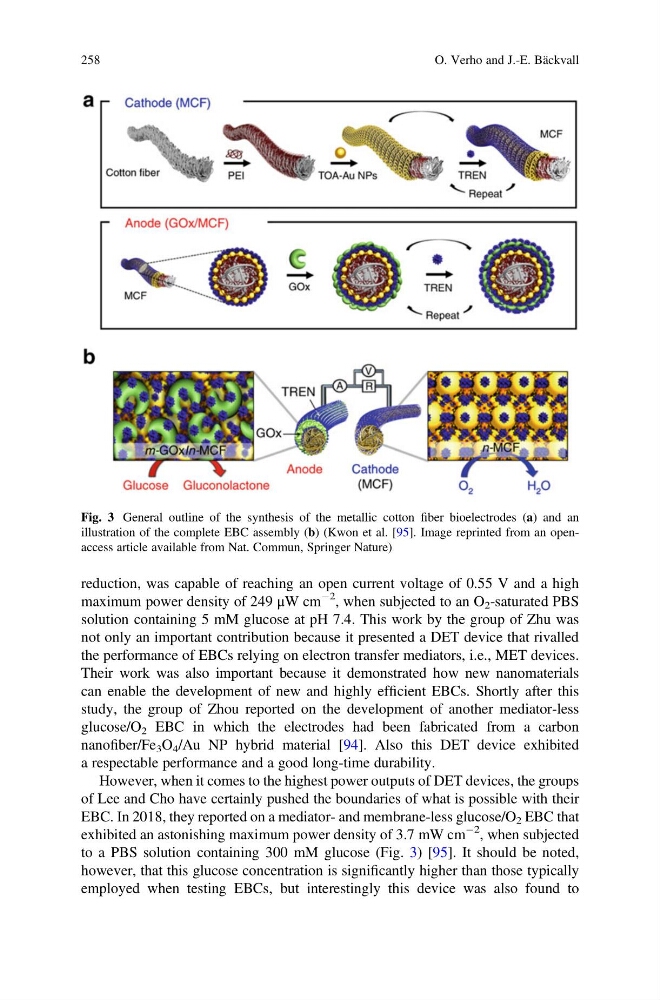
EBC. In 2018, they reported on a mediator- and membrane-less glucose/O 2 EBC that
exhibited an astonishing maximum power density of 3.7 mW cm
À2 , when subjected
to a PBS solution containing 300 mM glucose (Fig. 3) [95]. It should be noted,
however, that this glucose concentration is significantly higher than those typically
employed when testing EBCs, but interestingly this device was also found to
Fig. 3 General outline of the synthesis of the metallic cotton fiber bioelectrodes (a) and an
illustration of the complete EBC assembly (b) (Kwon et al. [95]. Image reprinted from an openaccess article available from Nat. Commun, Springer Nature)
258
O. Verho and J.-E. Bäckvall
maximum power density of 249 μW cm
À2 , when subjected to an O 2 -saturated PBS
solution containing 5 mM glucose at pH 7.4. This work by the group of Zhu was
not only an important contribution because it presented a DET device that rivalled
the performance of EBCs relying on electron transfer mediators, i.e., MET devices.
Their work was also important because it demonstrated how new nanomaterials
can enable the development of new and highly efficient EBCs. Shortly after this
study, the group of Zhou reported on the development of another mediator-less
glucose/O 2 EBC in which the electrodes had been fabricated from a carbon
nanofiber/Fe 3 O 4 /Au NP hybrid material [94]. Also this DET device exhibited
a respectable performance and a good long-time durability.
However, when it comes to the highest power outputs of DET devices, the groups
of Lee and Cho have certainly pushed the boundaries of what is possible with their
EBC. In 2018, they reported on a mediator- and membrane-less glucose/O 2 EBC that
exhibited an astonishing maximum power density of 3.7 mW cm
À2 , when subjected
to a PBS solution containing 300 mM glucose (Fig. 3) [95]. It should be noted,
however, that this glucose concentration is significantly higher than those typically
employed when testing EBCs, but interestingly this device was also found to
Fig. 3 General outline of the synthesis of the metallic cotton fiber bioelectrodes (a) and an
illustration of the complete EBC assembly (b) (Kwon et al. [95]. Image reprinted from an openaccess article available from Nat. Commun, Springer Nature)
258
O. Verho and J.-E. Bäckvall