

and ethanol over NPG containing the residual Ag in the range of 1–10% [92, 93]. For
methanol oxidation to give methyl formate, the highest activity was achieved by
NPG containing Ag less than 1%, while the selectivity of methyl formate was always
100% irrespective to the Ag content. In contrast, for ethanol oxidation, acetaldehyde
was obtained as a major product by NPG in which more than 2.5% Ag was
contained, whereas ethyl acetate was obtained selectively by NPG in which less
than 2.5% Ag was contained. This result suggests that the residual Ag is a determinant factor for the catalytic performance of NPG.
2.6.2 Polymer-Stabilized Au NPs and Clusters
The most intensively studied non-supported Au is ligand- or polymer-protected
pseudo-homogeneous Au clusters and NPs. Poly(vinyl alcohol)-stabilized Au NPs
have been also used to deposit carbons by colloid immobilization [11, 94]. Tsukuda
et al. prepared poly(N-vinyl-2-pyrrolidone)-protected Au clusters (Au:PVP) and
demonstrated the oxidation of benzylic alcohols in the presence of O 2 and K 2 CO 3
at room temperature [66–68]. They performed several characterization and revealed
that Au was negatively charged by the electron donation from PVP [67], which was
also theoretically confirmed by Okumura et al. [95]. According to the behavior of Au
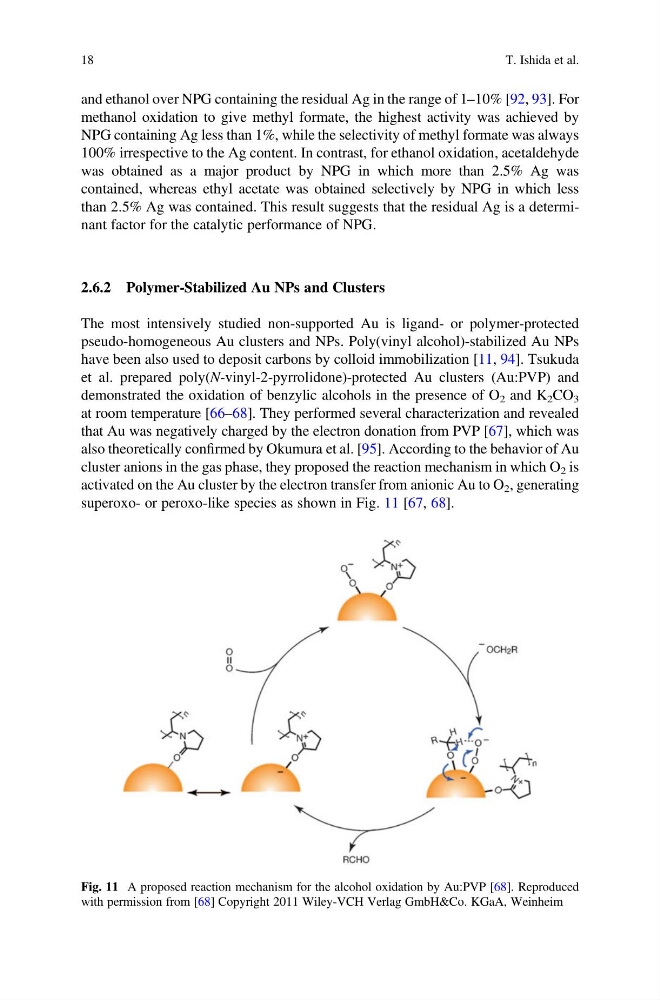
cluster anions in the gas phase, they proposed the reaction mechanism in which O 2 is
activated on the Au cluster by the electron transfer from anionic Au to O 2 , generating
superoxo- or peroxo-like species as shown in Fig. 11 [67, 68].
Fig. 11 A proposed reaction mechanism for the alcohol oxidation by Au:PVP [68]. Reproduced
with permission from [68] Copyright 2011 Wiley-VCH Verlag GmbH&Co. KGaA, Weinheim
18
T. Ishida et al.
methanol oxidation to give methyl formate, the highest activity was achieved by
NPG containing Ag less than 1%, while the selectivity of methyl formate was always
100% irrespective to the Ag content. In contrast, for ethanol oxidation, acetaldehyde
was obtained as a major product by NPG in which more than 2.5% Ag was
contained, whereas ethyl acetate was obtained selectively by NPG in which less
than 2.5% Ag was contained. This result suggests that the residual Ag is a determinant factor for the catalytic performance of NPG.
2.6.2 Polymer-Stabilized Au NPs and Clusters
The most intensively studied non-supported Au is ligand- or polymer-protected
pseudo-homogeneous Au clusters and NPs. Poly(vinyl alcohol)-stabilized Au NPs
have been also used to deposit carbons by colloid immobilization [11, 94]. Tsukuda
et al. prepared poly(N-vinyl-2-pyrrolidone)-protected Au clusters (Au:PVP) and
demonstrated the oxidation of benzylic alcohols in the presence of O 2 and K 2 CO 3
at room temperature [66–68]. They performed several characterization and revealed
that Au was negatively charged by the electron donation from PVP [67], which was
also theoretically confirmed by Okumura et al. [95]. According to the behavior of Au
cluster anions in the gas phase, they proposed the reaction mechanism in which O 2 is
activated on the Au cluster by the electron transfer from anionic Au to O 2 , generating
superoxo- or peroxo-like species as shown in Fig. 11 [67, 68].
Fig. 11 A proposed reaction mechanism for the alcohol oxidation by Au:PVP [68]. Reproduced
with permission from [68] Copyright 2011 Wiley-VCH Verlag GmbH&Co. KGaA, Weinheim
18
T. Ishida et al.