

2.6.3 Atomically Precise Au Clusters Protected by Ligands
Conventional several preparation methods for heterogeneous Au catalysts such as
DP and coprecipitation can obtain nanometer-sized Au particles with bare Au
surfaces on metal oxide supports. However, the aggregation of Au during deposition
or calcination cannot be completely avoided and leads to size distribution of Au NPs.
On the other hand, phosphine- and thiolate-protected Au clusters consisting of
precise number of Au atoms have been synthesized in organometallic chemistry
and recently been focused on the catalytic performance of these atomically precise
Au clusters as themselves or after the deposition onto supports.
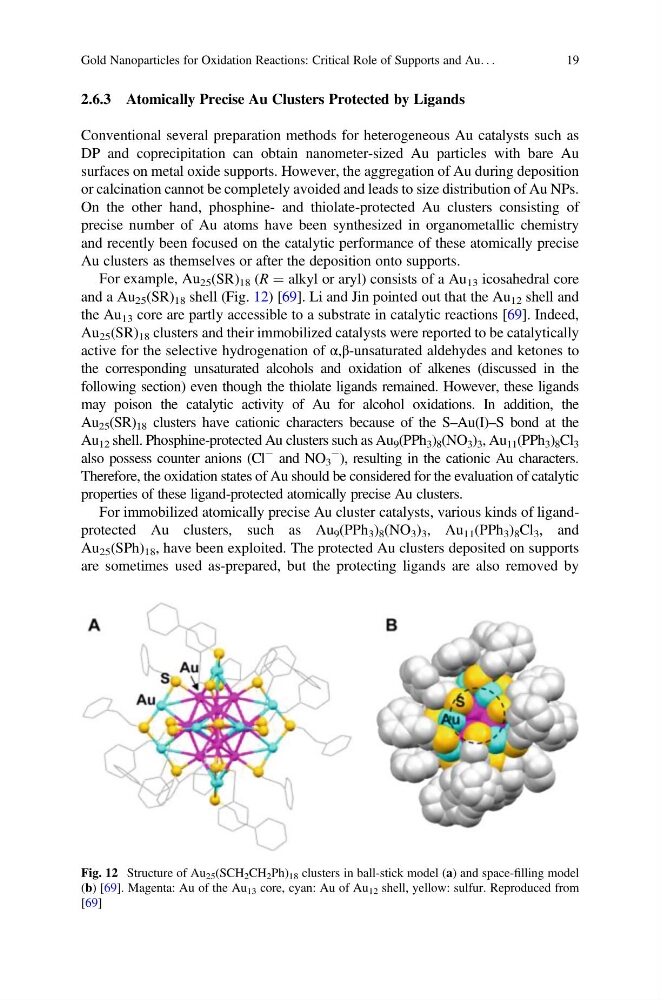
For example, Au 25 (SR) 18 (R ¼ alkyl or aryl) consists of a Au 13 icosahedral core
and a Au 25 (SR) 18 shell (Fig. 12) [69]. Li and Jin pointed out that the Au 12 shell and
the Au 13 core are partly accessible to a substrate in catalytic reactions [69]. Indeed,
Au 25 (SR) 18 clusters and their immobilized catalysts were reported to be catalytically
active for the selective hydrogenation of α,β-unsaturated aldehydes and ketones to
the corresponding unsaturated alcohols and oxidation of alkenes (discussed in the
following section) even though the thiolate ligands remained. However, these ligands
may poison the catalytic activity of Au for alcohol oxidations. In addition, the
Au 25 (SR) 18 clusters have cationic characters because of the S–Au(I)–S bond at the
Au 12 shell. Phosphine-protected Au clusters such as Au 9 (PPh 3 ) 8 (NO 3 ) 3 , Au 11 (PPh 3 ) 8 Cl 3
also possess counter anions (Cl
À and NO 3
À ), resulting in the cationic Au characters.
Therefore, the oxidation states of Au should be considered for the evaluation of catalytic
properties of these ligand-protected atomically precise Au clusters.
For immobilized atomically precise Au cluster catalysts, various kinds of ligandprotected Au clusters, such as Au 9 (PPh 3 ) 8 (NO 3 ) 3 , Au 11 (PPh 3 ) 8 Cl 3 , and
Au 25 (SPh) 18 , have been exploited. The protected Au clusters deposited on supports
are sometimes used as-prepared, but the protecting ligands are also removed by
Fig. 12 Structure of Au 25 (SCH 2 CH 2 Ph) 18 clusters in ball-stick model (a) and space-filling model
(b) [69]. Magenta: Au of the Au 13 core, cyan: Au of Au 12 shell, yellow: sulfur. Reproduced from
[69]
Gold Nanoparticles for Oxidation Reactions: Critical Role of Supports and Au. . .
19
Conventional several preparation methods for heterogeneous Au catalysts such as
DP and coprecipitation can obtain nanometer-sized Au particles with bare Au
surfaces on metal oxide supports. However, the aggregation of Au during deposition
or calcination cannot be completely avoided and leads to size distribution of Au NPs.
On the other hand, phosphine- and thiolate-protected Au clusters consisting of
precise number of Au atoms have been synthesized in organometallic chemistry
and recently been focused on the catalytic performance of these atomically precise
Au clusters as themselves or after the deposition onto supports.
For example, Au 25 (SR) 18 (R ¼ alkyl or aryl) consists of a Au 13 icosahedral core
and a Au 25 (SR) 18 shell (Fig. 12) [69]. Li and Jin pointed out that the Au 12 shell and
the Au 13 core are partly accessible to a substrate in catalytic reactions [69]. Indeed,
Au 25 (SR) 18 clusters and their immobilized catalysts were reported to be catalytically
active for the selective hydrogenation of α,β-unsaturated aldehydes and ketones to
the corresponding unsaturated alcohols and oxidation of alkenes (discussed in the
following section) even though the thiolate ligands remained. However, these ligands
may poison the catalytic activity of Au for alcohol oxidations. In addition, the
Au 25 (SR) 18 clusters have cationic characters because of the S–Au(I)–S bond at the
Au 12 shell. Phosphine-protected Au clusters such as Au 9 (PPh 3 ) 8 (NO 3 ) 3 , Au 11 (PPh 3 ) 8 Cl 3
also possess counter anions (Cl
À and NO 3
À ), resulting in the cationic Au characters.
Therefore, the oxidation states of Au should be considered for the evaluation of catalytic
properties of these ligand-protected atomically precise Au clusters.
For immobilized atomically precise Au cluster catalysts, various kinds of ligandprotected Au clusters, such as Au 9 (PPh 3 ) 8 (NO 3 ) 3 , Au 11 (PPh 3 ) 8 Cl 3 , and
Au 25 (SPh) 18 , have been exploited. The protected Au clusters deposited on supports
are sometimes used as-prepared, but the protecting ligands are also removed by
Fig. 12 Structure of Au 25 (SCH 2 CH 2 Ph) 18 clusters in ball-stick model (a) and space-filling model
(b) [69]. Magenta: Au of the Au 13 core, cyan: Au of Au 12 shell, yellow: sulfur. Reproduced from
[69]
Gold Nanoparticles for Oxidation Reactions: Critical Role of Supports and Au. . .
19