

to rearrange catalytically into two secondary products, styrene 25 and fluorene 26.
When using a homogeneous AuCl 3 catalyst at room temperature, a 40% yield of
cyclopropane 24 was obtained, with a cis/trans ratio of 3:1, accompanied by a 10%
yield of products 25 and 26 (in a 3:2 ratio) formed by the rearrangement of the
product cis-24. Switching to the heterogeneous Au-G4OH/SBA-15 catalyst in the
batch mode led to a better selectivity, with a cis/trans ratio of 12:1 for 24 and only a
small amount of the rearrangement products 25 and 26 (1% each). The same catalyst
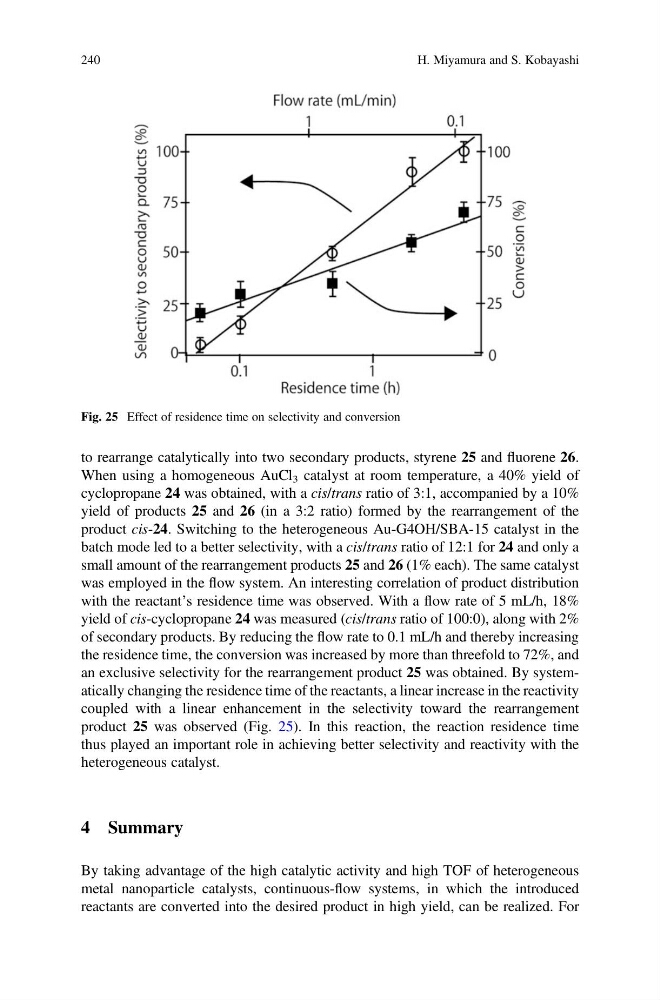
was employed in the flow system. An interesting correlation of product distribution
with the reactant’s residence time was observed. With a flow rate of 5 mL/h, 18%
yield of cis-cyclopropane 24 was measured (cis/trans ratio of 100:0), along with 2%
of secondary products. By reducing the flow rate to 0.1 mL/h and thereby increasing
the residence time, the conversion was increased by more than threefold to 72%, and
an exclusive selectivity for the rearrangement product 25 was obtained. By systematically changing the residence time of the reactants, a linear increase in the reactivity
coupled with a linear enhancement in the selectivity toward the rearrangement
product 25 was observed (Fig. 25). In this reaction, the reaction residence time
thus played an important role in achieving better selectivity and reactivity with the
heterogeneous catalyst.
4 Summary
By taking advantage of the high catalytic activity and high TOF of heterogeneous
metal nanoparticle catalysts, continuous-flow systems, in which the introduced
reactants are converted into the desired product in high yield, can be realized. For
Fig. 25 Effect of residence time on selectivity and conversion
240
H. Miyamura and S. Kobayashi
When using a homogeneous AuCl 3 catalyst at room temperature, a 40% yield of
cyclopropane 24 was obtained, with a cis/trans ratio of 3:1, accompanied by a 10%
yield of products 25 and 26 (in a 3:2 ratio) formed by the rearrangement of the
product cis-24. Switching to the heterogeneous Au-G4OH/SBA-15 catalyst in the
batch mode led to a better selectivity, with a cis/trans ratio of 12:1 for 24 and only a
small amount of the rearrangement products 25 and 26 (1% each). The same catalyst
was employed in the flow system. An interesting correlation of product distribution
with the reactant’s residence time was observed. With a flow rate of 5 mL/h, 18%
yield of cis-cyclopropane 24 was measured (cis/trans ratio of 100:0), along with 2%
of secondary products. By reducing the flow rate to 0.1 mL/h and thereby increasing
the residence time, the conversion was increased by more than threefold to 72%, and
an exclusive selectivity for the rearrangement product 25 was obtained. By systematically changing the residence time of the reactants, a linear increase in the reactivity
coupled with a linear enhancement in the selectivity toward the rearrangement
product 25 was observed (Fig. 25). In this reaction, the reaction residence time
thus played an important role in achieving better selectivity and reactivity with the
heterogeneous catalyst.
4 Summary
By taking advantage of the high catalytic activity and high TOF of heterogeneous
metal nanoparticle catalysts, continuous-flow systems, in which the introduced
reactants are converted into the desired product in high yield, can be realized. For
Fig. 25 Effect of residence time on selectivity and conversion
240
H. Miyamura and S. Kobayashi