

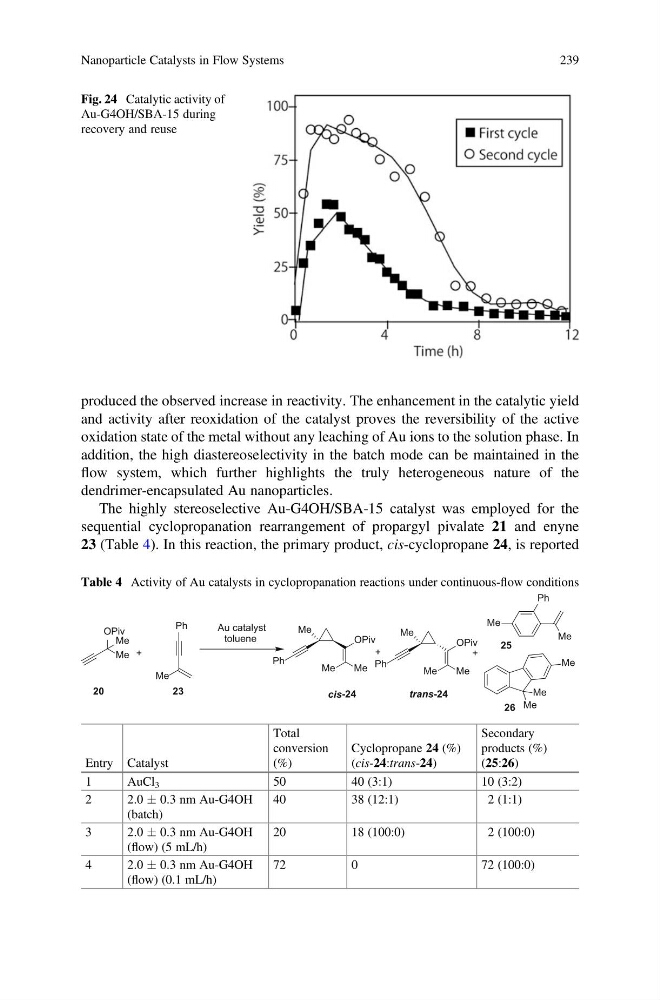
produced the observed increase in reactivity. The enhancement in the catalytic yield
and activity after reoxidation of the catalyst proves the reversibility of the active
oxidation state of the metal without any leaching of Au ions to the solution phase. In
addition, the high diastereoselectivity in the batch mode can be maintained in the
flow system, which further highlights the truly heterogeneous nature of the
dendrimer-encapsulated Au nanoparticles.
The highly stereoselective Au-G4OH/SBA-15 catalyst was employed for the
sequential cyclopropanation rearrangement of propargyl pivalate 21 and enyne
23 (Table 4). In this reaction, the primary product, cis-cyclopropane 24, is reported
Fig. 24 Catalytic activity of
Au-G4OH/SBA-15 during
recovery and reuse
Table 4 Activity of Au catalysts in cyclopropanation reactions under continuous-flow conditions
Me
OPiv
Me
+
Me
Me
OPiv
+
+
Au catalyst
toluene
Ph
Me
Ph
Me
Me
Me
OPiv
Ph
Me
Me
Me
Ph
Me
Me
Me
20
cis-24
trans-24
26
23
25
Entry Catalyst
Total
conversion
(%)
Cyclopropane 24 (%)
(cis-24:trans-24)
Secondary
products (%)
(25:26)
1
AuCl 3
50
40 (3:1)
10 (3:2)
2
2.0 Æ 0.3 nm Au-G4OH
(batch)
40
38 (12:1)
2 (1:1)
3
2.0 Æ 0.3 nm Au-G4OH
(flow) (5 mL/h)
20
18 (100:0)
2 (100:0)
4
2.0 Æ 0.3 nm Au-G4OH
(flow) (0.1 mL/h)
72
0
72 (100:0)
Nanoparticle Catalysts in Flow Systems
239
and activity after reoxidation of the catalyst proves the reversibility of the active
oxidation state of the metal without any leaching of Au ions to the solution phase. In
addition, the high diastereoselectivity in the batch mode can be maintained in the
flow system, which further highlights the truly heterogeneous nature of the
dendrimer-encapsulated Au nanoparticles.
The highly stereoselective Au-G4OH/SBA-15 catalyst was employed for the
sequential cyclopropanation rearrangement of propargyl pivalate 21 and enyne
23 (Table 4). In this reaction, the primary product, cis-cyclopropane 24, is reported
Fig. 24 Catalytic activity of
Au-G4OH/SBA-15 during
recovery and reuse
Table 4 Activity of Au catalysts in cyclopropanation reactions under continuous-flow conditions
Me
OPiv
Me
+
Me
Me
OPiv
+
+
Au catalyst
toluene
Ph
Me
Ph
Me
Me
Me
OPiv
Ph
Me
Me
Me
Ph
Me
Me
Me
20
cis-24
trans-24
26
23
25
Entry Catalyst
Total
conversion
(%)
Cyclopropane 24 (%)
(cis-24:trans-24)
Secondary
products (%)
(25:26)
1
AuCl 3
50
40 (3:1)
10 (3:2)
2
2.0 Æ 0.3 nm Au-G4OH
(batch)
40
38 (12:1)
2 (1:1)
3
2.0 Æ 0.3 nm Au-G4OH
(flow) (5 mL/h)
20
18 (100:0)
2 (100:0)
4
2.0 Æ 0.3 nm Au-G4OH
(flow) (0.1 mL/h)
72
0
72 (100:0)
Nanoparticle Catalysts in Flow Systems
239