

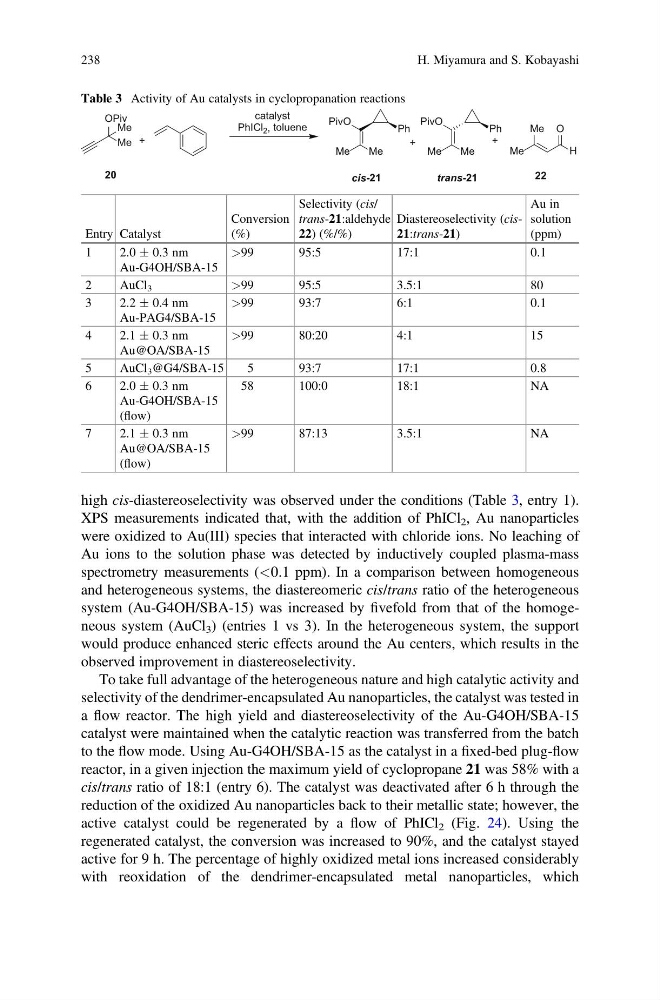
high cis-diastereoselectivity was observed under the conditions (Table 3, entry 1).
XPS measurements indicated that, with the addition of PhICl 2 , Au nanoparticles
were oxidized to Au(III) species that interacted with chloride ions. No leaching of
Au ions to the solution phase was detected by inductively coupled plasma-mass
spectrometry measurements (<0.1 ppm). In a comparison between homogeneous
and heterogeneous systems, the diastereomeric cis/trans ratio of the heterogeneous
system (Au-G4OH/SBA-15) was increased by fivefold from that of the homogeneous system (AuCl 3 ) (entries 1 vs 3). In the heterogeneous system, the support
would produce enhanced steric effects around the Au centers, which results in the
observed improvement in diastereoselectivity.
To take full advantage of the heterogeneous nature and high catalytic activity and
selectivity of the dendrimer-encapsulated Au nanoparticles, the catalyst was tested in
a flow reactor. The high yield and diastereoselectivity of the Au-G4OH/SBA-15
catalyst were maintained when the catalytic reaction was transferred from the batch
to the flow mode. Using Au-G4OH/SBA-15 as the catalyst in a fixed-bed plug-flow
reactor, in a given injection the maximum yield of cyclopropane 21 was 58% with a
cis/trans ratio of 18:1 (entry 6). The catalyst was deactivated after 6 h through the
reduction of the oxidized Au nanoparticles back to their metallic state; however, the
active catalyst could be regenerated by a flow of PhICl 2 (Fig. 24). Using the
regenerated catalyst, the conversion was increased to 90%, and the catalyst stayed
active for 9 h. The percentage of highly oxidized metal ions increased considerably
with reoxidation of the dendrimer-encapsulated metal nanoparticles, which
Table 3 Activity of Au catalysts in cyclopropanation reactions
Me
OPiv
Me
+
Ph
Me
Me
PivO
Ph
Me
Me
PivO
H
O
Me
Me
+
+
catalyst
PhICl 2 , toluene
20
cis-21
trans-21
22
Entry Catalyst
Conversion
(%)
Selectivity (cis/
trans-21:aldehyde
22) (%/%)
Diastereoselectivity (cis21:trans-21)
Au in
solution
(ppm)
1
2.0 Æ 0.3 nm
Au-G4OH/SBA-15
>99
95:5
17:1
0.1
2
AuCl 3
>99
95:5
3.5:1
80
3
2.2 Æ 0.4 nm
Au-PAG4/SBA-15
>99
93:7
6:1
0.1
4
2.1 Æ 0.3 nm
Au@OA/SBA-15
>99
80:20
4:1
15
5
AuCl 3 @G4/SBA-15
5
93:7
17:1
0.8
6
2.0 Æ 0.3 nm
Au-G4OH/SBA-15
(flow)
58
100:0
18:1
NA
7
2.1 Æ 0.3 nm
Au@OA/SBA-15
(flow)
>99
87:13
3.5:1
NA
238
H. Miyamura and S. Kobayashi
XPS measurements indicated that, with the addition of PhICl 2 , Au nanoparticles
were oxidized to Au(III) species that interacted with chloride ions. No leaching of
Au ions to the solution phase was detected by inductively coupled plasma-mass
spectrometry measurements (<0.1 ppm). In a comparison between homogeneous
and heterogeneous systems, the diastereomeric cis/trans ratio of the heterogeneous
system (Au-G4OH/SBA-15) was increased by fivefold from that of the homogeneous system (AuCl 3 ) (entries 1 vs 3). In the heterogeneous system, the support
would produce enhanced steric effects around the Au centers, which results in the
observed improvement in diastereoselectivity.
To take full advantage of the heterogeneous nature and high catalytic activity and
selectivity of the dendrimer-encapsulated Au nanoparticles, the catalyst was tested in
a flow reactor. The high yield and diastereoselectivity of the Au-G4OH/SBA-15
catalyst were maintained when the catalytic reaction was transferred from the batch
to the flow mode. Using Au-G4OH/SBA-15 as the catalyst in a fixed-bed plug-flow
reactor, in a given injection the maximum yield of cyclopropane 21 was 58% with a
cis/trans ratio of 18:1 (entry 6). The catalyst was deactivated after 6 h through the
reduction of the oxidized Au nanoparticles back to their metallic state; however, the
active catalyst could be regenerated by a flow of PhICl 2 (Fig. 24). Using the
regenerated catalyst, the conversion was increased to 90%, and the catalyst stayed
active for 9 h. The percentage of highly oxidized metal ions increased considerably
with reoxidation of the dendrimer-encapsulated metal nanoparticles, which
Table 3 Activity of Au catalysts in cyclopropanation reactions
Me
OPiv
Me
+
Ph
Me
Me
PivO
Ph
Me
Me
PivO
H
O
Me
Me
+
+
catalyst
PhICl 2 , toluene
20
cis-21
trans-21
22
Entry Catalyst
Conversion
(%)
Selectivity (cis/
trans-21:aldehyde
22) (%/%)
Diastereoselectivity (cis21:trans-21)
Au in
solution
(ppm)
1
2.0 Æ 0.3 nm
Au-G4OH/SBA-15
>99
95:5
17:1
0.1
2
AuCl 3
>99
95:5
3.5:1
80
3
2.2 Æ 0.4 nm
Au-PAG4/SBA-15
>99
93:7
6:1
0.1
4
2.1 Æ 0.3 nm
Au@OA/SBA-15
>99
80:20
4:1
15
5
AuCl 3 @G4/SBA-15
5
93:7
17:1
0.8
6
2.0 Æ 0.3 nm
Au-G4OH/SBA-15
(flow)
58
100:0
18:1
NA
7
2.1 Æ 0.3 nm
Au@OA/SBA-15
(flow)
>99
87:13
3.5:1
NA
238
H. Miyamura and S. Kobayashi