

3.6 Control of Selectivity in Heterogeneous Gold Catalysis
Under Flow Conditions
In 2012, Toste, Somorjai, and co-workers developed heterogeneous Au nanoparticle
catalysts in which highly active species were generated by the reversible oxidation of
metal nanoparticles to ions, which were stabilized by both the encapsulating
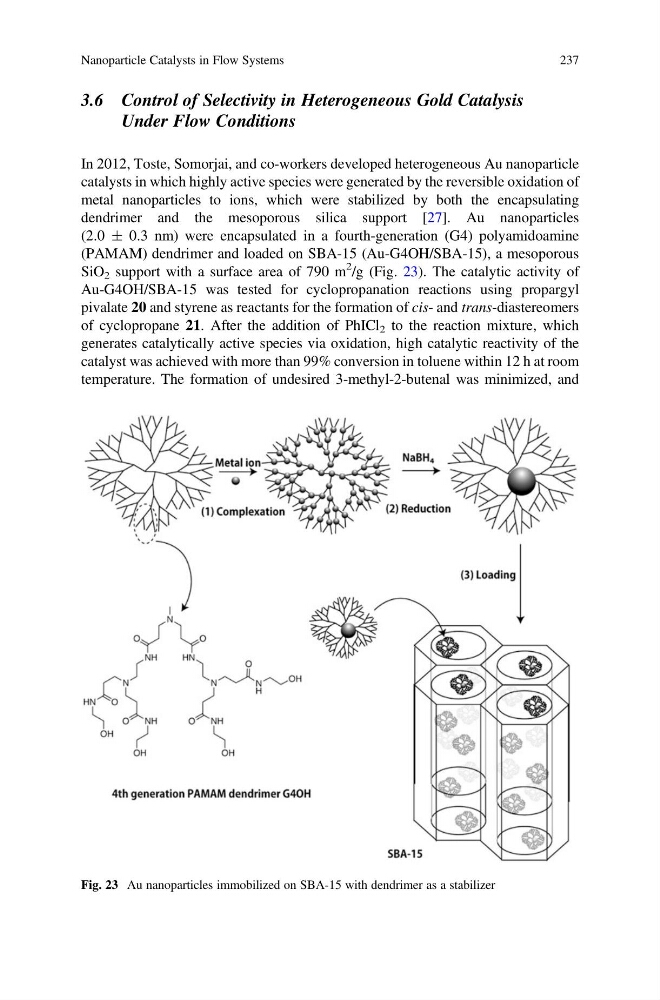
dendrimer and the mesoporous silica support [27]. Au nanoparticles
(2.0 Æ 0.3 nm) were encapsulated in a fourth-generation (G4) polyamidoamine
(PAMAM) dendrimer and loaded on SBA-15 (Au-G4OH/SBA-15), a mesoporous
SiO 2 support with a surface area of 790 m
2 /g (Fig. 23). The catalytic activity of
Au-G4OH/SBA-15 was tested for cyclopropanation reactions using propargyl
pivalate 20 and styrene as reactants for the formation of cis- and trans-diastereomers
of cyclopropane 21. After the addition of PhICl 2 to the reaction mixture, which
generates catalytically active species via oxidation, high catalytic reactivity of the
catalyst was achieved with more than 99% conversion in toluene within 12 h at room
temperature. The formation of undesired 3-methyl-2-butenal was minimized, and
Fig. 23 Au nanoparticles immobilized on SBA-15 with dendrimer as a stabilizer
Nanoparticle Catalysts in Flow Systems
237
Under Flow Conditions
In 2012, Toste, Somorjai, and co-workers developed heterogeneous Au nanoparticle
catalysts in which highly active species were generated by the reversible oxidation of
metal nanoparticles to ions, which were stabilized by both the encapsulating
dendrimer and the mesoporous silica support [27]. Au nanoparticles
(2.0 Æ 0.3 nm) were encapsulated in a fourth-generation (G4) polyamidoamine
(PAMAM) dendrimer and loaded on SBA-15 (Au-G4OH/SBA-15), a mesoporous
SiO 2 support with a surface area of 790 m
2 /g (Fig. 23). The catalytic activity of
Au-G4OH/SBA-15 was tested for cyclopropanation reactions using propargyl
pivalate 20 and styrene as reactants for the formation of cis- and trans-diastereomers
of cyclopropane 21. After the addition of PhICl 2 to the reaction mixture, which
generates catalytically active species via oxidation, high catalytic reactivity of the
catalyst was achieved with more than 99% conversion in toluene within 12 h at room
temperature. The formation of undesired 3-methyl-2-butenal was minimized, and
Fig. 23 Au nanoparticles immobilized on SBA-15 with dendrimer as a stabilizer
Nanoparticle Catalysts in Flow Systems
237