

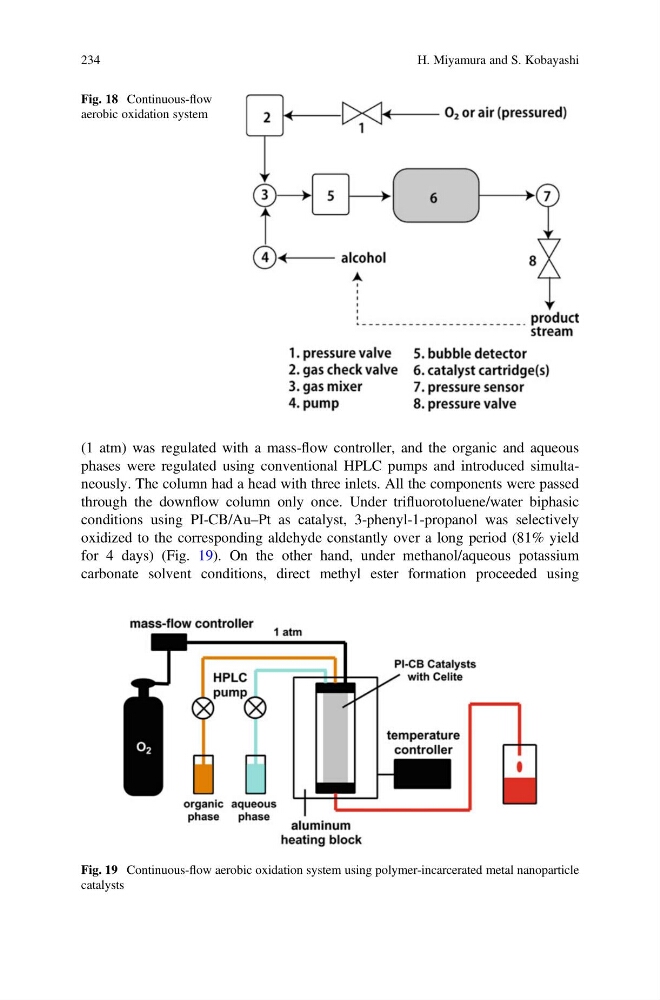
(1 atm) was regulated with a mass-flow controller, and the organic and aqueous
phases were regulated using conventional HPLC pumps and introduced simultaneously. The column had a head with three inlets. All the components were passed
through the downflow column only once. Under trifluorotoluene/water biphasic
conditions using PI-CB/Au–Pt as catalyst, 3-phenyl-1-propanol was selectively
oxidized to the corresponding aldehyde constantly over a long period (81% yield
for 4 days) (Fig. 19). On the other hand, under methanol/aqueous potassium
carbonate solvent conditions, direct methyl ester formation proceeded using
Fig. 18 Continuous-flow
aerobic oxidation system
Fig. 19 Continuous-flow aerobic oxidation system using polymer-incarcerated metal nanoparticle
catalysts
234
H. Miyamura and S. Kobayashi
phases were regulated using conventional HPLC pumps and introduced simultaneously. The column had a head with three inlets. All the components were passed
through the downflow column only once. Under trifluorotoluene/water biphasic
conditions using PI-CB/Au–Pt as catalyst, 3-phenyl-1-propanol was selectively
oxidized to the corresponding aldehyde constantly over a long period (81% yield
for 4 days) (Fig. 19). On the other hand, under methanol/aqueous potassium
carbonate solvent conditions, direct methyl ester formation proceeded using
Fig. 18 Continuous-flow
aerobic oxidation system
Fig. 19 Continuous-flow aerobic oxidation system using polymer-incarcerated metal nanoparticle
catalysts
234
H. Miyamura and S. Kobayashi