

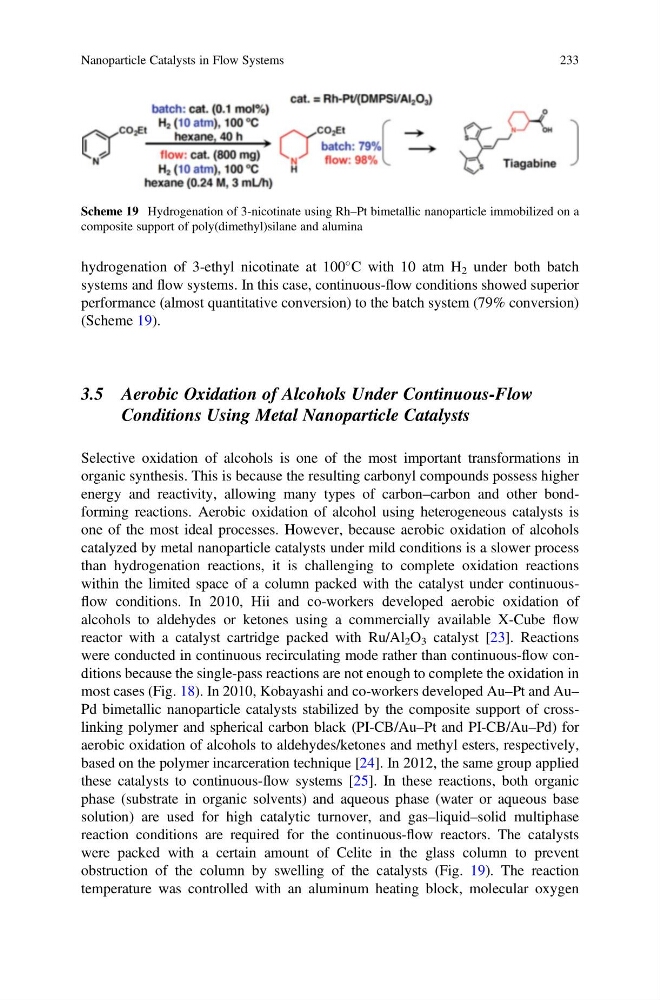
hydrogenation of 3-ethyl nicotinate at 100
C with 10 atm H 2 under both batch
systems and flow systems. In this case, continuous-flow conditions showed superior
performance (almost quantitative conversion) to the batch system (79% conversion)
(Scheme 19).
3.5 Aerobic Oxidation of Alcohols Under Continuous-Flow
Conditions Using Metal Nanoparticle Catalysts
Selective oxidation of alcohols is one of the most important transformations in
organic synthesis. This is because the resulting carbonyl compounds possess higher
energy and reactivity, allowing many types of carbon–carbon and other bondforming reactions. Aerobic oxidation of alcohol using heterogeneous catalysts is
one of the most ideal processes. However, because aerobic oxidation of alcohols
catalyzed by metal nanoparticle catalysts under mild conditions is a slower process
than hydrogenation reactions, it is challenging to complete oxidation reactions
within the limited space of a column packed with the catalyst under continuousflow conditions. In 2010, Hii and co-workers developed aerobic oxidation of
alcohols to aldehydes or ketones using a commercially available X-Cube flow
reactor with a catalyst cartridge packed with Ru/Al 2 O 3 catalyst [23]. Reactions
were conducted in continuous recirculating mode rather than continuous-flow conditions because the single-pass reactions are not enough to complete the oxidation in
most cases (Fig. 18). In 2010, Kobayashi and co-workers developed Au–Pt and Au–
Pd bimetallic nanoparticle catalysts stabilized by the composite support of crosslinking polymer and spherical carbon black (PI-CB/Au–Pt and PI-CB/Au–Pd) for
aerobic oxidation of alcohols to aldehydes/ketones and methyl esters, respectively,
based on the polymer incarceration technique [24]. In 2012, the same group applied
these catalysts to continuous-flow systems [25]. In these reactions, both organic
phase (substrate in organic solvents) and aqueous phase (water or aqueous base
solution) are used for high catalytic turnover, and gas–liquid–solid multiphase
reaction conditions are required for the continuous-flow reactors. The catalysts
were packed with a certain amount of Celite in the glass column to prevent
obstruction of the column by swelling of the catalysts (Fig. 19). The reaction
temperature was controlled with an aluminum heating block, molecular oxygen
Scheme 19 Hydrogenation of 3-nicotinate using Rh–Pt bimetallic nanoparticle immobilized on a
composite support of poly(dimethyl)silane and alumina
Nanoparticle Catalysts in Flow Systems
233
C with 10 atm H 2 under both batch
systems and flow systems. In this case, continuous-flow conditions showed superior
performance (almost quantitative conversion) to the batch system (79% conversion)
(Scheme 19).
3.5 Aerobic Oxidation of Alcohols Under Continuous-Flow
Conditions Using Metal Nanoparticle Catalysts
Selective oxidation of alcohols is one of the most important transformations in
organic synthesis. This is because the resulting carbonyl compounds possess higher
energy and reactivity, allowing many types of carbon–carbon and other bondforming reactions. Aerobic oxidation of alcohol using heterogeneous catalysts is
one of the most ideal processes. However, because aerobic oxidation of alcohols
catalyzed by metal nanoparticle catalysts under mild conditions is a slower process
than hydrogenation reactions, it is challenging to complete oxidation reactions
within the limited space of a column packed with the catalyst under continuousflow conditions. In 2010, Hii and co-workers developed aerobic oxidation of
alcohols to aldehydes or ketones using a commercially available X-Cube flow
reactor with a catalyst cartridge packed with Ru/Al 2 O 3 catalyst [23]. Reactions
were conducted in continuous recirculating mode rather than continuous-flow conditions because the single-pass reactions are not enough to complete the oxidation in
most cases (Fig. 18). In 2010, Kobayashi and co-workers developed Au–Pt and Au–
Pd bimetallic nanoparticle catalysts stabilized by the composite support of crosslinking polymer and spherical carbon black (PI-CB/Au–Pt and PI-CB/Au–Pd) for
aerobic oxidation of alcohols to aldehydes/ketones and methyl esters, respectively,
based on the polymer incarceration technique [24]. In 2012, the same group applied
these catalysts to continuous-flow systems [25]. In these reactions, both organic
phase (substrate in organic solvents) and aqueous phase (water or aqueous base
solution) are used for high catalytic turnover, and gas–liquid–solid multiphase
reaction conditions are required for the continuous-flow reactors. The catalysts
were packed with a certain amount of Celite in the glass column to prevent
obstruction of the column by swelling of the catalysts (Fig. 19). The reaction
temperature was controlled with an aluminum heating block, molecular oxygen
Scheme 19 Hydrogenation of 3-nicotinate using Rh–Pt bimetallic nanoparticle immobilized on a
composite support of poly(dimethyl)silane and alumina
Nanoparticle Catalysts in Flow Systems
233