

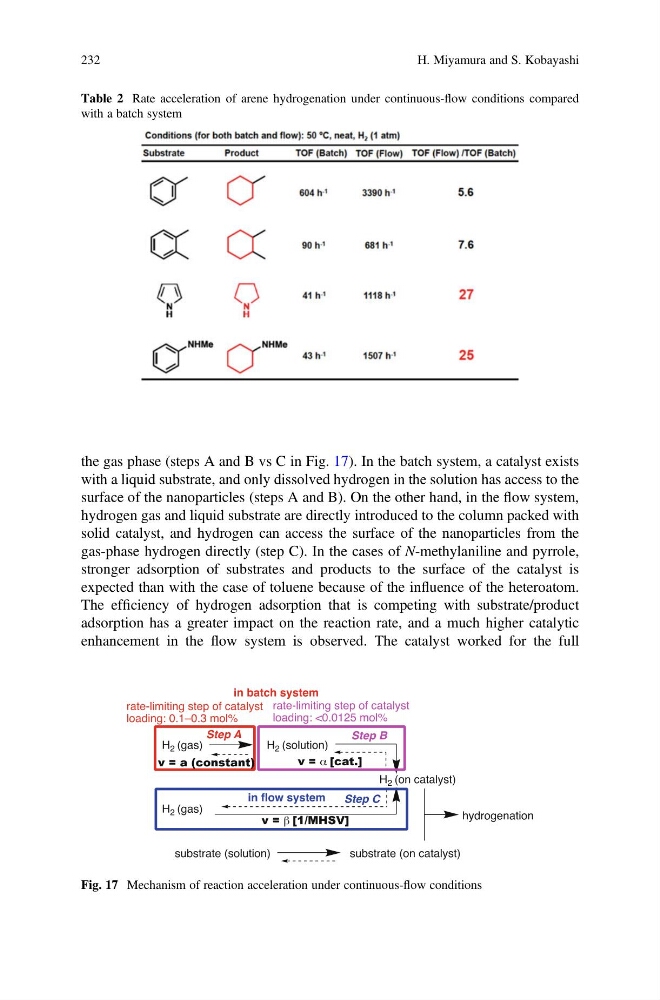
the gas phase (steps A and B vs C in Fig. 17). In the batch system, a catalyst exists
with a liquid substrate, and only dissolved hydrogen in the solution has access to the
surface of the nanoparticles (steps A and B). On the other hand, in the flow system,
hydrogen gas and liquid substrate are directly introduced to the column packed with
solid catalyst, and hydrogen can access the surface of the nanoparticles from the
gas-phase hydrogen directly (step C). In the cases of N-methylaniline and pyrrole,
stronger adsorption of substrates and products to the surface of the catalyst is
expected than with the case of toluene because of the influence of the heteroatom.
The efficiency of hydrogen adsorption that is competing with substrate/product
adsorption has a greater impact on the reaction rate, and a much higher catalytic
enhancement in the flow system is observed. The catalyst worked for the full
Table 2 Rate acceleration of arene hydrogenation under continuous-flow conditions compared
with a batch system
Fig. 17 Mechanism of reaction acceleration under continuous-flow conditions
232
H. Miyamura and S. Kobayashi
with a liquid substrate, and only dissolved hydrogen in the solution has access to the
surface of the nanoparticles (steps A and B). On the other hand, in the flow system,
hydrogen gas and liquid substrate are directly introduced to the column packed with
solid catalyst, and hydrogen can access the surface of the nanoparticles from the
gas-phase hydrogen directly (step C). In the cases of N-methylaniline and pyrrole,
stronger adsorption of substrates and products to the surface of the catalyst is
expected than with the case of toluene because of the influence of the heteroatom.
The efficiency of hydrogen adsorption that is competing with substrate/product
adsorption has a greater impact on the reaction rate, and a much higher catalytic
enhancement in the flow system is observed. The catalyst worked for the full
Table 2 Rate acceleration of arene hydrogenation under continuous-flow conditions compared
with a batch system
Fig. 17 Mechanism of reaction acceleration under continuous-flow conditions
232
H. Miyamura and S. Kobayashi