

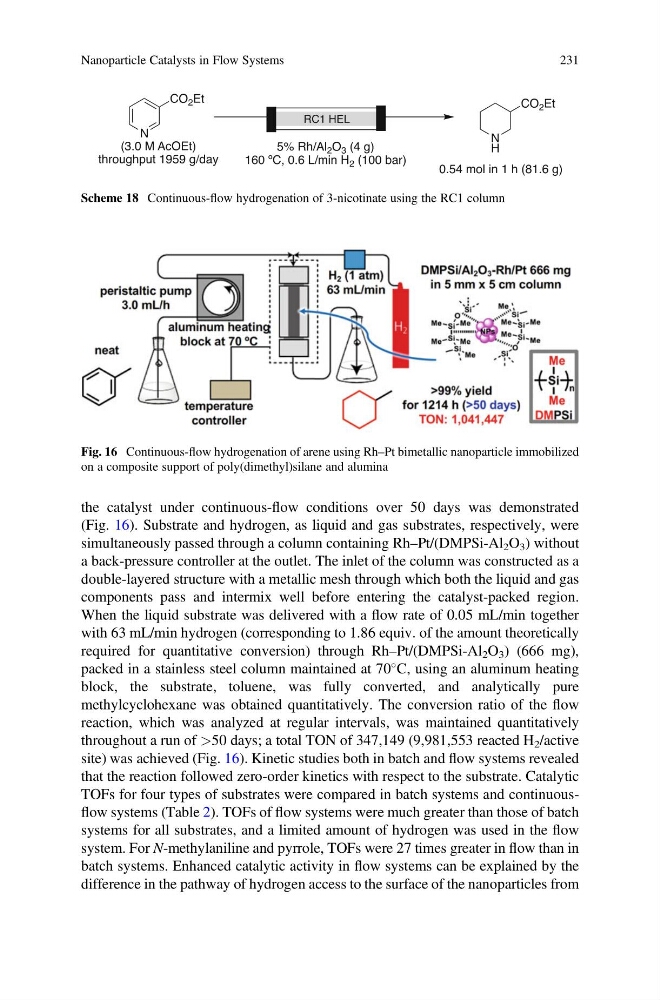
the catalyst under continuous-flow conditions over 50 days was demonstrated
(Fig. 16). Substrate and hydrogen, as liquid and gas substrates, respectively, were
simultaneously passed through a column containing Rh–Pt/(DMPSi-Al 2 O 3 ) without
a back-pressure controller at the outlet. The inlet of the column was constructed as a
double-layered structure with a metallic mesh through which both the liquid and gas
components pass and intermix well before entering the catalyst-packed region.
When the liquid substrate was delivered with a flow rate of 0.05 mL/min together
with 63 mL/min hydrogen (corresponding to 1.86 equiv. of the amount theoretically
required for quantitative conversion) through Rh–Pt/(DMPSi-Al 2 O 3 ) (666 mg),
packed in a stainless steel column maintained at 70
C, using an aluminum heating
block, the substrate, toluene, was fully converted, and analytically pure
methylcyclohexane was obtained quantitatively. The conversion ratio of the flow
reaction, which was analyzed at regular intervals, was maintained quantitatively
throughout a run of >50 days; a total TON of 347,149 (9,981,553 reacted H 2 /active
site) was achieved (Fig. 16). Kinetic studies both in batch and flow systems revealed
that the reaction followed zero-order kinetics with respect to the substrate. Catalytic
TOFs for four types of substrates were compared in batch systems and continuousflow systems (Table 2). TOFs of flow systems were much greater than those of batch
systems for all substrates, and a limited amount of hydrogen was used in the flow
system. For N-methylaniline and pyrrole, TOFs were 27 times greater in flow than in
batch systems. Enhanced catalytic activity in flow systems can be explained by the
difference in the pathway of hydrogen access to the surface of the nanoparticles from
Scheme 18 Continuous-flow hydrogenation of 3-nicotinate using the RC1 column
Fig. 16 Continuous-flow hydrogenation of arene using Rh–Pt bimetallic nanoparticle immobilized
on a composite support of poly(dimethyl)silane and alumina
Nanoparticle Catalysts in Flow Systems
231
(Fig. 16). Substrate and hydrogen, as liquid and gas substrates, respectively, were
simultaneously passed through a column containing Rh–Pt/(DMPSi-Al 2 O 3 ) without
a back-pressure controller at the outlet. The inlet of the column was constructed as a
double-layered structure with a metallic mesh through which both the liquid and gas
components pass and intermix well before entering the catalyst-packed region.
When the liquid substrate was delivered with a flow rate of 0.05 mL/min together
with 63 mL/min hydrogen (corresponding to 1.86 equiv. of the amount theoretically
required for quantitative conversion) through Rh–Pt/(DMPSi-Al 2 O 3 ) (666 mg),
packed in a stainless steel column maintained at 70
C, using an aluminum heating
block, the substrate, toluene, was fully converted, and analytically pure
methylcyclohexane was obtained quantitatively. The conversion ratio of the flow
reaction, which was analyzed at regular intervals, was maintained quantitatively
throughout a run of >50 days; a total TON of 347,149 (9,981,553 reacted H 2 /active
site) was achieved (Fig. 16). Kinetic studies both in batch and flow systems revealed
that the reaction followed zero-order kinetics with respect to the substrate. Catalytic
TOFs for four types of substrates were compared in batch systems and continuousflow systems (Table 2). TOFs of flow systems were much greater than those of batch
systems for all substrates, and a limited amount of hydrogen was used in the flow
system. For N-methylaniline and pyrrole, TOFs were 27 times greater in flow than in
batch systems. Enhanced catalytic activity in flow systems can be explained by the
difference in the pathway of hydrogen access to the surface of the nanoparticles from
Scheme 18 Continuous-flow hydrogenation of 3-nicotinate using the RC1 column
Fig. 16 Continuous-flow hydrogenation of arene using Rh–Pt bimetallic nanoparticle immobilized
on a composite support of poly(dimethyl)silane and alumina
Nanoparticle Catalysts in Flow Systems
231