

1 (RC1), 6 mm i.d., 3 mL internal volume, charge of 4 g of catalyst; reactor column
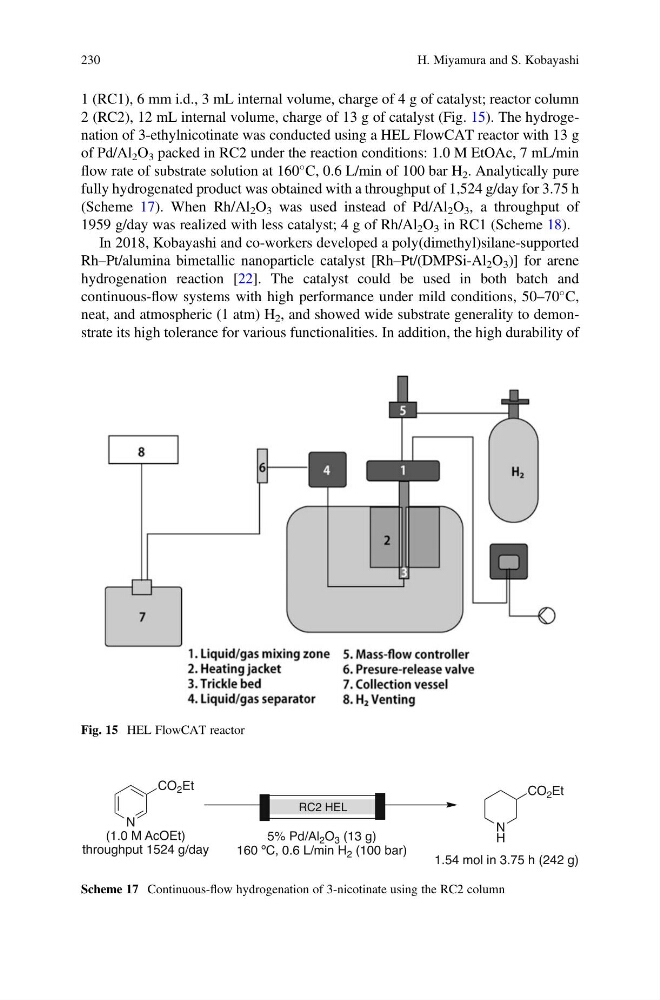
2 (RC2), 12 mL internal volume, charge of 13 g of catalyst (Fig. 15). The hydrogenation of 3-ethylnicotinate was conducted using a HEL FlowCAT reactor with 13 g
of Pd/Al 2 O 3 packed in RC2 under the reaction conditions: 1.0 M EtOAc, 7 mL/min
flow rate of substrate solution at 160
C, 0.6 L/min of 100 bar H 2 . Analytically pure
fully hydrogenated product was obtained with a throughput of 1,524 g/day for 3.75 h
(Scheme 17). When Rh/Al 2 O 3 was used instead of Pd/Al 2 O 3 , a throughput of
1959 g/day was realized with less catalyst; 4 g of Rh/Al 2 O 3 in RC1 (Scheme 18).
In 2018, Kobayashi and co-workers developed a poly(dimethyl)silane-supported
Rh–Pt/alumina bimetallic nanoparticle catalyst [Rh–Pt/(DMPSi-Al 2 O 3 )] for arene
hydrogenation reaction [22]. The catalyst could be used in both batch and
continuous-flow systems with high performance under mild conditions, 50–70
C,
neat, and atmospheric (1 atm) H 2 , and showed wide substrate generality to demonstrate its high tolerance for various functionalities. In addition, the high durability of
Fig. 15 HEL FlowCAT reactor
Scheme 17 Continuous-flow hydrogenation of 3-nicotinate using the RC2 column
230
H. Miyamura and S. Kobayashi
2 (RC2), 12 mL internal volume, charge of 13 g of catalyst (Fig. 15). The hydrogenation of 3-ethylnicotinate was conducted using a HEL FlowCAT reactor with 13 g
of Pd/Al 2 O 3 packed in RC2 under the reaction conditions: 1.0 M EtOAc, 7 mL/min
flow rate of substrate solution at 160
C, 0.6 L/min of 100 bar H 2 . Analytically pure
fully hydrogenated product was obtained with a throughput of 1,524 g/day for 3.75 h
(Scheme 17). When Rh/Al 2 O 3 was used instead of Pd/Al 2 O 3 , a throughput of
1959 g/day was realized with less catalyst; 4 g of Rh/Al 2 O 3 in RC1 (Scheme 18).
In 2018, Kobayashi and co-workers developed a poly(dimethyl)silane-supported
Rh–Pt/alumina bimetallic nanoparticle catalyst [Rh–Pt/(DMPSi-Al 2 O 3 )] for arene
hydrogenation reaction [22]. The catalyst could be used in both batch and
continuous-flow systems with high performance under mild conditions, 50–70
C,
neat, and atmospheric (1 atm) H 2 , and showed wide substrate generality to demonstrate its high tolerance for various functionalities. In addition, the high durability of
Fig. 15 HEL FlowCAT reactor
Scheme 17 Continuous-flow hydrogenation of 3-nicotinate using the RC2 column
230
H. Miyamura and S. Kobayashi