

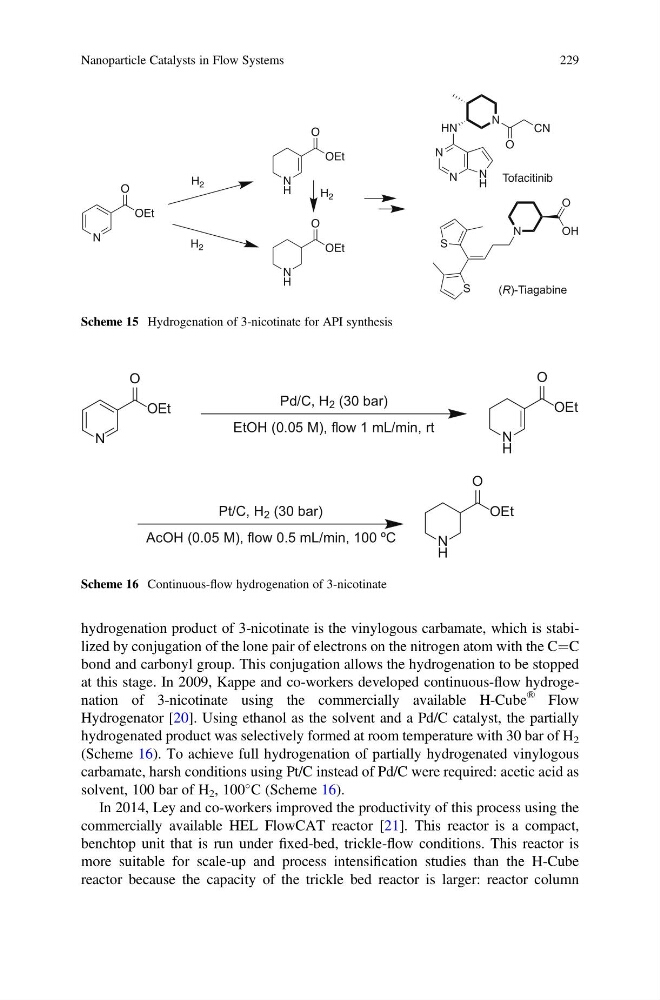
hydrogenation product of 3-nicotinate is the vinylogous carbamate, which is stabilized by conjugation of the lone pair of electrons on the nitrogen atom with the C¼C
bond and carbonyl group. This conjugation allows the hydrogenation to be stopped
at this stage. In 2009, Kappe and co-workers developed continuous-flow hydrogenation of 3-nicotinate using the commercially available H-Cube
® Flow
Hydrogenator [20]. Using ethanol as the solvent and a Pd/C catalyst, the partially
hydrogenated product was selectively formed at room temperature with 30 bar of H 2
(Scheme 16). To achieve full hydrogenation of partially hydrogenated vinylogous
carbamate, harsh conditions using Pt/C instead of Pd/C were required: acetic acid as
solvent, 100 bar of H 2 , 100
C (Scheme 16).
In 2014, Ley and co-workers improved the productivity of this process using the
commercially available HEL FlowCAT reactor [21]. This reactor is a compact,
benchtop unit that is run under fixed-bed, trickle-flow conditions. This reactor is
more suitable for scale-up and process intensification studies than the H-Cube
reactor because the capacity of the trickle bed reactor is larger: reactor column
N
O
OEt
N
H
O
OEt
N
H
O
OEt
Pd/C, H 2 (30 bar)
EtOH (0.05 M), flow 1 mL/min, rt
Pt/C, H 2 (30 bar)
AcOH (0.05 M), flow 0.5 mL/min, 100 ºC
Scheme 16 Continuous-flow hydrogenation of 3-nicotinate
Scheme 15 Hydrogenation of 3-nicotinate for API synthesis
Nanoparticle Catalysts in Flow Systems
229
bond and carbonyl group. This conjugation allows the hydrogenation to be stopped
at this stage. In 2009, Kappe and co-workers developed continuous-flow hydrogenation of 3-nicotinate using the commercially available H-Cube
® Flow
Hydrogenator [20]. Using ethanol as the solvent and a Pd/C catalyst, the partially
hydrogenated product was selectively formed at room temperature with 30 bar of H 2
(Scheme 16). To achieve full hydrogenation of partially hydrogenated vinylogous
carbamate, harsh conditions using Pt/C instead of Pd/C were required: acetic acid as
solvent, 100 bar of H 2 , 100
C (Scheme 16).
In 2014, Ley and co-workers improved the productivity of this process using the
commercially available HEL FlowCAT reactor [21]. This reactor is a compact,
benchtop unit that is run under fixed-bed, trickle-flow conditions. This reactor is
more suitable for scale-up and process intensification studies than the H-Cube
reactor because the capacity of the trickle bed reactor is larger: reactor column
N
O
OEt
N
H
O
OEt
N
H
O
OEt
Pd/C, H 2 (30 bar)
EtOH (0.05 M), flow 1 mL/min, rt
Pt/C, H 2 (30 bar)
AcOH (0.05 M), flow 0.5 mL/min, 100 ºC
Scheme 16 Continuous-flow hydrogenation of 3-nicotinate
Scheme 15 Hydrogenation of 3-nicotinate for API synthesis
Nanoparticle Catalysts in Flow Systems
229