

3.4 Hydrogenation of Arenes and Heteroarenes Using Metal
Nanoparticle Catalysts Under Continuous-Flow
Conditions
Hydrogenation of arenes and heteroarenes is an important reaction in a variety of
fields of organic synthesis, including drug and natural product synthesis, and
petroleum chemistry, as well as for the transition to a hydrogen-based society. In
addition, selective hydrogenation of arene and heteroarene moieties in more complex compounds bearing various functionalities is a challenge that must be overcome
for the synthesis of biologically active compounds such as APIs.
The selective and efficient partial and full hydrogenation of pyridine derivatives
to provide valuable intermediates of APIs is particularly interesting (Scheme 15).
Hydrogenation of 3-nicotinate is one of the most challenging tasks. The partial
HN
OEt
O
H
O
1 equiv
1.2 equiv
H 2
(15 mL/min)
N
O
O
Et
Ph
Pt/C (0.05 mmol)
0.1 mL/min
4.8 mm x 100 mm SUS
80 °C
5 °C
0.1 M in toluene
0.1 mL/min
AC (0.4 g)
Y-shape
mixer
>99%
TOF 24 /h
STY: 3.9 kg/(L.day)
N
Ph
O
MeO
MeO
Donepezil
1 equiv
1.2 equiv
H 2
(15 mL/min)
Pt/C (0.05 mmol)
0.1 mL/min
4.8 mm x 200 mm SUS
80 °C
5 °C
0.1 M in toluene
0.1 mL/min
AC (0.4 g)
Y-shape
mixer
96->99%
ee: 70%
TOF(Pd) 5.9 /h
STY: 1.2 kg/(L.day)
AC (0.3 g)
Pd/C (0.2 mmol)
AC: 50 mg
O
MeO
Ph
NH 2
OMe
NH 2
MeO
H
N
OH
OH
NH
O
MeO
H
N
O
EtO
H 2 NO 2 S
Arformoterol
Tamsulosin
13
14
15
16
17
19
MeO
NH
18
Ph
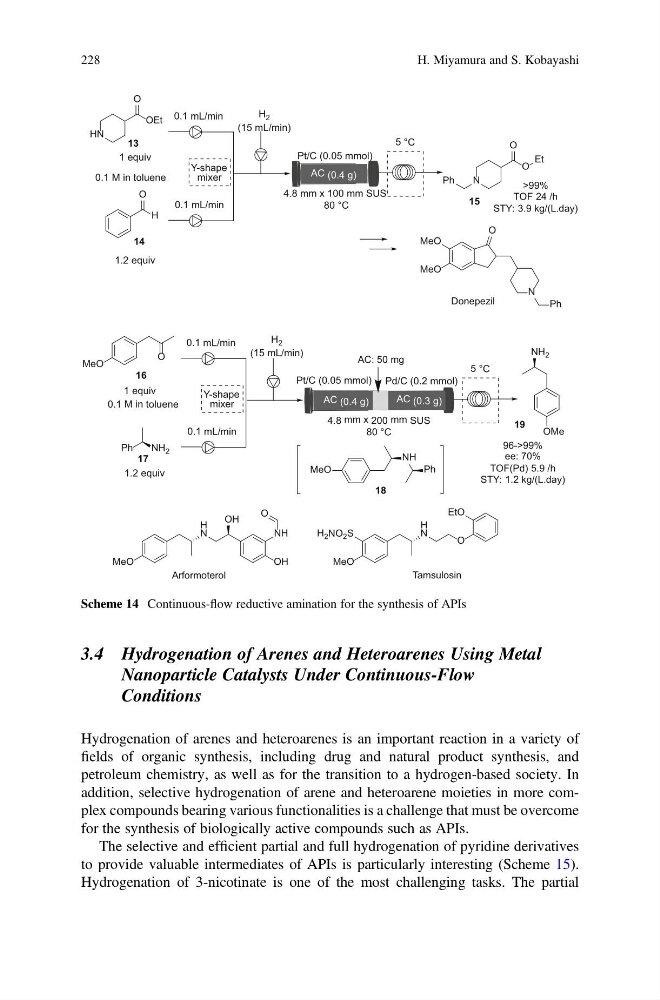
Scheme 14 Continuous-flow reductive amination for the synthesis of APIs
228
H. Miyamura and S. Kobayashi
Nanoparticle Catalysts Under Continuous-Flow
Conditions
Hydrogenation of arenes and heteroarenes is an important reaction in a variety of
fields of organic synthesis, including drug and natural product synthesis, and
petroleum chemistry, as well as for the transition to a hydrogen-based society. In
addition, selective hydrogenation of arene and heteroarene moieties in more complex compounds bearing various functionalities is a challenge that must be overcome
for the synthesis of biologically active compounds such as APIs.
The selective and efficient partial and full hydrogenation of pyridine derivatives
to provide valuable intermediates of APIs is particularly interesting (Scheme 15).
Hydrogenation of 3-nicotinate is one of the most challenging tasks. The partial
HN
OEt
O
H
O
1 equiv
1.2 equiv
H 2
(15 mL/min)
N
O
O
Et
Ph
Pt/C (0.05 mmol)
0.1 mL/min
4.8 mm x 100 mm SUS
80 °C
5 °C
0.1 M in toluene
0.1 mL/min
AC (0.4 g)
Y-shape
mixer
>99%
TOF 24 /h
STY: 3.9 kg/(L.day)
N
Ph
O
MeO
MeO
Donepezil
1 equiv
1.2 equiv
H 2
(15 mL/min)
Pt/C (0.05 mmol)
0.1 mL/min
4.8 mm x 200 mm SUS
80 °C
5 °C
0.1 M in toluene
0.1 mL/min
AC (0.4 g)
Y-shape
mixer
96->99%
ee: 70%
TOF(Pd) 5.9 /h
STY: 1.2 kg/(L.day)
AC (0.3 g)
Pd/C (0.2 mmol)
AC: 50 mg
O
MeO
Ph
NH 2
OMe
NH 2
MeO
H
N
OH
OH
NH
O
MeO
H
N
O
EtO
H 2 NO 2 S
Arformoterol
Tamsulosin
13
14
15
16
17
19
MeO
NH
18
Ph
Scheme 14 Continuous-flow reductive amination for the synthesis of APIs
228
H. Miyamura and S. Kobayashi