

enables the cartridge to be heated to 100
C, and a responsive back-pressure regulator
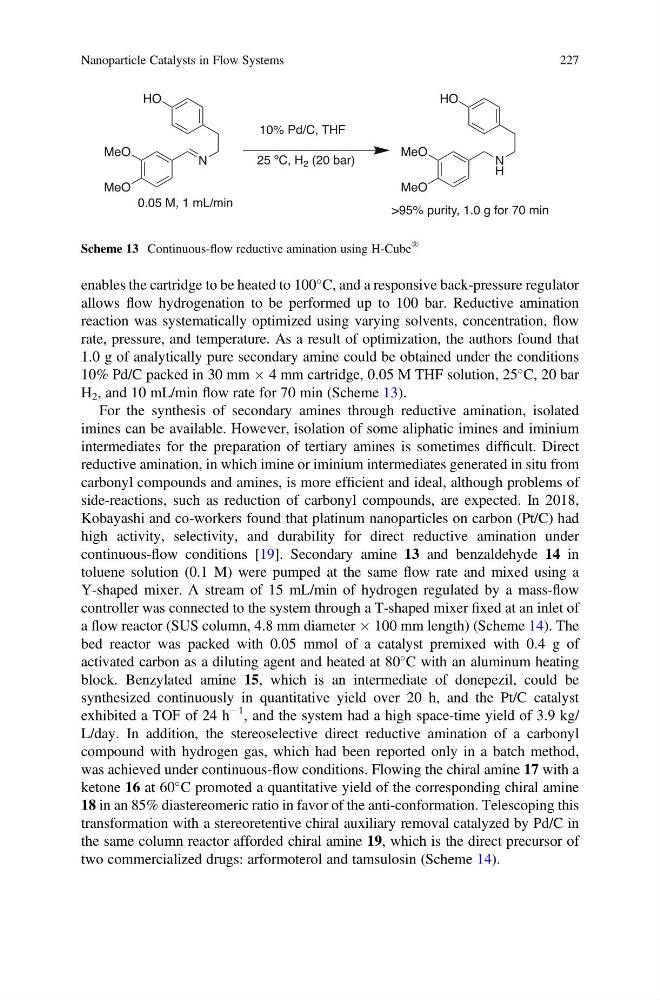
allows flow hydrogenation to be performed up to 100 bar. Reductive amination
reaction was systematically optimized using varying solvents, concentration, flow
rate, pressure, and temperature. As a result of optimization, the authors found that
1.0 g of analytically pure secondary amine could be obtained under the conditions
10% Pd/C packed in 30 mm  4 mm cartridge, 0.05 M THF solution, 25
C, 20 bar
H 2 , and 10 mL/min flow rate for 70 min (Scheme 13).
For the synthesis of secondary amines through reductive amination, isolated
imines can be available. However, isolation of some aliphatic imines and iminium
intermediates for the preparation of tertiary amines is sometimes difficult. Direct
reductive amination, in which imine or iminium intermediates generated in situ from
carbonyl compounds and amines, is more efficient and ideal, although problems of
side-reactions, such as reduction of carbonyl compounds, are expected. In 2018,
Kobayashi and co-workers found that platinum nanoparticles on carbon (Pt/C) had
high activity, selectivity, and durability for direct reductive amination under
continuous-flow conditions [19]. Secondary amine 13 and benzaldehyde 14 in
toluene solution (0.1 M) were pumped at the same flow rate and mixed using a
Y-shaped mixer. A stream of 15 mL/min of hydrogen regulated by a mass-flow
controller was connected to the system through a T-shaped mixer fixed at an inlet of
a flow reactor (SUS column, 4.8 mm diameter  100 mm length) (Scheme 14). The
bed reactor was packed with 0.05 mmol of a catalyst premixed with 0.4 g of
activated carbon as a diluting agent and heated at 80
C with an aluminum heating
block. Benzylated amine 15, which is an intermediate of donepezil, could be
synthesized continuously in quantitative yield over 20 h, and the Pt/C catalyst
exhibited a TOF of 24 h
À1 , and the system had a high space-time yield of 3.9 kg/
L/day. In addition, the stereoselective direct reductive amination of a carbonyl
compound with hydrogen gas, which had been reported only in a batch method,
was achieved under continuous-flow conditions. Flowing the chiral amine 17 with a
ketone 16 at 60
C promoted a quantitative yield of the corresponding chiral amine
18 in an 85% diastereomeric ratio in favor of the anti-conformation. Telescoping this
transformation with a stereoretentive chiral auxiliary removal catalyzed by Pd/C in
the same column reactor afforded chiral amine 19, which is the direct precursor of
two commercialized drugs: arformoterol and tamsulosin (Scheme 14).
Scheme 13 Continuous-flow reductive amination using H-Cube
®
Nanoparticle Catalysts in Flow Systems
227
C, and a responsive back-pressure regulator
allows flow hydrogenation to be performed up to 100 bar. Reductive amination
reaction was systematically optimized using varying solvents, concentration, flow
rate, pressure, and temperature. As a result of optimization, the authors found that
1.0 g of analytically pure secondary amine could be obtained under the conditions
10% Pd/C packed in 30 mm  4 mm cartridge, 0.05 M THF solution, 25
C, 20 bar
H 2 , and 10 mL/min flow rate for 70 min (Scheme 13).
For the synthesis of secondary amines through reductive amination, isolated
imines can be available. However, isolation of some aliphatic imines and iminium
intermediates for the preparation of tertiary amines is sometimes difficult. Direct
reductive amination, in which imine or iminium intermediates generated in situ from
carbonyl compounds and amines, is more efficient and ideal, although problems of
side-reactions, such as reduction of carbonyl compounds, are expected. In 2018,
Kobayashi and co-workers found that platinum nanoparticles on carbon (Pt/C) had
high activity, selectivity, and durability for direct reductive amination under
continuous-flow conditions [19]. Secondary amine 13 and benzaldehyde 14 in
toluene solution (0.1 M) were pumped at the same flow rate and mixed using a
Y-shaped mixer. A stream of 15 mL/min of hydrogen regulated by a mass-flow
controller was connected to the system through a T-shaped mixer fixed at an inlet of
a flow reactor (SUS column, 4.8 mm diameter  100 mm length) (Scheme 14). The
bed reactor was packed with 0.05 mmol of a catalyst premixed with 0.4 g of
activated carbon as a diluting agent and heated at 80
C with an aluminum heating
block. Benzylated amine 15, which is an intermediate of donepezil, could be
synthesized continuously in quantitative yield over 20 h, and the Pt/C catalyst
exhibited a TOF of 24 h
À1 , and the system had a high space-time yield of 3.9 kg/
L/day. In addition, the stereoselective direct reductive amination of a carbonyl
compound with hydrogen gas, which had been reported only in a batch method,
was achieved under continuous-flow conditions. Flowing the chiral amine 17 with a
ketone 16 at 60
C promoted a quantitative yield of the corresponding chiral amine
18 in an 85% diastereomeric ratio in favor of the anti-conformation. Telescoping this
transformation with a stereoretentive chiral auxiliary removal catalyzed by Pd/C in
the same column reactor afforded chiral amine 19, which is the direct precursor of
two commercialized drugs: arformoterol and tamsulosin (Scheme 14).
Scheme 13 Continuous-flow reductive amination using H-Cube
®
Nanoparticle Catalysts in Flow Systems
227