

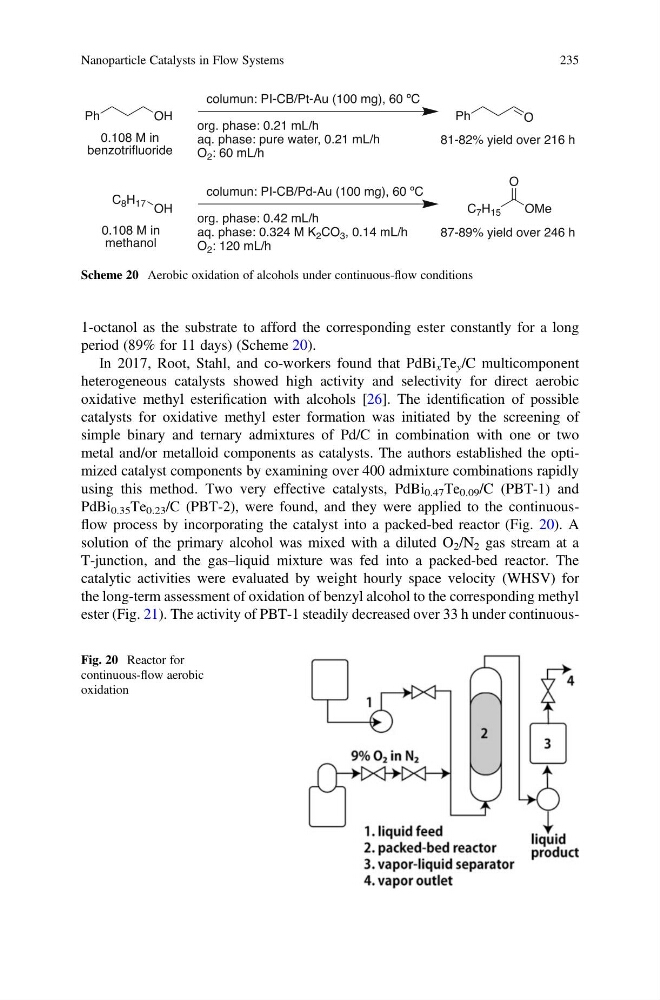
1-octanol as the substrate to afford the corresponding ester constantly for a long
period (89% for 11 days) (Scheme 20).
In 2017, Root, Stahl, and co-workers found that PdBi x Te y /C multicomponent
heterogeneous catalysts showed high activity and selectivity for direct aerobic
oxidative methyl esterification with alcohols [26]. The identification of possible
catalysts for oxidative methyl ester formation was initiated by the screening of
simple binary and ternary admixtures of Pd/C in combination with one or two
metal and/or metalloid components as catalysts. The authors established the optimized catalyst components by examining over 400 admixture combinations rapidly
using this method. Two very effective catalysts, PdBi 0.47 Te 0.09 /C (PBT-1) and
PdBi 0.35 Te 0.23 /C (PBT-2), were found, and they were applied to the continuousflow process by incorporating the catalyst into a packed-bed reactor (Fig. 20). A
solution of the primary alcohol was mixed with a diluted O 2 /N 2 gas stream at a
T-junction, and the gas–liquid mixture was fed into a packed-bed reactor. The
catalytic activities were evaluated by weight hourly space velocity (WHSV) for
the long-term assessment of oxidation of benzyl alcohol to the corresponding methyl
ester (Fig. 21). The activity of PBT-1 steadily decreased over 33 h under continuousScheme 20 Aerobic oxidation of alcohols under continuous-flow conditions
Fig. 20 Reactor for
continuous-flow aerobic
oxidation
Nanoparticle Catalysts in Flow Systems
235
period (89% for 11 days) (Scheme 20).
In 2017, Root, Stahl, and co-workers found that PdBi x Te y /C multicomponent
heterogeneous catalysts showed high activity and selectivity for direct aerobic
oxidative methyl esterification with alcohols [26]. The identification of possible
catalysts for oxidative methyl ester formation was initiated by the screening of
simple binary and ternary admixtures of Pd/C in combination with one or two
metal and/or metalloid components as catalysts. The authors established the optimized catalyst components by examining over 400 admixture combinations rapidly
using this method. Two very effective catalysts, PdBi 0.47 Te 0.09 /C (PBT-1) and
PdBi 0.35 Te 0.23 /C (PBT-2), were found, and they were applied to the continuousflow process by incorporating the catalyst into a packed-bed reactor (Fig. 20). A
solution of the primary alcohol was mixed with a diluted O 2 /N 2 gas stream at a
T-junction, and the gas–liquid mixture was fed into a packed-bed reactor. The
catalytic activities were evaluated by weight hourly space velocity (WHSV) for
the long-term assessment of oxidation of benzyl alcohol to the corresponding methyl
ester (Fig. 21). The activity of PBT-1 steadily decreased over 33 h under continuousScheme 20 Aerobic oxidation of alcohols under continuous-flow conditions
Fig. 20 Reactor for
continuous-flow aerobic
oxidation
Nanoparticle Catalysts in Flow Systems
235