

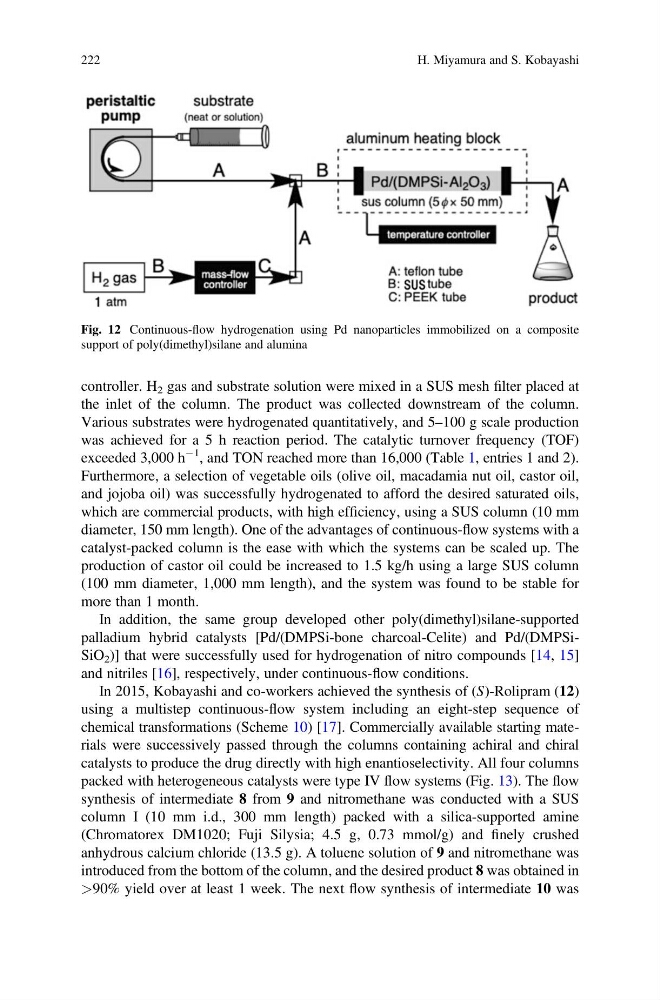
controller. H 2 gas and substrate solution were mixed in a SUS mesh filter placed at
the inlet of the column. The product was collected downstream of the column.
Various substrates were hydrogenated quantitatively, and 5–100 g scale production
was achieved for a 5 h reaction period. The catalytic turnover frequency (TOF)
exceeded 3,000 h
À1 , and TON reached more than 16,000 (Table 1, entries 1 and 2).
Furthermore, a selection of vegetable oils (olive oil, macadamia nut oil, castor oil,
and jojoba oil) was successfully hydrogenated to afford the desired saturated oils,
which are commercial products, with high efficiency, using a SUS column (10 mm
diameter, 150 mm length). One of the advantages of continuous-flow systems with a
catalyst-packed column is the ease with which the systems can be scaled up. The
production of castor oil could be increased to 1.5 kg/h using a large SUS column
(100 mm diameter, 1,000 mm length), and the system was found to be stable for
more than 1 month.
In addition, the same group developed other poly(dimethyl)silane-supported
palladium hybrid catalysts [Pd/(DMPSi-bone charcoal-Celite) and Pd/(DMPSiSiO 2 )] that were successfully used for hydrogenation of nitro compounds [14, 15]
and nitriles [16], respectively, under continuous-flow conditions.
In 2015, Kobayashi and co-workers achieved the synthesis of (S)-Rolipram (12)
using a multistep continuous-flow system including an eight-step sequence of
chemical transformations (Scheme 10) [17]. Commercially available starting materials were successively passed through the columns containing achiral and chiral
catalysts to produce the drug directly with high enantioselectivity. All four columns
packed with heterogeneous catalysts were type IV flow systems (Fig. 13). The flow
synthesis of intermediate 8 from 9 and nitromethane was conducted with a SUS
column I (10 mm i.d., 300 mm length) packed with a silica-supported amine
(Chromatorex DM1020; Fuji Silysia; 4.5 g, 0.73 mmol/g) and finely crushed
anhydrous calcium chloride (13.5 g). A toluene solution of 9 and nitromethane was
introduced from the bottom of the column, and the desired product 8 was obtained in
>90% yield over at least 1 week. The next flow synthesis of intermediate 10 was
Fig. 12 Continuous-flow hydrogenation using Pd nanoparticles immobilized on a composite
support of poly(dimethyl)silane and alumina
222
H. Miyamura and S. Kobayashi
the inlet of the column. The product was collected downstream of the column.
Various substrates were hydrogenated quantitatively, and 5–100 g scale production
was achieved for a 5 h reaction period. The catalytic turnover frequency (TOF)
exceeded 3,000 h
À1 , and TON reached more than 16,000 (Table 1, entries 1 and 2).
Furthermore, a selection of vegetable oils (olive oil, macadamia nut oil, castor oil,
and jojoba oil) was successfully hydrogenated to afford the desired saturated oils,
which are commercial products, with high efficiency, using a SUS column (10 mm
diameter, 150 mm length). One of the advantages of continuous-flow systems with a
catalyst-packed column is the ease with which the systems can be scaled up. The
production of castor oil could be increased to 1.5 kg/h using a large SUS column
(100 mm diameter, 1,000 mm length), and the system was found to be stable for
more than 1 month.
In addition, the same group developed other poly(dimethyl)silane-supported
palladium hybrid catalysts [Pd/(DMPSi-bone charcoal-Celite) and Pd/(DMPSiSiO 2 )] that were successfully used for hydrogenation of nitro compounds [14, 15]
and nitriles [16], respectively, under continuous-flow conditions.
In 2015, Kobayashi and co-workers achieved the synthesis of (S)-Rolipram (12)
using a multistep continuous-flow system including an eight-step sequence of
chemical transformations (Scheme 10) [17]. Commercially available starting materials were successively passed through the columns containing achiral and chiral
catalysts to produce the drug directly with high enantioselectivity. All four columns
packed with heterogeneous catalysts were type IV flow systems (Fig. 13). The flow
synthesis of intermediate 8 from 9 and nitromethane was conducted with a SUS
column I (10 mm i.d., 300 mm length) packed with a silica-supported amine
(Chromatorex DM1020; Fuji Silysia; 4.5 g, 0.73 mmol/g) and finely crushed
anhydrous calcium chloride (13.5 g). A toluene solution of 9 and nitromethane was
introduced from the bottom of the column, and the desired product 8 was obtained in
>90% yield over at least 1 week. The next flow synthesis of intermediate 10 was
Fig. 12 Continuous-flow hydrogenation using Pd nanoparticles immobilized on a composite
support of poly(dimethyl)silane and alumina
222
H. Miyamura and S. Kobayashi