

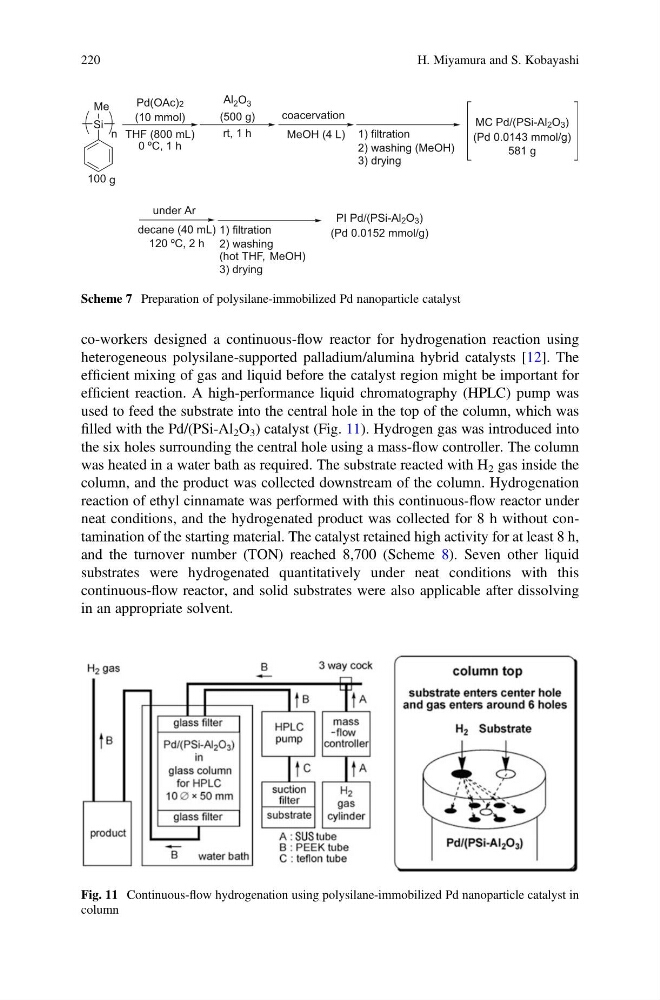
co-workers designed a continuous-flow reactor for hydrogenation reaction using
heterogeneous polysilane-supported palladium/alumina hybrid catalysts [12]. The
efficient mixing of gas and liquid before the catalyst region might be important for
efficient reaction. A high-performance liquid chromatography (HPLC) pump was
used to feed the substrate into the central hole in the top of the column, which was
filled with the Pd/(PSi-Al 2 O 3 ) catalyst (Fig. 11). Hydrogen gas was introduced into
the six holes surrounding the central hole using a mass-flow controller. The column
was heated in a water bath as required. The substrate reacted with H 2 gas inside the
column, and the product was collected downstream of the column. Hydrogenation
reaction of ethyl cinnamate was performed with this continuous-flow reactor under
neat conditions, and the hydrogenated product was collected for 8 h without contamination of the starting material. The catalyst retained high activity for at least 8 h,
and the turnover number (TON) reached 8,700 (Scheme 8). Seven other liquid
substrates were hydrogenated quantitatively under neat conditions with this
continuous-flow reactor, and solid substrates were also applicable after dissolving
in an appropriate solvent.
Fig. 11 Continuous-flow hydrogenation using polysilane-immobilized Pd nanoparticle catalyst in
column
Si
Me
n
Pd(OAc)2
(10 mmol)
THF (800 mL)
0 ºC, 1 h
Al 2 O 3
(500 g)
rt, 1 h
coacervation
MeOH (4 L)
100 g
1) filtration
2) washing (MeOH)
3) drying
MC Pd/(PSi-Al 2 O 3 )
(Pd 0.0143 mmol/g)
581 g
under Ar
decane (40 mL)
120 ºC, 2 h
1) filtration
2) washing
(hot THF, MeOH)
3) drying
PI Pd/(PSi-Al 2 O 3 )
(Pd 0.0152 mmol/g)
Scheme 7 Preparation of polysilane-immobilized Pd nanoparticle catalyst
220
H. Miyamura and S. Kobayashi
heterogeneous polysilane-supported palladium/alumina hybrid catalysts [12]. The
efficient mixing of gas and liquid before the catalyst region might be important for
efficient reaction. A high-performance liquid chromatography (HPLC) pump was
used to feed the substrate into the central hole in the top of the column, which was
filled with the Pd/(PSi-Al 2 O 3 ) catalyst (Fig. 11). Hydrogen gas was introduced into
the six holes surrounding the central hole using a mass-flow controller. The column
was heated in a water bath as required. The substrate reacted with H 2 gas inside the
column, and the product was collected downstream of the column. Hydrogenation
reaction of ethyl cinnamate was performed with this continuous-flow reactor under
neat conditions, and the hydrogenated product was collected for 8 h without contamination of the starting material. The catalyst retained high activity for at least 8 h,
and the turnover number (TON) reached 8,700 (Scheme 8). Seven other liquid
substrates were hydrogenated quantitatively under neat conditions with this
continuous-flow reactor, and solid substrates were also applicable after dissolving
in an appropriate solvent.
Fig. 11 Continuous-flow hydrogenation using polysilane-immobilized Pd nanoparticle catalyst in
column
Si
Me
n
Pd(OAc)2
(10 mmol)
THF (800 mL)
0 ºC, 1 h
Al 2 O 3
(500 g)
rt, 1 h
coacervation
MeOH (4 L)
100 g
1) filtration
2) washing (MeOH)
3) drying
MC Pd/(PSi-Al 2 O 3 )
(Pd 0.0143 mmol/g)
581 g
under Ar
decane (40 mL)
120 ºC, 2 h
1) filtration
2) washing
(hot THF, MeOH)
3) drying
PI Pd/(PSi-Al 2 O 3 )
(Pd 0.0152 mmol/g)
Scheme 7 Preparation of polysilane-immobilized Pd nanoparticle catalyst
220
H. Miyamura and S. Kobayashi