

3.1 Continuous-Flow Hydrogenation Using
Polysilane-Supported Palladium Catalysts
In 2008, Kobayashi and co-workers developed poly(methylphenylsilane)-supported
palladium nanoparticles on metal oxide hybrid catalysts (Pd/(PSi-MOx)), and they
worked as hydrogenation catalysts without leaching of palladium (Scheme 7)
[11]. The hybrid catalysts were insoluble, did not swell in any solvent, and were
predicted to be applicable to continuous-flow reactors. In 2011, Kobayashi and
µ-device 6a-6f
aq. HCOONa
50 ºC, 8 s
OMe
MeO
Cl
OMe
MeO
H
µ-device 6a: 99%
µ-device 6b: 10%
µ-device 6c: 35%
µ-device 6d: 99%
µ-device 6e: 0%
µ-device 6f: 65%
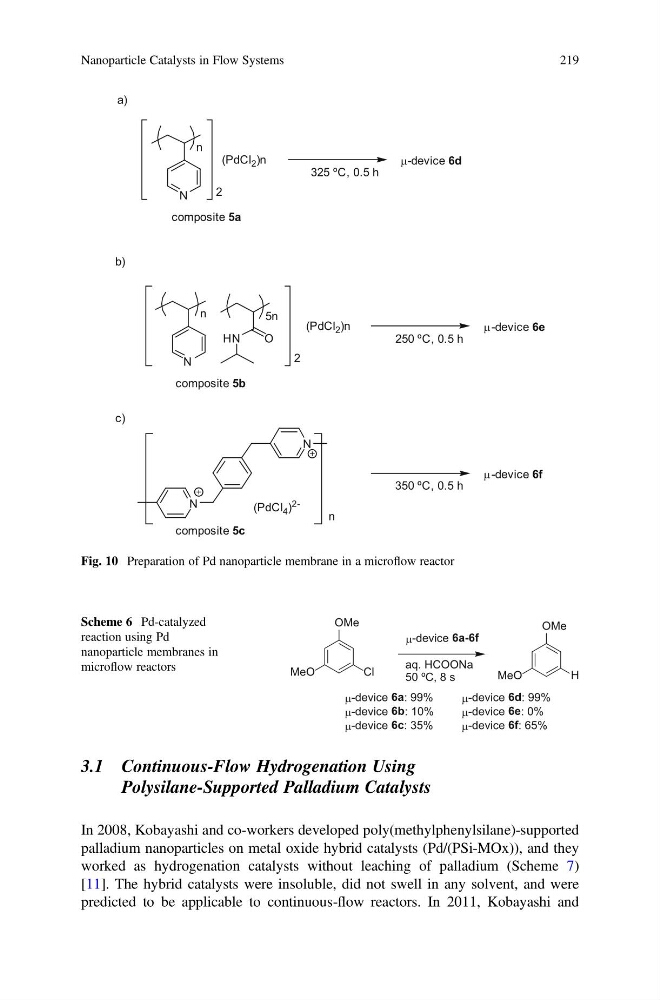
Scheme 6 Pd-catalyzed
reaction using Pd
nanoparticle membranes in
microflow reactors
N
n
2
(PdCl 2 )n
(PdCl 2 )n
composite 5a
µ-device 6d
325 ºC, 0.5 h
250 ºC, 0.5 h
350 ºC, 0.5 h
a)
b)
N
n
2
composite 5b
µ -device 6e
5n
HN
O
c)
n
(PdCl 4 )
2composite 5c
µ -device 6f
N
N
Fig. 10 Preparation of Pd nanoparticle membrane in a microflow reactor
Nanoparticle Catalysts in Flow Systems
219
Polysilane-Supported Palladium Catalysts
In 2008, Kobayashi and co-workers developed poly(methylphenylsilane)-supported
palladium nanoparticles on metal oxide hybrid catalysts (Pd/(PSi-MOx)), and they
worked as hydrogenation catalysts without leaching of palladium (Scheme 7)
[11]. The hybrid catalysts were insoluble, did not swell in any solvent, and were
predicted to be applicable to continuous-flow reactors. In 2011, Kobayashi and
µ-device 6a-6f
aq. HCOONa
50 ºC, 8 s
OMe
MeO
Cl
OMe
MeO
H
µ-device 6a: 99%
µ-device 6b: 10%
µ-device 6c: 35%
µ-device 6d: 99%
µ-device 6e: 0%
µ-device 6f: 65%
Scheme 6 Pd-catalyzed
reaction using Pd
nanoparticle membranes in
microflow reactors
N
n
2
(PdCl 2 )n
(PdCl 2 )n
composite 5a
µ-device 6d
325 ºC, 0.5 h
250 ºC, 0.5 h
350 ºC, 0.5 h
a)
b)
N
n
2
composite 5b
µ -device 6e
5n
HN
O
c)
n
(PdCl 4 )
2composite 5c
µ -device 6f
N
N
Fig. 10 Preparation of Pd nanoparticle membrane in a microflow reactor
Nanoparticle Catalysts in Flow Systems
219