

2.5 Carbonaceous and Organic Materials
In the early stage of research, the deposition of Au NPs and clusters onto inert
supports were difficult by conventional deposition-precipitation (DP) using HAuCl 4
as a precursor due to electrostatic repulsion between [Au(OH)4]
− and negatively
charged inert support surface. Therefore, colloid immobilization (CI) using ligandor polymer-protected Au NPs had been usually exploited for the preparation of Au/
C, and other new deposition techniques have also been developed to prepare Au/C
and Au/polymers [81]. These Au catalysts have appeared to catalyze liquid-phase
oxidation. Whereas Au/MO x and Au on basic non-oxides promote alcohol oxidations in the absence of base, base is often required for Au/C and Au/polymers under
mild conditions. In early studies, more than stoichiometric amount of base was
required for alcohol oxidations over Au/C [11].
Recently, Au on modified carbonaceous materials was reported to catalyze the
alcohol oxidation even in the absence of base. Wang et al. reported that nitrogendoped graphenes (NG) enable to deposit small Au NPs (ca. 3 nm), whereas the size
of Au on the undoped graphene was much larger (>20 nm), and the resultant Au/NG
promoted the base-free oxidation of alcohols [82].
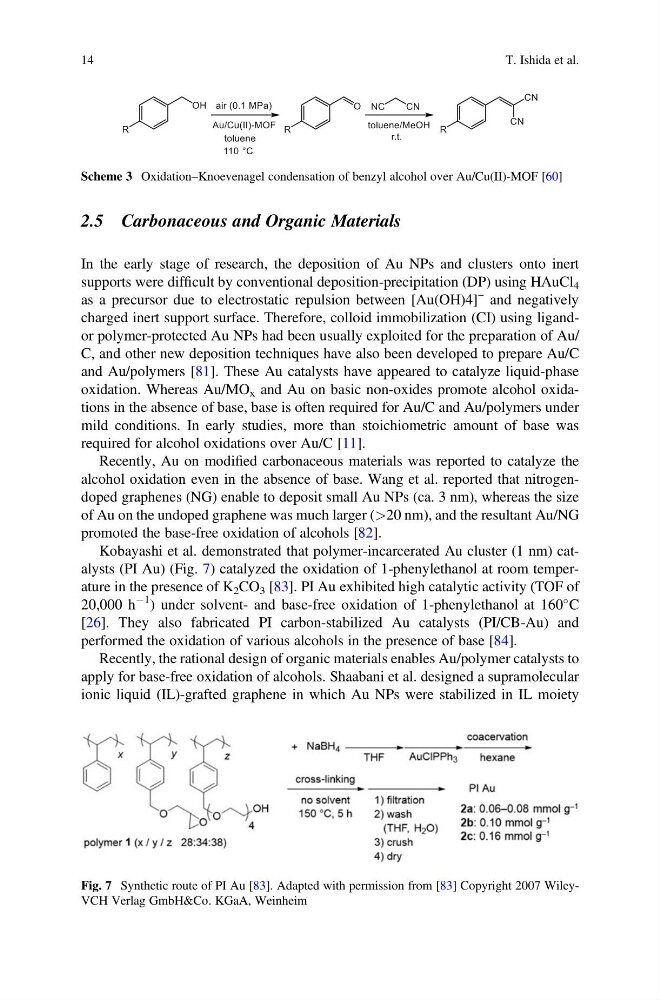
Kobayashi et al. demonstrated that polymer-incarcerated Au cluster (1 nm) catalysts (PI Au) (Fig. 7) catalyzed the oxidation of 1-phenylethanol at room temperature in the presence of K 2 CO 3 [83]. PI Au exhibited high catalytic activity (TOF of
20,000 h
À1 ) under solvent- and base-free oxidation of 1-phenylethanol at 160
C
[26]. They also fabricated PI carbon-stabilized Au catalysts (PI/CB-Au) and
performed the oxidation of various alcohols in the presence of base [84].
Recently, the rational design of organic materials enables Au/polymer catalysts to
apply for base-free oxidation of alcohols. Shaabani et al. designed a supramolecular
ionic liquid (IL)-grafted graphene in which Au NPs were stabilized in IL moiety
Scheme 3 Oxidation–Knoevenagel condensation of benzyl alcohol over Au/Cu(II)-MOF [60]
Fig. 7 Synthetic route of PI Au [83]. Adapted with permission from [83] Copyright 2007 WileyVCH Verlag GmbH&Co. KGaA, Weinheim
14
T. Ishida et al.
In the early stage of research, the deposition of Au NPs and clusters onto inert
supports were difficult by conventional deposition-precipitation (DP) using HAuCl 4
as a precursor due to electrostatic repulsion between [Au(OH)4]
− and negatively
charged inert support surface. Therefore, colloid immobilization (CI) using ligandor polymer-protected Au NPs had been usually exploited for the preparation of Au/
C, and other new deposition techniques have also been developed to prepare Au/C
and Au/polymers [81]. These Au catalysts have appeared to catalyze liquid-phase
oxidation. Whereas Au/MO x and Au on basic non-oxides promote alcohol oxidations in the absence of base, base is often required for Au/C and Au/polymers under
mild conditions. In early studies, more than stoichiometric amount of base was
required for alcohol oxidations over Au/C [11].
Recently, Au on modified carbonaceous materials was reported to catalyze the
alcohol oxidation even in the absence of base. Wang et al. reported that nitrogendoped graphenes (NG) enable to deposit small Au NPs (ca. 3 nm), whereas the size
of Au on the undoped graphene was much larger (>20 nm), and the resultant Au/NG
promoted the base-free oxidation of alcohols [82].
Kobayashi et al. demonstrated that polymer-incarcerated Au cluster (1 nm) catalysts (PI Au) (Fig. 7) catalyzed the oxidation of 1-phenylethanol at room temperature in the presence of K 2 CO 3 [83]. PI Au exhibited high catalytic activity (TOF of
20,000 h
À1 ) under solvent- and base-free oxidation of 1-phenylethanol at 160
C
[26]. They also fabricated PI carbon-stabilized Au catalysts (PI/CB-Au) and
performed the oxidation of various alcohols in the presence of base [84].
Recently, the rational design of organic materials enables Au/polymer catalysts to
apply for base-free oxidation of alcohols. Shaabani et al. designed a supramolecular
ionic liquid (IL)-grafted graphene in which Au NPs were stabilized in IL moiety
Scheme 3 Oxidation–Knoevenagel condensation of benzyl alcohol over Au/Cu(II)-MOF [60]
Fig. 7 Synthetic route of PI Au [83]. Adapted with permission from [83] Copyright 2007 WileyVCH Verlag GmbH&Co. KGaA, Weinheim
14
T. Ishida et al.