

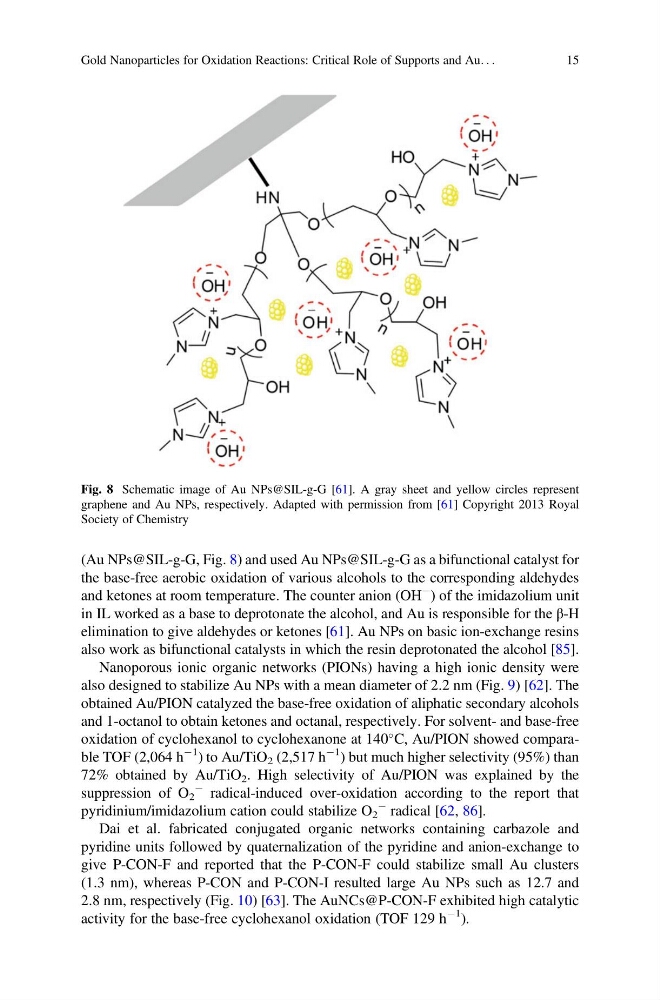
(Au NPs@SIL-g-G, Fig. 8) and used Au NPs@SIL-g-G as a bifunctional catalyst for
the base-free aerobic oxidation of various alcohols to the corresponding aldehydes
and ketones at room temperature. The counter anion (OH
À ) of the imidazolium unit
in IL worked as a base to deprotonate the alcohol, and Au is responsible for the β-H
elimination to give aldehydes or ketones [61]. Au NPs on basic ion-exchange resins
also work as bifunctional catalysts in which the resin deprotonated the alcohol [85].
Nanoporous ionic organic networks (PIONs) having a high ionic density were
also designed to stabilize Au NPs with a mean diameter of 2.2 nm (Fig. 9) [62]. The
obtained Au/PION catalyzed the base-free oxidation of aliphatic secondary alcohols
and 1-octanol to obtain ketones and octanal, respectively. For solvent- and base-free
oxidation of cyclohexanol to cyclohexanone at 140
C, Au/PION showed comparable TOF (2,064 h
À1 ) to Au/TiO 2 (2,517 h
À1 ) but much higher selectivity (95%) than
72% obtained by Au/TiO 2 . High selectivity of Au/PION was explained by the
suppression of O 2
À radical-induced over-oxidation according to the report that
pyridinium/imidazolium cation could stabilize O 2
À radical [62, 86].
Dai et al. fabricated conjugated organic networks containing carbazole and
pyridine units followed by quaternalization of the pyridine and anion-exchange to
give P-CON-F and reported that the P-CON-F could stabilize small Au clusters
(1.3 nm), whereas P-CON and P-CON-I resulted large Au NPs such as 12.7 and
2.8 nm, respectively (Fig. 10) [63]. The AuNCs@P-CON-F exhibited high catalytic
activity for the base-free cyclohexanol oxidation (TOF 129 h
À1 ).
Fig. 8 Schematic image of Au NPs@SIL-g-G [61]. A gray sheet and yellow circles represent
graphene and Au NPs, respectively. Adapted with permission from [61] Copyright 2013 Royal
Society of Chemistry
Gold Nanoparticles for Oxidation Reactions: Critical Role of Supports and Au. . .
15
the base-free aerobic oxidation of various alcohols to the corresponding aldehydes
and ketones at room temperature. The counter anion (OH
À ) of the imidazolium unit
in IL worked as a base to deprotonate the alcohol, and Au is responsible for the β-H
elimination to give aldehydes or ketones [61]. Au NPs on basic ion-exchange resins
also work as bifunctional catalysts in which the resin deprotonated the alcohol [85].
Nanoporous ionic organic networks (PIONs) having a high ionic density were
also designed to stabilize Au NPs with a mean diameter of 2.2 nm (Fig. 9) [62]. The
obtained Au/PION catalyzed the base-free oxidation of aliphatic secondary alcohols
and 1-octanol to obtain ketones and octanal, respectively. For solvent- and base-free
oxidation of cyclohexanol to cyclohexanone at 140
C, Au/PION showed comparable TOF (2,064 h
À1 ) to Au/TiO 2 (2,517 h
À1 ) but much higher selectivity (95%) than
72% obtained by Au/TiO 2 . High selectivity of Au/PION was explained by the
suppression of O 2
À radical-induced over-oxidation according to the report that
pyridinium/imidazolium cation could stabilize O 2
À radical [62, 86].
Dai et al. fabricated conjugated organic networks containing carbazole and
pyridine units followed by quaternalization of the pyridine and anion-exchange to
give P-CON-F and reported that the P-CON-F could stabilize small Au clusters
(1.3 nm), whereas P-CON and P-CON-I resulted large Au NPs such as 12.7 and
2.8 nm, respectively (Fig. 10) [63]. The AuNCs@P-CON-F exhibited high catalytic
activity for the base-free cyclohexanol oxidation (TOF 129 h
À1 ).
Fig. 8 Schematic image of Au NPs@SIL-g-G [61]. A gray sheet and yellow circles represent
graphene and Au NPs, respectively. Adapted with permission from [61] Copyright 2013 Royal
Society of Chemistry
Gold Nanoparticles for Oxidation Reactions: Critical Role of Supports and Au. . .
15