

2.3 Gold Nanoparticles Immobilized in a Capillary
for Aerobic Oxidation
In 2007, Kobayashi and co-workers developed Au nanoparticle catalysts
immobilized on polystyrene-based copolymer with a cross-linking moiety (4)
(Fig. 5), the so-called polymer-incarcerated Au nanoparticle catalyst (PI-Au)
[6]. In 2009, the same group developed Au nanoparticle-immobilized capillary
reactors for aerobic oxidation of alcohols to the corresponding carbonyl compounds
[7]. In general, aerobic oxidation of alcohols using heterogeneous catalysts is slower
than hydrogenation of olefins, and a reaction environment with a large gas–liquid–
solid interfacial surface area is required to complete the reaction within the limited
length of the reaction channel under continuous-flow conditions. Commercially
available polysiloxane-coated capillary (3) (50 cm length, 250 μm i.d.) that
contained 50% phenyl and 50% n-cyanopropyl functionalities on silicon atoms
with a film thickness of 0.25 μm on the walls was employed as the base of the
reactors (Fig. 6). The cyanopropyl group was reduced to the corresponding primary
amine group using lithium aluminum hydride (Scheme 5a). Microencapsulated
gold nanoparticles (MC-Au), which were prepared by reduction of
chlorotriphenylphosphine gold using sodium borohydride in the presence of copolymer with alcohol and epoxide moieties as a stabilizer (4), were used for the
immobilization (Scheme 5b). The colloidal solution of the MC-Au was slowly
pumped into the modified capillary, and the capillary was heated at 170
C for 5 h.
Cross-linking and covalent bond formation between the copolymer and the capillary
surface occurred to afford the Au nanoparticle-immobilized capillary (Scheme 5c).
The prepared Au nanoparticle-immobilized capillary was attached to a T-shaped
Si
Me
n
Pd(OAc)2
(0.1 mmol/g)
THF (8 mL/g)
0 ºC, 1 h
MOx (g/g)
rt, 1 h
catalyst
suspension
capillary
(I.D. 530 µm)
remove of
solvent
50 ºC, 5 h
Cross-linking
120 ºC, 12 h
Pd/PSi-MO x
Immobilized Capillary
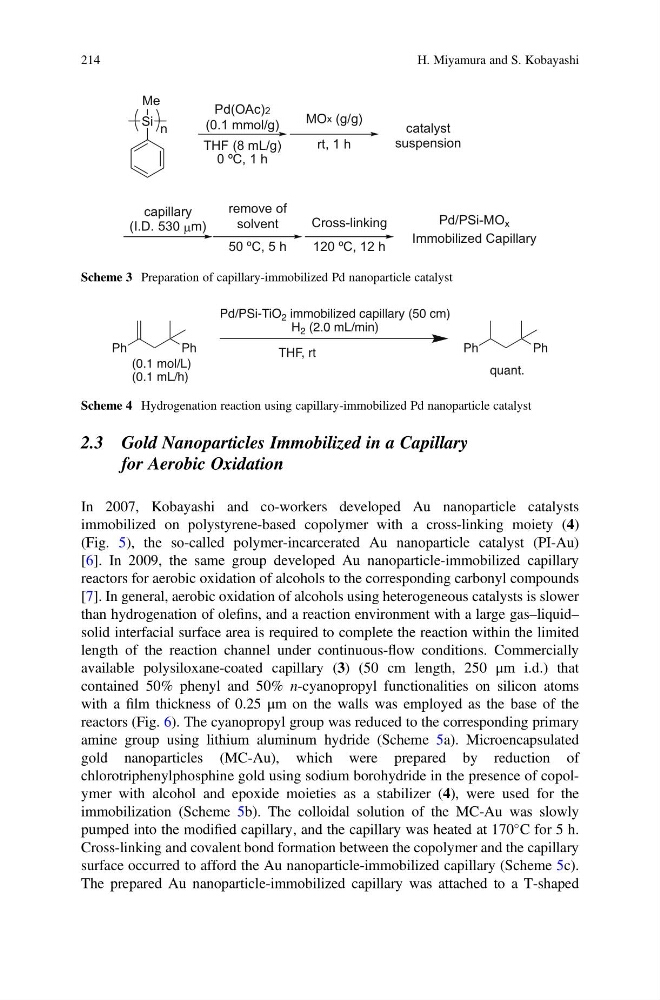
Scheme 3 Preparation of capillary-immobilized Pd nanoparticle catalyst
Scheme 4 Hydrogenation reaction using capillary-immobilized Pd nanoparticle catalyst
214
H. Miyamura and S. Kobayashi
for Aerobic Oxidation
In 2007, Kobayashi and co-workers developed Au nanoparticle catalysts
immobilized on polystyrene-based copolymer with a cross-linking moiety (4)
(Fig. 5), the so-called polymer-incarcerated Au nanoparticle catalyst (PI-Au)
[6]. In 2009, the same group developed Au nanoparticle-immobilized capillary
reactors for aerobic oxidation of alcohols to the corresponding carbonyl compounds
[7]. In general, aerobic oxidation of alcohols using heterogeneous catalysts is slower
than hydrogenation of olefins, and a reaction environment with a large gas–liquid–
solid interfacial surface area is required to complete the reaction within the limited
length of the reaction channel under continuous-flow conditions. Commercially
available polysiloxane-coated capillary (3) (50 cm length, 250 μm i.d.) that
contained 50% phenyl and 50% n-cyanopropyl functionalities on silicon atoms
with a film thickness of 0.25 μm on the walls was employed as the base of the
reactors (Fig. 6). The cyanopropyl group was reduced to the corresponding primary
amine group using lithium aluminum hydride (Scheme 5a). Microencapsulated
gold nanoparticles (MC-Au), which were prepared by reduction of
chlorotriphenylphosphine gold using sodium borohydride in the presence of copolymer with alcohol and epoxide moieties as a stabilizer (4), were used for the
immobilization (Scheme 5b). The colloidal solution of the MC-Au was slowly
pumped into the modified capillary, and the capillary was heated at 170
C for 5 h.
Cross-linking and covalent bond formation between the copolymer and the capillary
surface occurred to afford the Au nanoparticle-immobilized capillary (Scheme 5c).
The prepared Au nanoparticle-immobilized capillary was attached to a T-shaped
Si
Me
n
Pd(OAc)2
(0.1 mmol/g)
THF (8 mL/g)
0 ºC, 1 h
MOx (g/g)
rt, 1 h
catalyst
suspension
capillary
(I.D. 530 µm)
remove of
solvent
50 ºC, 5 h
Cross-linking
120 ºC, 12 h
Pd/PSi-MO x
Immobilized Capillary
Scheme 3 Preparation of capillary-immobilized Pd nanoparticle catalyst
Scheme 4 Hydrogenation reaction using capillary-immobilized Pd nanoparticle catalyst
214
H. Miyamura and S. Kobayashi