

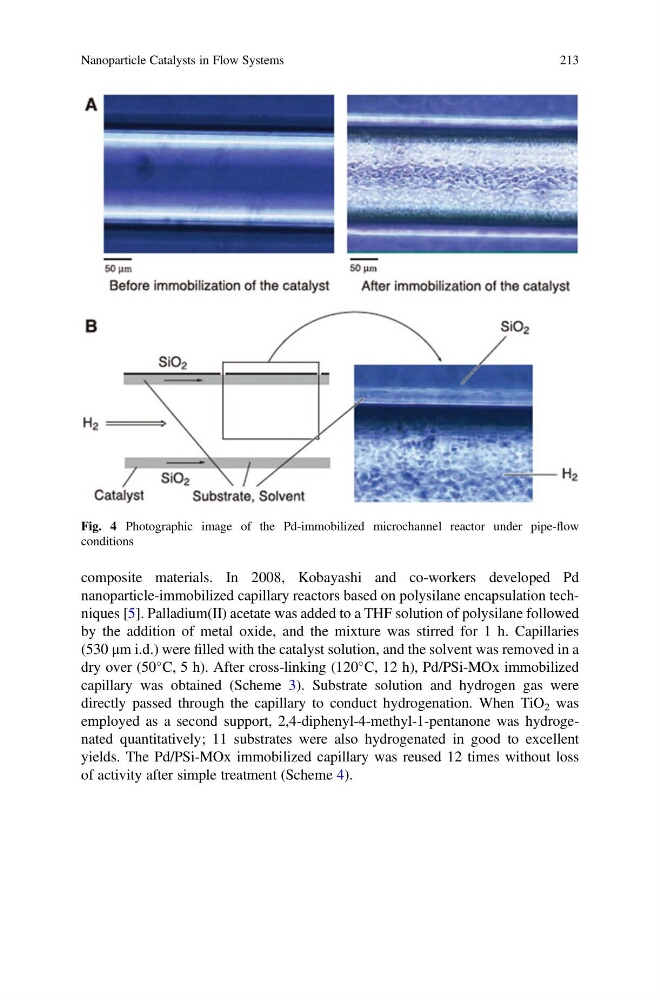
composite materials. In 2008, Kobayashi and co-workers developed Pd
nanoparticle-immobilized capillary reactors based on polysilane encapsulation techniques [5]. Palladium(II) acetate was added to a THF solution of polysilane followed
by the addition of metal oxide, and the mixture was stirred for 1 h. Capillaries
(530 μm i.d.) were filled with the catalyst solution, and the solvent was removed in a
dry over (50
C, 5 h). After cross-linking (120
C, 12 h), Pd/PSi-MOx immobilized
capillary was obtained (Scheme 3). Substrate solution and hydrogen gas were
directly passed through the capillary to conduct hydrogenation. When TiO 2 was
employed as a second support, 2,4-diphenyl-4-methyl-1-pentanone was hydrogenated quantitatively; 11 substrates were also hydrogenated in good to excellent
yields. The Pd/PSi-MOx immobilized capillary was reused 12 times without loss
of activity after simple treatment (Scheme 4).
Fig. 4 Photographic image of the Pd-immobilized microchannel reactor under pipe-flow
conditions
Nanoparticle Catalysts in Flow Systems
213
nanoparticle-immobilized capillary reactors based on polysilane encapsulation techniques [5]. Palladium(II) acetate was added to a THF solution of polysilane followed
by the addition of metal oxide, and the mixture was stirred for 1 h. Capillaries
(530 μm i.d.) were filled with the catalyst solution, and the solvent was removed in a
dry over (50
C, 5 h). After cross-linking (120
C, 12 h), Pd/PSi-MOx immobilized
capillary was obtained (Scheme 3). Substrate solution and hydrogen gas were
directly passed through the capillary to conduct hydrogenation. When TiO 2 was
employed as a second support, 2,4-diphenyl-4-methyl-1-pentanone was hydrogenated quantitatively; 11 substrates were also hydrogenated in good to excellent
yields. The Pd/PSi-MOx immobilized capillary was reused 12 times without loss
of activity after simple treatment (Scheme 4).
Fig. 4 Photographic image of the Pd-immobilized microchannel reactor under pipe-flow
conditions
Nanoparticle Catalysts in Flow Systems
213