

2 Metal Nanoparticle Catalysts Immobilized
in Microchannels and Microreactors
Redox reactions are key for flow “fine” synthesis. Especially, type IV flow reactors
for aerobic oxidation and hydrogenation are useful and ideal to flow “fine” synthesis
as discussed above. However, multi-interfacial reaction environments involving
gas–liquid–solid multiphase reaction conditions are needed for continuous-flow
systems. Microchannels and microreactors are ideal devices for such purpose
because they can maximize the specific surface area. Therefore, methods that can
be applied to immobilize heterogeneous metal nanoparticle catalysts in such
microfluidic devices are crucial for success.
2.1 Polymer-Incarcerated Palladium Nanoparticles
Immobilized in Microchannels for Hydrogenation
In 2004, Kobayashi and co-workers designed a microchannel reactor that has a very
large specific interfacial area per unit of volume (10,000–50,000 m
2 /m
3 ), in which
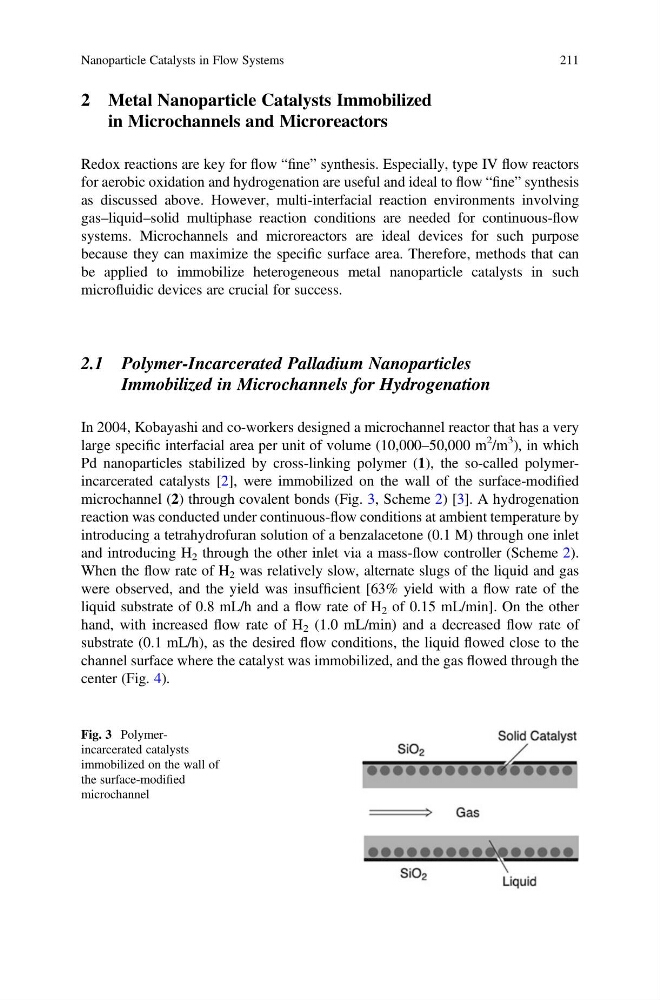
Pd nanoparticles stabilized by cross-linking polymer (1), the so-called polymerincarcerated catalysts [2], were immobilized on the wall of the surface-modified
microchannel (2) through covalent bonds (Fig. 3, Scheme 2) [3]. A hydrogenation
reaction was conducted under continuous-flow conditions at ambient temperature by
introducing a tetrahydrofuran solution of a benzalacetone (0.1 M) through one inlet
and introducing H 2 through the other inlet via a mass-flow controller (Scheme 2).
When the flow rate of H 2 was relatively slow, alternate slugs of the liquid and gas
were observed, and the yield was insufficient [63% yield with a flow rate of the
liquid substrate of 0.8 mL/h and a flow rate of H 2 of 0.15 mL/min]. On the other
hand, with increased flow rate of H 2 (1.0 mL/min) and a decreased flow rate of
substrate (0.1 mL/h), as the desired flow conditions, the liquid flowed close to the
channel surface where the catalyst was immobilized, and the gas flowed through the
center (Fig. 4).
Fig. 3 Polymerincarcerated catalysts
immobilized on the wall of
the surface-modified
microchannel
Nanoparticle Catalysts in Flow Systems
211
in Microchannels and Microreactors
Redox reactions are key for flow “fine” synthesis. Especially, type IV flow reactors
for aerobic oxidation and hydrogenation are useful and ideal to flow “fine” synthesis
as discussed above. However, multi-interfacial reaction environments involving
gas–liquid–solid multiphase reaction conditions are needed for continuous-flow
systems. Microchannels and microreactors are ideal devices for such purpose
because they can maximize the specific surface area. Therefore, methods that can
be applied to immobilize heterogeneous metal nanoparticle catalysts in such
microfluidic devices are crucial for success.
2.1 Polymer-Incarcerated Palladium Nanoparticles
Immobilized in Microchannels for Hydrogenation
In 2004, Kobayashi and co-workers designed a microchannel reactor that has a very
large specific interfacial area per unit of volume (10,000–50,000 m
2 /m
3 ), in which
Pd nanoparticles stabilized by cross-linking polymer (1), the so-called polymerincarcerated catalysts [2], were immobilized on the wall of the surface-modified
microchannel (2) through covalent bonds (Fig. 3, Scheme 2) [3]. A hydrogenation
reaction was conducted under continuous-flow conditions at ambient temperature by
introducing a tetrahydrofuran solution of a benzalacetone (0.1 M) through one inlet
and introducing H 2 through the other inlet via a mass-flow controller (Scheme 2).
When the flow rate of H 2 was relatively slow, alternate slugs of the liquid and gas
were observed, and the yield was insufficient [63% yield with a flow rate of the
liquid substrate of 0.8 mL/h and a flow rate of H 2 of 0.15 mL/min]. On the other
hand, with increased flow rate of H 2 (1.0 mL/min) and a decreased flow rate of
substrate (0.1 mL/h), as the desired flow conditions, the liquid flowed close to the
channel surface where the catalyst was immobilized, and the gas flowed through the
center (Fig. 4).
Fig. 3 Polymerincarcerated catalysts
immobilized on the wall of
the surface-modified
microchannel
Nanoparticle Catalysts in Flow Systems
211