

product by unreacted A or B may be avoided, overreactions may occur. In addition,
once supported B is consumed, the column must be changed.
Type III: Substrate A reacts with B in the presence of a homogeneous catalyst.
Although catalysis proceeds smoothly, the catalyst cannot be easily separated, and it
elutes as a contaminant in the product.
Type IV: Substrate A reacts with B in the presence of a heterogeneous catalyst. If
catalysis proceeds smoothly, no separation of the catalyst from the product is
required.
Considering the recent guidelines on green sustainable chemistry, synthesis with
catalysts is preferred to synthesis without catalysts because the former can lead to
energy saving and waste reduction. From this viewpoint, flow systems of types II
and IV are recommended. Furthermore, whereas the products are contaminated by
homogeneous catalysts in type III flow systems, no contamination of catalysts is
expected under ideal conditions of type IV systems. If multistep continuous-flow
systems are designed for the synthesis of complex molecules, the generation of
by-products and contamination of catalysts may be problematic for downstream flow
reactions. Therefore, type IV flow systems may have some advantages over other
types of flow reactions, and type IV flow systems that produce no by-products or
only by-products that can be easily removed by phase separation, such as gas or
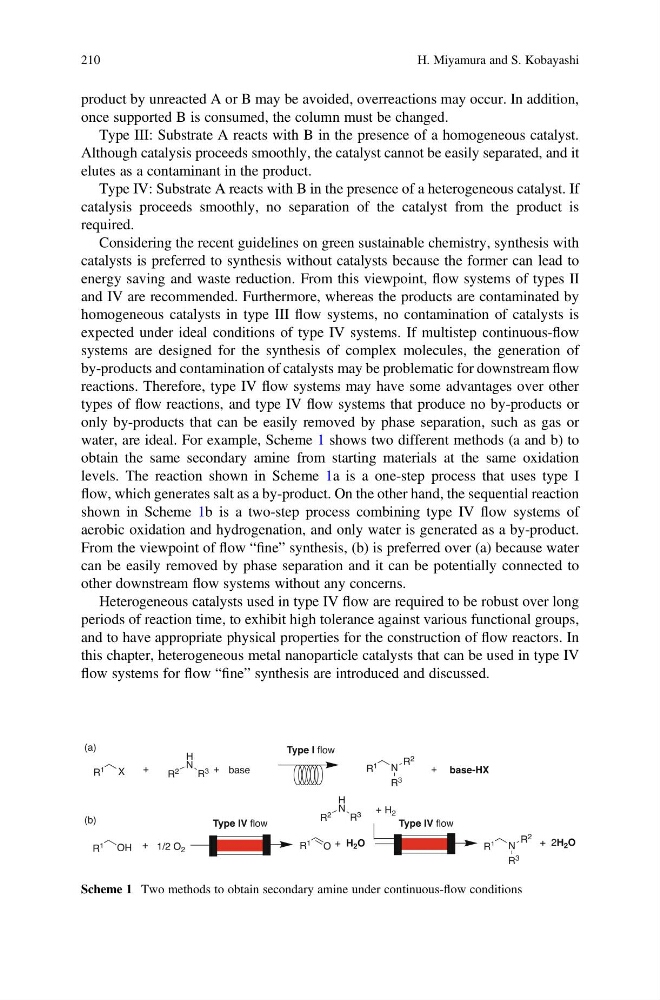
water, are ideal. For example, Scheme 1 shows two different methods (a and b) to
obtain the same secondary amine from starting materials at the same oxidation
levels. The reaction shown in Scheme 1a is a one-step process that uses type I
flow, which generates salt as a by-product. On the other hand, the sequential reaction
shown in Scheme 1b is a two-step process combining type IV flow systems of
aerobic oxidation and hydrogenation, and only water is generated as a by-product.
From the viewpoint of flow “fine” synthesis, (b) is preferred over (a) because water
can be easily removed by phase separation and it can be potentially connected to
other downstream flow systems without any concerns.
Heterogeneous catalysts used in type IV flow are required to be robust over long
periods of reaction time, to exhibit high tolerance against various functional groups,
and to have appropriate physical properties for the construction of flow reactors. In
this chapter, heterogeneous metal nanoparticle catalysts that can be used in type IV
flow systems for flow “fine” synthesis are introduced and discussed.
Scheme 1 Two methods to obtain secondary amine under continuous-flow conditions
210
H. Miyamura and S. Kobayashi
once supported B is consumed, the column must be changed.
Type III: Substrate A reacts with B in the presence of a homogeneous catalyst.
Although catalysis proceeds smoothly, the catalyst cannot be easily separated, and it
elutes as a contaminant in the product.
Type IV: Substrate A reacts with B in the presence of a heterogeneous catalyst. If
catalysis proceeds smoothly, no separation of the catalyst from the product is
required.
Considering the recent guidelines on green sustainable chemistry, synthesis with
catalysts is preferred to synthesis without catalysts because the former can lead to
energy saving and waste reduction. From this viewpoint, flow systems of types II
and IV are recommended. Furthermore, whereas the products are contaminated by
homogeneous catalysts in type III flow systems, no contamination of catalysts is
expected under ideal conditions of type IV systems. If multistep continuous-flow
systems are designed for the synthesis of complex molecules, the generation of
by-products and contamination of catalysts may be problematic for downstream flow
reactions. Therefore, type IV flow systems may have some advantages over other
types of flow reactions, and type IV flow systems that produce no by-products or
only by-products that can be easily removed by phase separation, such as gas or
water, are ideal. For example, Scheme 1 shows two different methods (a and b) to
obtain the same secondary amine from starting materials at the same oxidation
levels. The reaction shown in Scheme 1a is a one-step process that uses type I
flow, which generates salt as a by-product. On the other hand, the sequential reaction
shown in Scheme 1b is a two-step process combining type IV flow systems of
aerobic oxidation and hydrogenation, and only water is generated as a by-product.
From the viewpoint of flow “fine” synthesis, (b) is preferred over (a) because water
can be easily removed by phase separation and it can be potentially connected to
other downstream flow systems without any concerns.
Heterogeneous catalysts used in type IV flow are required to be robust over long
periods of reaction time, to exhibit high tolerance against various functional groups,
and to have appropriate physical properties for the construction of flow reactors. In
this chapter, heterogeneous metal nanoparticle catalysts that can be used in type IV
flow systems for flow “fine” synthesis are introduced and discussed.
Scheme 1 Two methods to obtain secondary amine under continuous-flow conditions
210
H. Miyamura and S. Kobayashi