

flow “fine” synthesis in 2016 [1], increasing numbers of syntheses and reactions that
attain high yields and high selectivities for complex molecules using flow methods
have been reported. Flow “fine” synthesis can be defined as “reaction and synthesis
that attain high yields and high selectivities by a flow method.” Furthermore,
because a characteristic of the flow method is that it is continuous, flow “fine”
synthesis should construct multistep flow systems by combining individual flow
reactions to synthesize structurally complex molecules. Flow “fine” synthesis has
several advantages over conventional organic synthesis. (1) High-energy productivity and energy saving compared with batch methods can be realized. (2) The
compact nature of a reactor means that space saving can be realized in addition to
energy saving. (3) The low-volume reaction space means that the risk of out-ofcontrol reactions can be minimized by rapid heat exchange and it is possible to
suppress damage caused in the event of leakage even when high-risk substances are
used; therefore, flow “fine” synthesis ensures high safety. (4) It is possible to adjust
the quantity of production by controlling the rate of introduction of starting materials; such “just-in-time” production can reduce the amount of waste generated,
which can lead to reduced costs. (5) Automation is easier, and it is possible to
minimize the exposure of operators to hazardous chemicals. (6) Using columns
packed with a suitable catalyst (fixed-bed reactor), the separation of catalyst from
the product is not required.
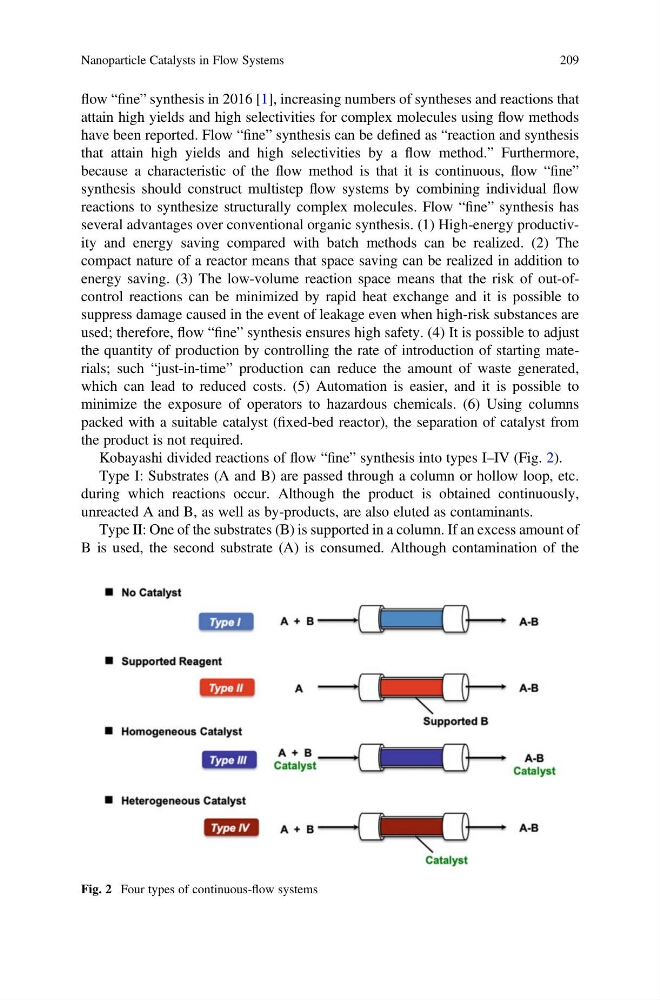
Kobayashi divided reactions of flow “fine” synthesis into types I–IV (Fig. 2).
Type I: Substrates (A and B) are passed through a column or hollow loop, etc.
during which reactions occur. Although the product is obtained continuously,
unreacted A and B, as well as by-products, are also eluted as contaminants.
Type II: One of the substrates (B) is supported in a column. If an excess amount of
B is used, the second substrate (A) is consumed. Although contamination of the
Fig. 2 Four types of continuous-flow systems
Nanoparticle Catalysts in Flow Systems
209
attain high yields and high selectivities for complex molecules using flow methods
have been reported. Flow “fine” synthesis can be defined as “reaction and synthesis
that attain high yields and high selectivities by a flow method.” Furthermore,
because a characteristic of the flow method is that it is continuous, flow “fine”
synthesis should construct multistep flow systems by combining individual flow
reactions to synthesize structurally complex molecules. Flow “fine” synthesis has
several advantages over conventional organic synthesis. (1) High-energy productivity and energy saving compared with batch methods can be realized. (2) The
compact nature of a reactor means that space saving can be realized in addition to
energy saving. (3) The low-volume reaction space means that the risk of out-ofcontrol reactions can be minimized by rapid heat exchange and it is possible to
suppress damage caused in the event of leakage even when high-risk substances are
used; therefore, flow “fine” synthesis ensures high safety. (4) It is possible to adjust
the quantity of production by controlling the rate of introduction of starting materials; such “just-in-time” production can reduce the amount of waste generated,
which can lead to reduced costs. (5) Automation is easier, and it is possible to
minimize the exposure of operators to hazardous chemicals. (6) Using columns
packed with a suitable catalyst (fixed-bed reactor), the separation of catalyst from
the product is not required.
Kobayashi divided reactions of flow “fine” synthesis into types I–IV (Fig. 2).
Type I: Substrates (A and B) are passed through a column or hollow loop, etc.
during which reactions occur. Although the product is obtained continuously,
unreacted A and B, as well as by-products, are also eluted as contaminants.
Type II: One of the substrates (B) is supported in a column. If an excess amount of
B is used, the second substrate (A) is consumed. Although contamination of the
Fig. 2 Four types of continuous-flow systems
Nanoparticle Catalysts in Flow Systems
209