

synthesis of biologically active compounds such as active pharmaceutical ingredients (APIs) and natural products.
Keywords Continuous-flow reaction · Heterogeneous catalyst · Packed-bed reactor
1 Introduction: Nanoparticles as Heterogeneous Catalysts
in Flow “Fine” Synthesis
Modern organic synthesis, the so-called fine organic synthesis, is used for the
synthesis of a wide range of useful compounds, and many synthetic reactions can
be used to achieve high yields and selectivities. These chemical syntheses are mainly
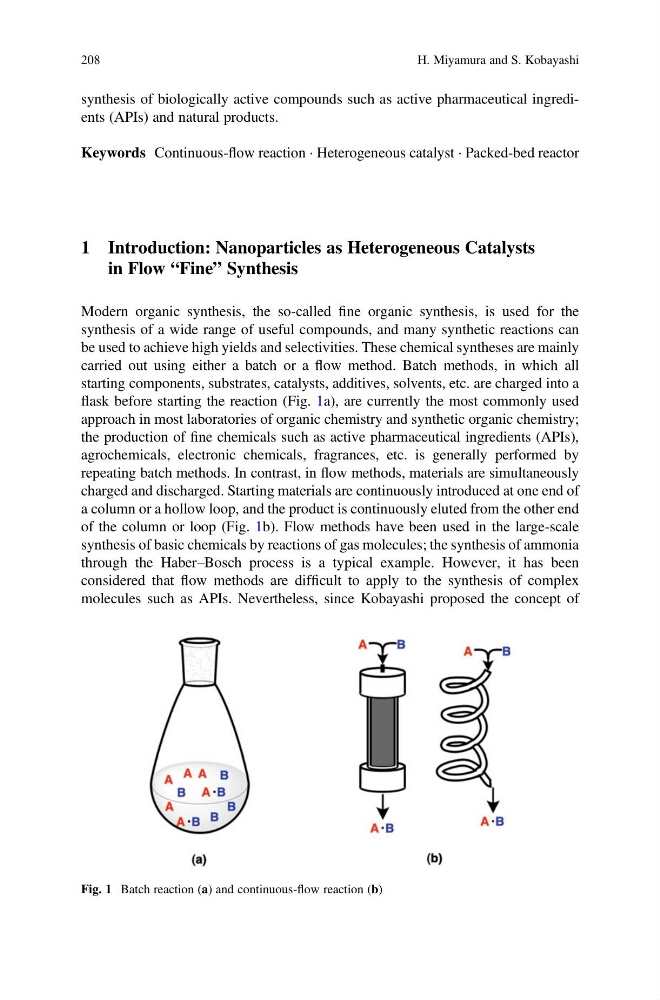
carried out using either a batch or a flow method. Batch methods, in which all
starting components, substrates, catalysts, additives, solvents, etc. are charged into a
flask before starting the reaction (Fig. 1a), are currently the most commonly used
approach in most laboratories of organic chemistry and synthetic organic chemistry;
the production of fine chemicals such as active pharmaceutical ingredients (APIs),
agrochemicals, electronic chemicals, fragrances, etc. is generally performed by
repeating batch methods. In contrast, in flow methods, materials are simultaneously
charged and discharged. Starting materials are continuously introduced at one end of
a column or a hollow loop, and the product is continuously eluted from the other end
of the column or loop (Fig. 1b). Flow methods have been used in the large-scale
synthesis of basic chemicals by reactions of gas molecules; the synthesis of ammonia
through the Haber–Bosch process is a typical example. However, it has been
considered that flow methods are difficult to apply to the synthesis of complex
molecules such as APIs. Nevertheless, since Kobayashi proposed the concept of
Fig. 1 Batch reaction (a) and continuous-flow reaction (b)
208
H. Miyamura and S. Kobayashi
Keywords Continuous-flow reaction · Heterogeneous catalyst · Packed-bed reactor
1 Introduction: Nanoparticles as Heterogeneous Catalysts
in Flow “Fine” Synthesis
Modern organic synthesis, the so-called fine organic synthesis, is used for the
synthesis of a wide range of useful compounds, and many synthetic reactions can
be used to achieve high yields and selectivities. These chemical syntheses are mainly
carried out using either a batch or a flow method. Batch methods, in which all
starting components, substrates, catalysts, additives, solvents, etc. are charged into a
flask before starting the reaction (Fig. 1a), are currently the most commonly used
approach in most laboratories of organic chemistry and synthetic organic chemistry;
the production of fine chemicals such as active pharmaceutical ingredients (APIs),
agrochemicals, electronic chemicals, fragrances, etc. is generally performed by
repeating batch methods. In contrast, in flow methods, materials are simultaneously
charged and discharged. Starting materials are continuously introduced at one end of
a column or a hollow loop, and the product is continuously eluted from the other end
of the column or loop (Fig. 1b). Flow methods have been used in the large-scale
synthesis of basic chemicals by reactions of gas molecules; the synthesis of ammonia
through the Haber–Bosch process is a typical example. However, it has been
considered that flow methods are difficult to apply to the synthesis of complex
molecules such as APIs. Nevertheless, since Kobayashi proposed the concept of
Fig. 1 Batch reaction (a) and continuous-flow reaction (b)
208
H. Miyamura and S. Kobayashi