

5.6 Case Study VI) Development and Optimisation
of Conditions for Pd/C-Catalysed Site-Selective C–H
Activation Reactions
It is well-established that Pd/C can be used as a heterogeneous hydrogenation
catalyst, but only relatively recently has Pd/C seen application in cross-couplings
involving C–H bond functionalisation. To this end, Glorius et al. have recently led
the way. Methodologies for direct C–H arylation at benzothiophenes were discovered and later developed and optimised, expanding the scope to a wider variety of
heterocyclic coupling partners. These conditions were later adapted for the C–H
arylation of polyaromatic hydrocarbon compounds.
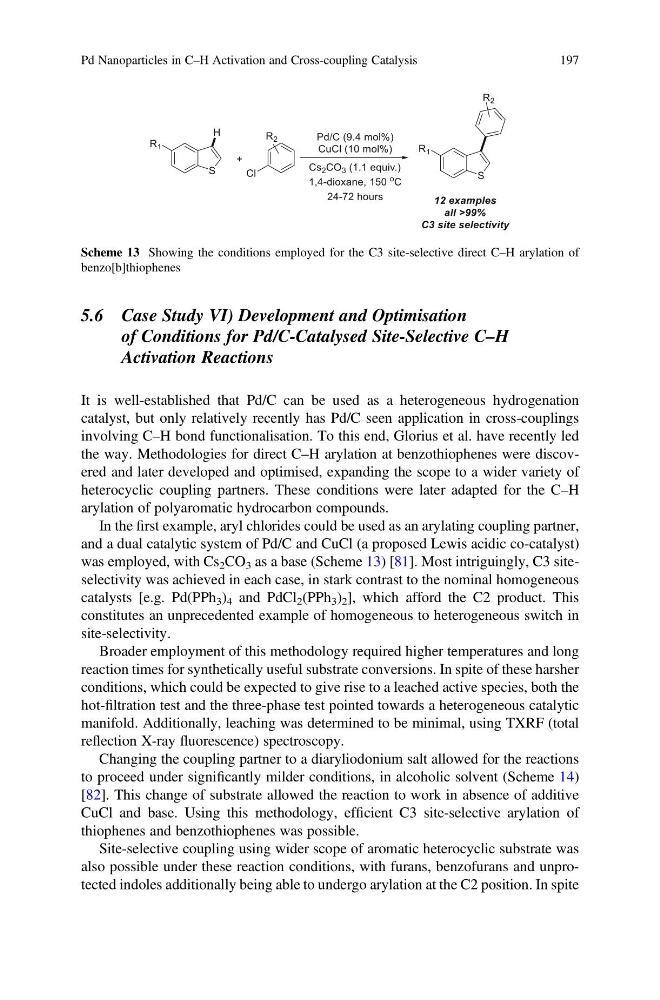
In the first example, aryl chlorides could be used as an arylating coupling partner,
and a dual catalytic system of Pd/C and CuCl (a proposed Lewis acidic co-catalyst)
was employed, with Cs 2 CO 3 as a base (Scheme 13) [81]. Most intriguingly, C3 siteselectivity was achieved in each case, in stark contrast to the nominal homogeneous
catalysts [e.g. Pd(PPh 3 ) 4 and PdCl 2 (PPh 3 ) 2 ], which afford the C2 product. This
constitutes an unprecedented example of homogeneous to heterogeneous switch in
site-selectivity.
Broader employment of this methodology required higher temperatures and long
reaction times for synthetically useful substrate conversions. In spite of these harsher
conditions, which could be expected to give rise to a leached active species, both the
hot-filtration test and the three-phase test pointed towards a heterogeneous catalytic
manifold. Additionally, leaching was determined to be minimal, using TXRF (total
reflection X-ray fluorescence) spectroscopy.
Changing the coupling partner to a diaryliodonium salt allowed for the reactions
to proceed under significantly milder conditions, in alcoholic solvent (Scheme 14)
[82]. This change of substrate allowed the reaction to work in absence of additive
CuCl and base. Using this methodology, efficient C3 site-selective arylation of
thiophenes and benzothiophenes was possible.
Site-selective coupling using wider scope of aromatic heterocyclic substrate was
also possible under these reaction conditions, with furans, benzofurans and unprotected indoles additionally being able to undergo arylation at the C2 position. In spite
Scheme 13 Showing the conditions employed for the C3 site-selective direct C–H arylation of
benzo[b]thiophenes
Pd Nanoparticles in C–H Activation and Cross-coupling Catalysis
197
of Conditions for Pd/C-Catalysed Site-Selective C–H
Activation Reactions
It is well-established that Pd/C can be used as a heterogeneous hydrogenation
catalyst, but only relatively recently has Pd/C seen application in cross-couplings
involving C–H bond functionalisation. To this end, Glorius et al. have recently led
the way. Methodologies for direct C–H arylation at benzothiophenes were discovered and later developed and optimised, expanding the scope to a wider variety of
heterocyclic coupling partners. These conditions were later adapted for the C–H
arylation of polyaromatic hydrocarbon compounds.
In the first example, aryl chlorides could be used as an arylating coupling partner,
and a dual catalytic system of Pd/C and CuCl (a proposed Lewis acidic co-catalyst)
was employed, with Cs 2 CO 3 as a base (Scheme 13) [81]. Most intriguingly, C3 siteselectivity was achieved in each case, in stark contrast to the nominal homogeneous
catalysts [e.g. Pd(PPh 3 ) 4 and PdCl 2 (PPh 3 ) 2 ], which afford the C2 product. This
constitutes an unprecedented example of homogeneous to heterogeneous switch in
site-selectivity.
Broader employment of this methodology required higher temperatures and long
reaction times for synthetically useful substrate conversions. In spite of these harsher
conditions, which could be expected to give rise to a leached active species, both the
hot-filtration test and the three-phase test pointed towards a heterogeneous catalytic
manifold. Additionally, leaching was determined to be minimal, using TXRF (total
reflection X-ray fluorescence) spectroscopy.
Changing the coupling partner to a diaryliodonium salt allowed for the reactions
to proceed under significantly milder conditions, in alcoholic solvent (Scheme 14)
[82]. This change of substrate allowed the reaction to work in absence of additive
CuCl and base. Using this methodology, efficient C3 site-selective arylation of
thiophenes and benzothiophenes was possible.
Site-selective coupling using wider scope of aromatic heterocyclic substrate was
also possible under these reaction conditions, with furans, benzofurans and unprotected indoles additionally being able to undergo arylation at the C2 position. In spite
Scheme 13 Showing the conditions employed for the C3 site-selective direct C–H arylation of
benzo[b]thiophenes
Pd Nanoparticles in C–H Activation and Cross-coupling Catalysis
197