

of the highly oxidising reaction conditions employed (which may be expected to
result in oxidative leaching of metal), standard heterogeneity tests (Hg-poisoning
test, the three-phase test and the hot-filtration test) all point towards a heterogeneous
active catalyst. After each catalyst use, yields dropped by 41%, indicating a severe
change in catalyst morphology after a single cycle.
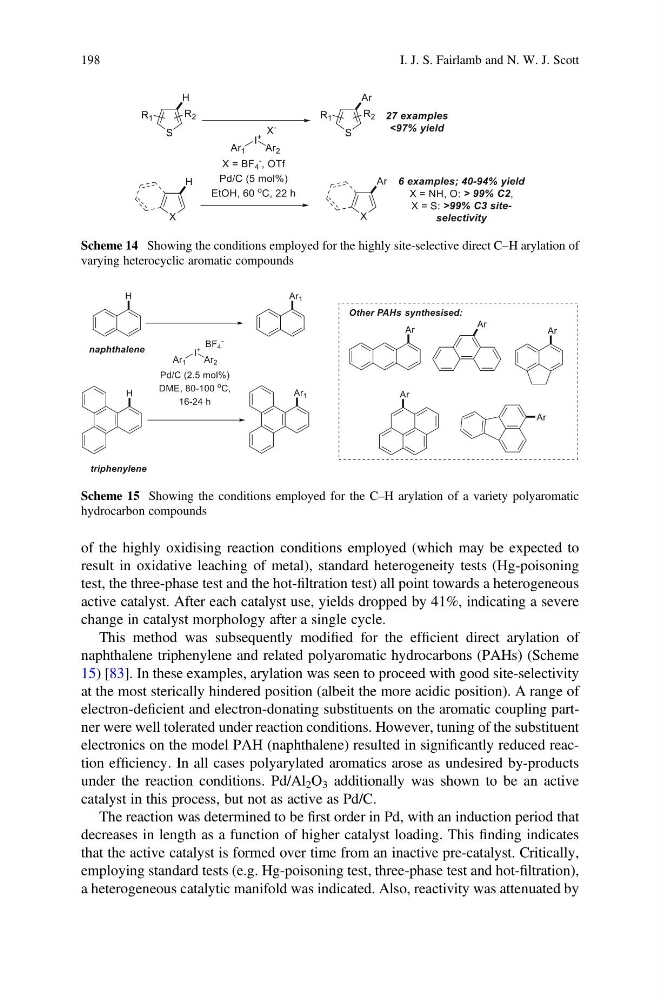
This method was subsequently modified for the efficient direct arylation of
naphthalene triphenylene and related polyaromatic hydrocarbons (PAHs) (Scheme
15) [83]. In these examples, arylation was seen to proceed with good site-selectivity
at the most sterically hindered position (albeit the more acidic position). A range of
electron-deficient and electron-donating substituents on the aromatic coupling partner were well tolerated under reaction conditions. However, tuning of the substituent
electronics on the model PAH (naphthalene) resulted in significantly reduced reaction efficiency. In all cases polyarylated aromatics arose as undesired by-products
under the reaction conditions. Pd/Al 2 O 3 additionally was shown to be an active
catalyst in this process, but not as active as Pd/C.
The reaction was determined to be first order in Pd, with an induction period that
decreases in length as a function of higher catalyst loading. This finding indicates
that the active catalyst is formed over time from an inactive pre-catalyst. Critically,
employing standard tests (e.g. Hg-poisoning test, three-phase test and hot-filtration),
a heterogeneous catalytic manifold was indicated. Also, reactivity was attenuated by
Scheme 14 Showing the conditions employed for the highly site-selective direct C–H arylation of
varying heterocyclic aromatic compounds
Scheme 15 Showing the conditions employed for the C–H arylation of a variety polyaromatic
hydrocarbon compounds
198
I. J. S. Fairlamb and N. W. J. Scott
result in oxidative leaching of metal), standard heterogeneity tests (Hg-poisoning
test, the three-phase test and the hot-filtration test) all point towards a heterogeneous
active catalyst. After each catalyst use, yields dropped by 41%, indicating a severe
change in catalyst morphology after a single cycle.
This method was subsequently modified for the efficient direct arylation of
naphthalene triphenylene and related polyaromatic hydrocarbons (PAHs) (Scheme
15) [83]. In these examples, arylation was seen to proceed with good site-selectivity
at the most sterically hindered position (albeit the more acidic position). A range of
electron-deficient and electron-donating substituents on the aromatic coupling partner were well tolerated under reaction conditions. However, tuning of the substituent
electronics on the model PAH (naphthalene) resulted in significantly reduced reaction efficiency. In all cases polyarylated aromatics arose as undesired by-products
under the reaction conditions. Pd/Al 2 O 3 additionally was shown to be an active
catalyst in this process, but not as active as Pd/C.
The reaction was determined to be first order in Pd, with an induction period that
decreases in length as a function of higher catalyst loading. This finding indicates
that the active catalyst is formed over time from an inactive pre-catalyst. Critically,
employing standard tests (e.g. Hg-poisoning test, three-phase test and hot-filtration),
a heterogeneous catalytic manifold was indicated. Also, reactivity was attenuated by
Scheme 14 Showing the conditions employed for the highly site-selective direct C–H arylation of
varying heterocyclic aromatic compounds
Scheme 15 Showing the conditions employed for the C–H arylation of a variety polyaromatic
hydrocarbon compounds
198
I. J. S. Fairlamb and N. W. J. Scott