

The catalyst system was prepared by NaBH 4 reduction of PdCl 2 in the presence
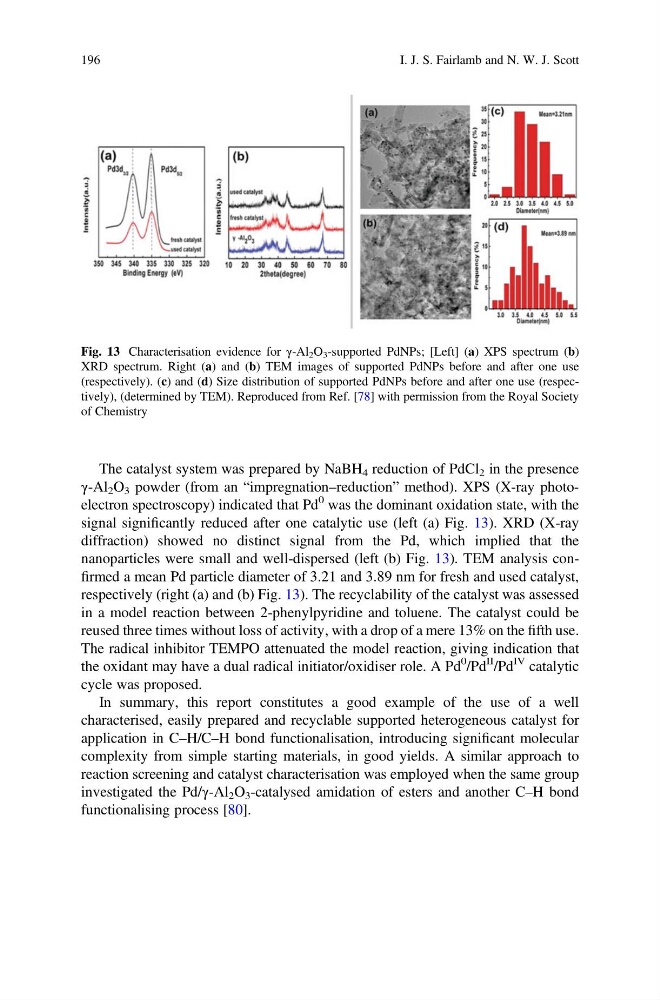
γ-Al 2 O 3 powder (from an “impregnation–reduction” method). XPS (X-ray photoelectron spectroscopy) indicated that Pd
0 was the dominant oxidation state, with the
signal significantly reduced after one catalytic use (left (a) Fig. 13). XRD (X-ray
diffraction) showed no distinct signal from the Pd, which implied that the
nanoparticles were small and well-dispersed (left (b) Fig. 13). TEM analysis confirmed a mean Pd particle diameter of 3.21 and 3.89 nm for fresh and used catalyst,
respectively (right (a) and (b) Fig. 13). The recyclability of the catalyst was assessed
in a model reaction between 2-phenylpyridine and toluene. The catalyst could be
reused three times without loss of activity, with a drop of a mere 13% on the fifth use.
The radical inhibitor TEMPO attenuated the model reaction, giving indication that
the oxidant may have a dual radical initiator/oxidiser role. A Pd
0 /Pd
II /Pd
IV catalytic
cycle was proposed.
In summary, this report constitutes a good example of the use of a well
characterised, easily prepared and recyclable supported heterogeneous catalyst for
application in C–H/C–H bond functionalisation, introducing significant molecular
complexity from simple starting materials, in good yields. A similar approach to
reaction screening and catalyst characterisation was employed when the same group
investigated the Pd/γ-Al 2 O 3 -catalysed amidation of esters and another C–H bond
functionalising process [80].
Fig. 13 Characterisation evidence for γ-Al 2 O 3 -supported PdNPs; [Left] (a) XPS spectrum (b)
XRD spectrum. Right (a) and (b) TEM images of supported PdNPs before and after one use
(respectively). (c) and (d) Size distribution of supported PdNPs before and after one use (respectively), (determined by TEM). Reproduced from Ref. [78] with permission from the Royal Society
of Chemistry
196
I. J. S. Fairlamb and N. W. J. Scott
γ-Al 2 O 3 powder (from an “impregnation–reduction” method). XPS (X-ray photoelectron spectroscopy) indicated that Pd
0 was the dominant oxidation state, with the
signal significantly reduced after one catalytic use (left (a) Fig. 13). XRD (X-ray
diffraction) showed no distinct signal from the Pd, which implied that the
nanoparticles were small and well-dispersed (left (b) Fig. 13). TEM analysis confirmed a mean Pd particle diameter of 3.21 and 3.89 nm for fresh and used catalyst,
respectively (right (a) and (b) Fig. 13). The recyclability of the catalyst was assessed
in a model reaction between 2-phenylpyridine and toluene. The catalyst could be
reused three times without loss of activity, with a drop of a mere 13% on the fifth use.
The radical inhibitor TEMPO attenuated the model reaction, giving indication that
the oxidant may have a dual radical initiator/oxidiser role. A Pd
0 /Pd
II /Pd
IV catalytic
cycle was proposed.
In summary, this report constitutes a good example of the use of a well
characterised, easily prepared and recyclable supported heterogeneous catalyst for
application in C–H/C–H bond functionalisation, introducing significant molecular
complexity from simple starting materials, in good yields. A similar approach to
reaction screening and catalyst characterisation was employed when the same group
investigated the Pd/γ-Al 2 O 3 -catalysed amidation of esters and another C–H bond
functionalising process [80].
Fig. 13 Characterisation evidence for γ-Al 2 O 3 -supported PdNPs; [Left] (a) XPS spectrum (b)
XRD spectrum. Right (a) and (b) TEM images of supported PdNPs before and after one use
(respectively). (c) and (d) Size distribution of supported PdNPs before and after one use (respectively), (determined by TEM). Reproduced from Ref. [78] with permission from the Royal Society
of Chemistry
196
I. J. S. Fairlamb and N. W. J. Scott