

This study demonstrates the catalyst efficacy of PdNPs on a well-characterised
organic framework which could effectively catalyse direct C–H arylations in a range
of pharmaceutically relevant substrates.
5.5 Case Study V) 2-Arylpyridine Coupling with Alkylbenzene
PdNPs on a γ-Al 2 O 3 Support
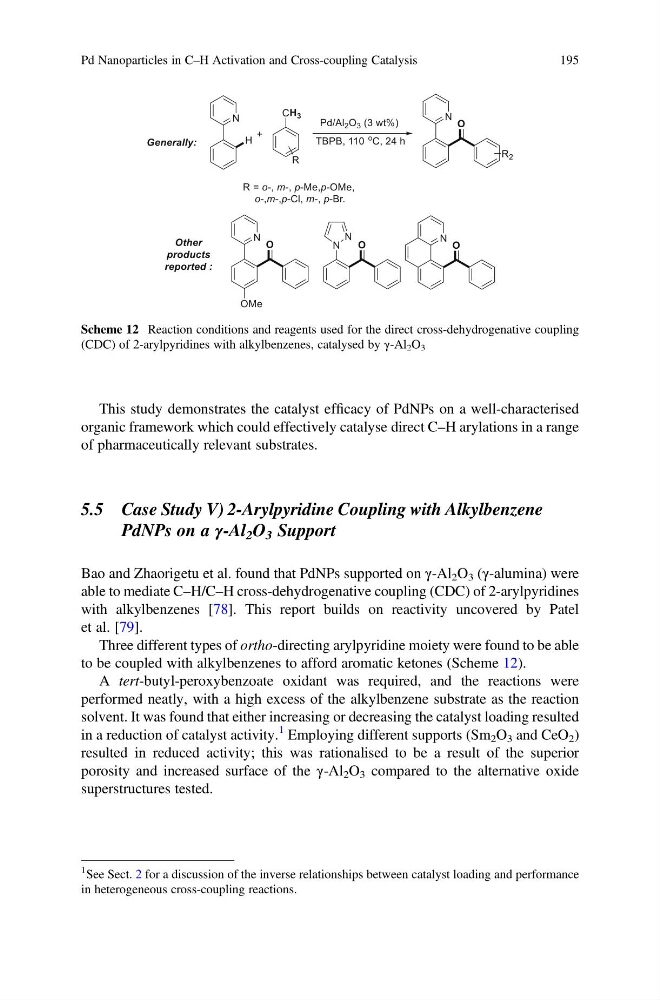
Bao and Zhaorigetu et al. found that PdNPs supported on γ-Al 2 O 3 (γ-alumina) were
able to mediate C–H/C–H cross-dehydrogenative coupling (CDC) of 2-arylpyridines
with alkylbenzenes [78]. This report builds on reactivity uncovered by Patel
et al. [79].
Three different types of ortho-directing arylpyridine moiety were found to be able
to be coupled with alkylbenzenes to afford aromatic ketones (Scheme 12).
A tert-butyl-peroxybenzoate oxidant was required, and the reactions were
performed neatly, with a high excess of the alkylbenzene substrate as the reaction
solvent. It was found that either increasing or decreasing the catalyst loading resulted
in a reduction of catalyst activity.
1 Employing different supports (Sm 2 O 3 and CeO 2 )
resulted in reduced activity; this was rationalised to be a result of the superior
porosity and increased surface of the γ-Al 2 O 3 compared to the alternative oxide
superstructures tested.
Scheme 12 Reaction conditions and reagents used for the direct cross-dehydrogenative coupling
(CDC) of 2-arylpyridines with alkylbenzenes, catalysed by γ-Al 2 O 3
1 See Sect. 2 for a discussion of the inverse relationships between catalyst loading and performance
in heterogeneous cross-coupling reactions.
Pd Nanoparticles in C–H Activation and Cross-coupling Catalysis
195
organic framework which could effectively catalyse direct C–H arylations in a range
of pharmaceutically relevant substrates.
5.5 Case Study V) 2-Arylpyridine Coupling with Alkylbenzene
PdNPs on a γ-Al 2 O 3 Support
Bao and Zhaorigetu et al. found that PdNPs supported on γ-Al 2 O 3 (γ-alumina) were
able to mediate C–H/C–H cross-dehydrogenative coupling (CDC) of 2-arylpyridines
with alkylbenzenes [78]. This report builds on reactivity uncovered by Patel
et al. [79].
Three different types of ortho-directing arylpyridine moiety were found to be able
to be coupled with alkylbenzenes to afford aromatic ketones (Scheme 12).
A tert-butyl-peroxybenzoate oxidant was required, and the reactions were
performed neatly, with a high excess of the alkylbenzene substrate as the reaction
solvent. It was found that either increasing or decreasing the catalyst loading resulted
in a reduction of catalyst activity.
1 Employing different supports (Sm 2 O 3 and CeO 2 )
resulted in reduced activity; this was rationalised to be a result of the superior
porosity and increased surface of the γ-Al 2 O 3 compared to the alternative oxide
superstructures tested.
Scheme 12 Reaction conditions and reagents used for the direct cross-dehydrogenative coupling
(CDC) of 2-arylpyridines with alkylbenzenes, catalysed by γ-Al 2 O 3
1 See Sect. 2 for a discussion of the inverse relationships between catalyst loading and performance
in heterogeneous cross-coupling reactions.
Pd Nanoparticles in C–H Activation and Cross-coupling Catalysis
195