

the 5-position [77]. N-Me-imidazoles could additionally be coupled with both
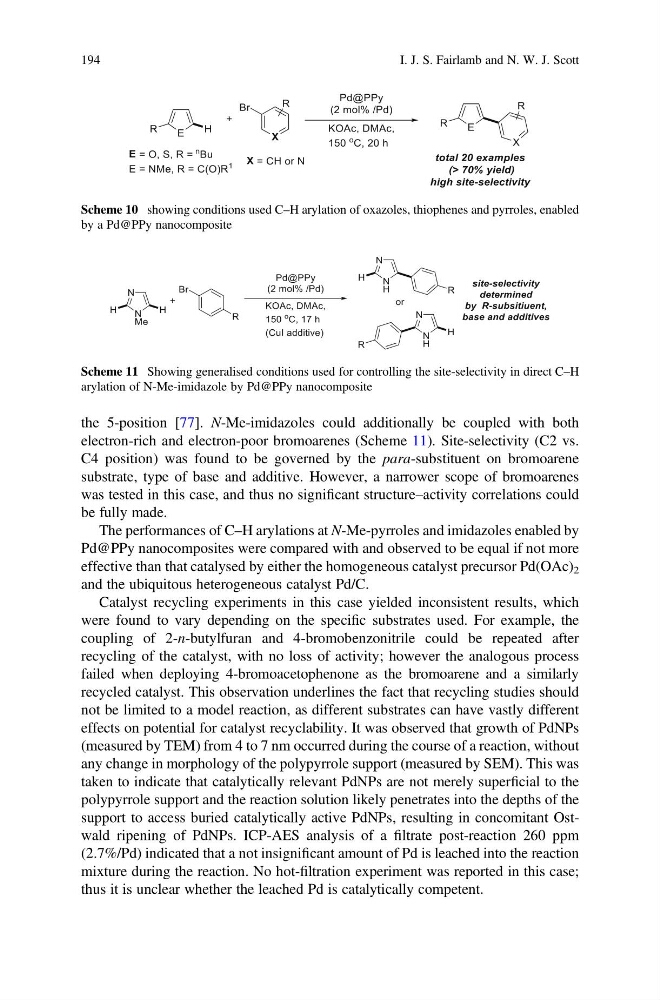
electron-rich and electron-poor bromoarenes (Scheme 11). Site-selectivity (C2 vs.
C4 position) was found to be governed by the para-substituent on bromoarene
substrate, type of base and additive. However, a narrower scope of bromoarenes
was tested in this case, and thus no significant structure–activity correlations could
be fully made.
The performances of C–H arylations at N-Me-pyrroles and imidazoles enabled by
Pd@PPy nanocomposites were compared with and observed to be equal if not more
effective than that catalysed by either the homogeneous catalyst precursor Pd(OAc) 2
and the ubiquitous heterogeneous catalyst Pd/C.
Catalyst recycling experiments in this case yielded inconsistent results, which
were found to vary depending on the specific substrates used. For example, the
coupling of 2-n-butylfuran and 4-bromobenzonitrile could be repeated after
recycling of the catalyst, with no loss of activity; however the analogous process
failed when deploying 4-bromoacetophenone as the bromoarene and a similarly
recycled catalyst. This observation underlines the fact that recycling studies should
not be limited to a model reaction, as different substrates can have vastly different
effects on potential for catalyst recyclability. It was observed that growth of PdNPs
(measured by TEM) from 4 to 7 nm occurred during the course of a reaction, without
any change in morphology of the polypyrrole support (measured by SEM). This was
taken to indicate that catalytically relevant PdNPs are not merely superficial to the
polypyrrole support and the reaction solution likely penetrates into the depths of the
support to access buried catalytically active PdNPs, resulting in concomitant Ostwald ripening of PdNPs. ICP-AES analysis of a filtrate post-reaction 260 ppm
(2.7%/Pd) indicated that a not insignificant amount of Pd is leached into the reaction
mixture during the reaction. No hot-filtration experiment was reported in this case;
thus it is unclear whether the leached Pd is catalytically competent.
Scheme 10 showing conditions used C–H arylation of oxazoles, thiophenes and pyrroles, enabled
by a Pd@PPy nanocomposite
Scheme 11 Showing generalised conditions used for controlling the site-selectivity in direct C–H
arylation of N-Me-imidazole by Pd@PPy nanocomposite
194
I. J. S. Fairlamb and N. W. J. Scott
electron-rich and electron-poor bromoarenes (Scheme 11). Site-selectivity (C2 vs.
C4 position) was found to be governed by the para-substituent on bromoarene
substrate, type of base and additive. However, a narrower scope of bromoarenes
was tested in this case, and thus no significant structure–activity correlations could
be fully made.
The performances of C–H arylations at N-Me-pyrroles and imidazoles enabled by
Pd@PPy nanocomposites were compared with and observed to be equal if not more
effective than that catalysed by either the homogeneous catalyst precursor Pd(OAc) 2
and the ubiquitous heterogeneous catalyst Pd/C.
Catalyst recycling experiments in this case yielded inconsistent results, which
were found to vary depending on the specific substrates used. For example, the
coupling of 2-n-butylfuran and 4-bromobenzonitrile could be repeated after
recycling of the catalyst, with no loss of activity; however the analogous process
failed when deploying 4-bromoacetophenone as the bromoarene and a similarly
recycled catalyst. This observation underlines the fact that recycling studies should
not be limited to a model reaction, as different substrates can have vastly different
effects on potential for catalyst recyclability. It was observed that growth of PdNPs
(measured by TEM) from 4 to 7 nm occurred during the course of a reaction, without
any change in morphology of the polypyrrole support (measured by SEM). This was
taken to indicate that catalytically relevant PdNPs are not merely superficial to the
polypyrrole support and the reaction solution likely penetrates into the depths of the
support to access buried catalytically active PdNPs, resulting in concomitant Ostwald ripening of PdNPs. ICP-AES analysis of a filtrate post-reaction 260 ppm
(2.7%/Pd) indicated that a not insignificant amount of Pd is leached into the reaction
mixture during the reaction. No hot-filtration experiment was reported in this case;
thus it is unclear whether the leached Pd is catalytically competent.
Scheme 10 showing conditions used C–H arylation of oxazoles, thiophenes and pyrroles, enabled
by a Pd@PPy nanocomposite
Scheme 11 Showing generalised conditions used for controlling the site-selectivity in direct C–H
arylation of N-Me-imidazole by Pd@PPy nanocomposite
194
I. J. S. Fairlamb and N. W. J. Scott