

5-membered heteroarenes [75–77]. The catalyst was easily prepared in water by
reduction of Pd
II (NH 3 ) 4 Cl 2 in the presence of excess pyrrole (a reductant), with
sonication. This procedure affords a highly nanoparticulate, high Pd loading material
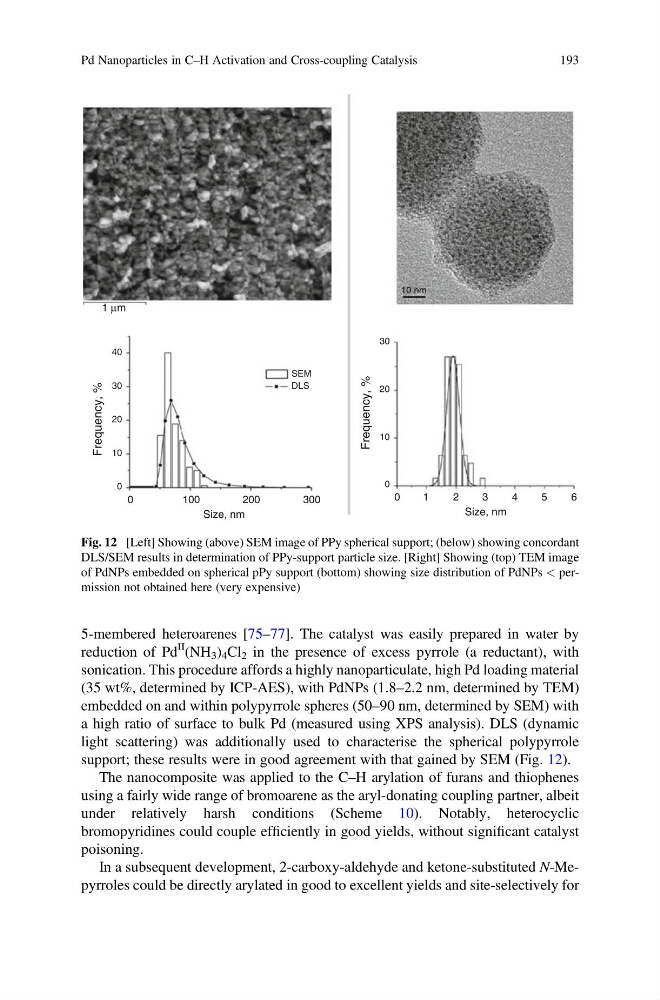
(35 wt%, determined by ICP-AES), with PdNPs (1.8–2.2 nm, determined by TEM)
embedded on and within polypyrrole spheres (50–90 nm, determined by SEM) with
a high ratio of surface to bulk Pd (measured using XPS analysis). DLS (dynamic
light scattering) was additionally used to characterise the spherical polypyrrole
support; these results were in good agreement with that gained by SEM (Fig. 12).
The nanocomposite was applied to the C–H arylation of furans and thiophenes
using a fairly wide range of bromoarene as the aryl-donating coupling partner, albeit
under relatively harsh conditions (Scheme 10). Notably, heterocyclic
bromopyridines could couple efficiently in good yields, without significant catalyst
poisoning.
In a subsequent development, 2-carboxy-aldehyde and ketone-substituted N-Mepyrroles could be directly arylated in good to excellent yields and site-selectively for
10 nm
30
20
10
0
0
1
2
3
4
5
6
1 µm
40
30
20
10
0
0
100
200
300
Size, nm
Size, nm
Frequency, %
Frequency, %
SEM
DLS
Fig. 12 [Left] Showing (above) SEM image of PPy spherical support; (below) showing concordant
DLS/SEM results in determination of PPy-support particle size. [Right] Showing (top) TEM image
of PdNPs embedded on spherical pPy support (bottom) showing size distribution of PdNPs < permission not obtained here (very expensive)
Pd Nanoparticles in C–H Activation and Cross-coupling Catalysis
193
reduction of Pd
II (NH 3 ) 4 Cl 2 in the presence of excess pyrrole (a reductant), with
sonication. This procedure affords a highly nanoparticulate, high Pd loading material
(35 wt%, determined by ICP-AES), with PdNPs (1.8–2.2 nm, determined by TEM)
embedded on and within polypyrrole spheres (50–90 nm, determined by SEM) with
a high ratio of surface to bulk Pd (measured using XPS analysis). DLS (dynamic
light scattering) was additionally used to characterise the spherical polypyrrole
support; these results were in good agreement with that gained by SEM (Fig. 12).
The nanocomposite was applied to the C–H arylation of furans and thiophenes
using a fairly wide range of bromoarene as the aryl-donating coupling partner, albeit
under relatively harsh conditions (Scheme 10). Notably, heterocyclic
bromopyridines could couple efficiently in good yields, without significant catalyst
poisoning.
In a subsequent development, 2-carboxy-aldehyde and ketone-substituted N-Mepyrroles could be directly arylated in good to excellent yields and site-selectively for
10 nm
30
20
10
0
0
1
2
3
4
5
6
1 µm
40
30
20
10
0
0
100
200
300
Size, nm
Size, nm
Frequency, %
Frequency, %
SEM
DLS
Fig. 12 [Left] Showing (above) SEM image of PPy spherical support; (below) showing concordant
DLS/SEM results in determination of PPy-support particle size. [Right] Showing (top) TEM image
of PdNPs embedded on spherical pPy support (bottom) showing size distribution of PdNPs < permission not obtained here (very expensive)
Pd Nanoparticles in C–H Activation and Cross-coupling Catalysis
193