

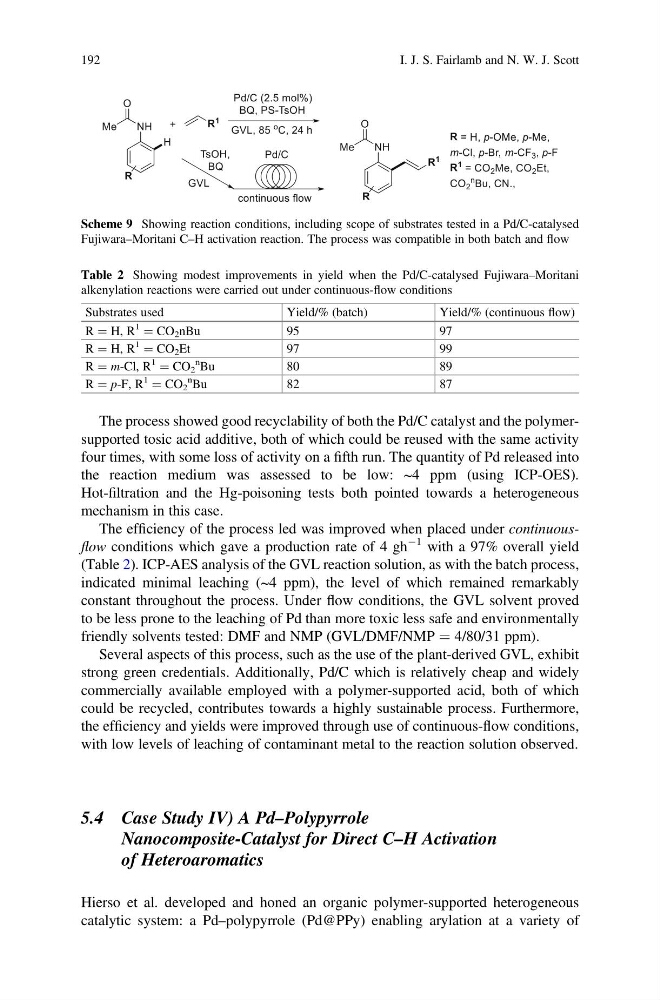
The process showed good recyclability of both the Pd/C catalyst and the polymersupported tosic acid additive, both of which could be reused with the same activity
four times, with some loss of activity on a fifth run. The quantity of Pd released into
the reaction medium was assessed to be low: ~4 ppm (using ICP-OES).
Hot-filtration and the Hg-poisoning tests both pointed towards a heterogeneous
mechanism in this case.
The efficiency of the process led was improved when placed under continuousflow conditions which gave a production rate of 4 gh
À1 with a 97% overall yield
(Table 2). ICP-AES analysis of the GVL reaction solution, as with the batch process,
indicated minimal leaching (~4 ppm), the level of which remained remarkably
constant throughout the process. Under flow conditions, the GVL solvent proved
to be less prone to the leaching of Pd than more toxic less safe and environmentally
friendly solvents tested: DMF and NMP (GVL/DMF/NMP ¼ 4/80/31 ppm).
Several aspects of this process, such as the use of the plant-derived GVL, exhibit
strong green credentials. Additionally, Pd/C which is relatively cheap and widely
commercially available employed with a polymer-supported acid, both of which
could be recycled, contributes towards a highly sustainable process. Furthermore,
the efficiency and yields were improved through use of continuous-flow conditions,
with low levels of leaching of contaminant metal to the reaction solution observed.
5.4 Case Study IV) A Pd–Polypyrrole
Nanocomposite-Catalyst for Direct C–H Activation
of Heteroaromatics
Hierso et al. developed and honed an organic polymer-supported heterogeneous
catalytic system: a Pd–polypyrrole (Pd@PPy) enabling arylation at a variety of
Scheme 9 Showing reaction conditions, including scope of substrates tested in a Pd/C-catalysed
Fujiwara–Moritani C–H activation reaction. The process was compatible in both batch and flow
Table 2 Showing modest improvements in yield when the Pd/C-catalysed Fujiwara–Moritani
alkenylation reactions were carried out under continuous-flow conditions
Substrates used
Yield/% (batch)
Yield/% (continuous flow)
R ¼ H, R
1 ¼ CO 2 nBu
95
97
R ¼ H, R
1 ¼ CO 2 Et
97
99
R ¼ m-Cl, R
1 ¼ CO 2
n
Bu
80
89
R ¼ p-F, R
1 ¼ CO 2
n
Bu
82
87
192
I. J. S. Fairlamb and N. W. J. Scott
four times, with some loss of activity on a fifth run. The quantity of Pd released into
the reaction medium was assessed to be low: ~4 ppm (using ICP-OES).
Hot-filtration and the Hg-poisoning tests both pointed towards a heterogeneous
mechanism in this case.
The efficiency of the process led was improved when placed under continuousflow conditions which gave a production rate of 4 gh
À1 with a 97% overall yield
(Table 2). ICP-AES analysis of the GVL reaction solution, as with the batch process,
indicated minimal leaching (~4 ppm), the level of which remained remarkably
constant throughout the process. Under flow conditions, the GVL solvent proved
to be less prone to the leaching of Pd than more toxic less safe and environmentally
friendly solvents tested: DMF and NMP (GVL/DMF/NMP ¼ 4/80/31 ppm).
Several aspects of this process, such as the use of the plant-derived GVL, exhibit
strong green credentials. Additionally, Pd/C which is relatively cheap and widely
commercially available employed with a polymer-supported acid, both of which
could be recycled, contributes towards a highly sustainable process. Furthermore,
the efficiency and yields were improved through use of continuous-flow conditions,
with low levels of leaching of contaminant metal to the reaction solution observed.
5.4 Case Study IV) A Pd–Polypyrrole
Nanocomposite-Catalyst for Direct C–H Activation
of Heteroaromatics
Hierso et al. developed and honed an organic polymer-supported heterogeneous
catalytic system: a Pd–polypyrrole (Pd@PPy) enabling arylation at a variety of
Scheme 9 Showing reaction conditions, including scope of substrates tested in a Pd/C-catalysed
Fujiwara–Moritani C–H activation reaction. The process was compatible in both batch and flow
Table 2 Showing modest improvements in yield when the Pd/C-catalysed Fujiwara–Moritani
alkenylation reactions were carried out under continuous-flow conditions
Substrates used
Yield/% (batch)
Yield/% (continuous flow)
R ¼ H, R
1 ¼ CO 2 nBu
95
97
R ¼ H, R
1 ¼ CO 2 Et
97
99
R ¼ m-Cl, R
1 ¼ CO 2
n
Bu
80
89
R ¼ p-F, R
1 ¼ CO 2
n
Bu
82
87
192
I. J. S. Fairlamb and N. W. J. Scott