

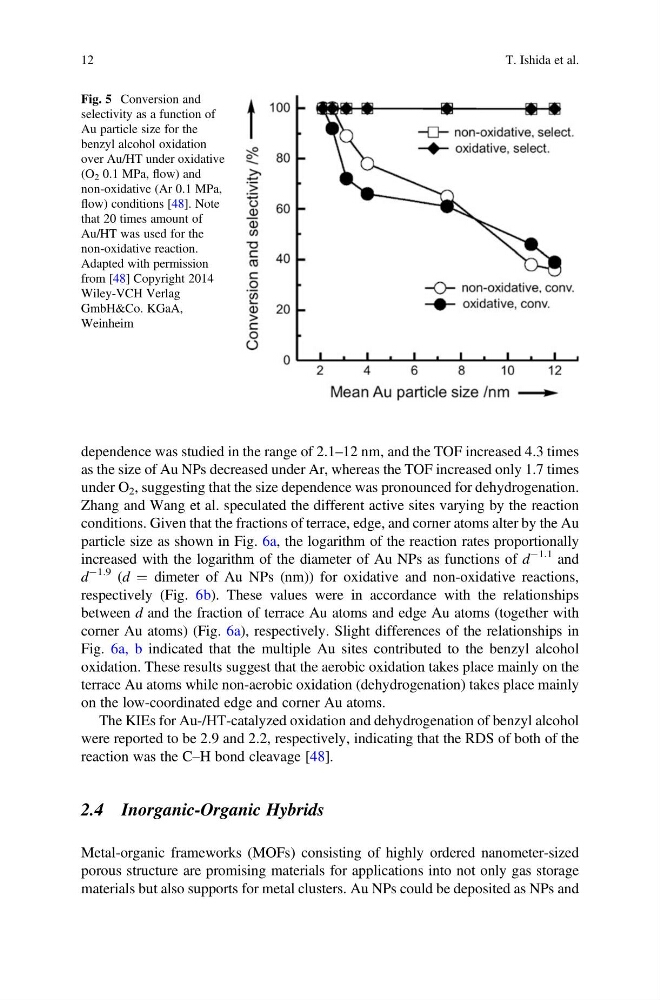
dependence was studied in the range of 2.1–12 nm, and the TOF increased 4.3 times
as the size of Au NPs decreased under Ar, whereas the TOF increased only 1.7 times
under O 2 , suggesting that the size dependence was pronounced for dehydrogenation.
Zhang and Wang et al. speculated the different active sites varying by the reaction
conditions. Given that the fractions of terrace, edge, and corner atoms alter by the Au
particle size as shown in Fig. 6a, the logarithm of the reaction rates proportionally
increased with the logarithm of the diameter of Au NPs as functions of d
À1.1 and
d
À1.9 (d ¼ dimeter of Au NPs (nm)) for oxidative and non-oxidative reactions,
respectively (Fig. 6b). These values were in accordance with the relationships
between d and the fraction of terrace Au atoms and edge Au atoms (together with
corner Au atoms) (Fig. 6a), respectively. Slight differences of the relationships in
Fig. 6a, b indicated that the multiple Au sites contributed to the benzyl alcohol
oxidation. These results suggest that the aerobic oxidation takes place mainly on the
terrace Au atoms while non-aerobic oxidation (dehydrogenation) takes place mainly
on the low-coordinated edge and corner Au atoms.
The KIEs for Au-/HT-catalyzed oxidation and dehydrogenation of benzyl alcohol
were reported to be 2.9 and 2.2, respectively, indicating that the RDS of both of the
reaction was the C–H bond cleavage [48].
2.4 Inorganic-Organic Hybrids
Metal-organic frameworks (MOFs) consisting of highly ordered nanometer-sized
porous structure are promising materials for applications into not only gas storage
materials but also supports for metal clusters. Au NPs could be deposited as NPs and
Fig. 5 Conversion and
selectivity as a function of
Au particle size for the
benzyl alcohol oxidation
over Au/HT under oxidative
(O 2 0.1 MPa, flow) and
non-oxidative (Ar 0.1 MPa,
flow) conditions [48]. Note
that 20 times amount of
Au/HT was used for the
non-oxidative reaction.
Adapted with permission
from [48] Copyright 2014
Wiley-VCH Verlag
GmbH&Co. KGaA,
Weinheim
12
T. Ishida et al.
as the size of Au NPs decreased under Ar, whereas the TOF increased only 1.7 times
under O 2 , suggesting that the size dependence was pronounced for dehydrogenation.
Zhang and Wang et al. speculated the different active sites varying by the reaction
conditions. Given that the fractions of terrace, edge, and corner atoms alter by the Au
particle size as shown in Fig. 6a, the logarithm of the reaction rates proportionally
increased with the logarithm of the diameter of Au NPs as functions of d
À1.1 and
d
À1.9 (d ¼ dimeter of Au NPs (nm)) for oxidative and non-oxidative reactions,
respectively (Fig. 6b). These values were in accordance with the relationships
between d and the fraction of terrace Au atoms and edge Au atoms (together with
corner Au atoms) (Fig. 6a), respectively. Slight differences of the relationships in
Fig. 6a, b indicated that the multiple Au sites contributed to the benzyl alcohol
oxidation. These results suggest that the aerobic oxidation takes place mainly on the
terrace Au atoms while non-aerobic oxidation (dehydrogenation) takes place mainly
on the low-coordinated edge and corner Au atoms.
The KIEs for Au-/HT-catalyzed oxidation and dehydrogenation of benzyl alcohol
were reported to be 2.9 and 2.2, respectively, indicating that the RDS of both of the
reaction was the C–H bond cleavage [48].
2.4 Inorganic-Organic Hybrids
Metal-organic frameworks (MOFs) consisting of highly ordered nanometer-sized
porous structure are promising materials for applications into not only gas storage
materials but also supports for metal clusters. Au NPs could be deposited as NPs and
Fig. 5 Conversion and
selectivity as a function of
Au particle size for the
benzyl alcohol oxidation
over Au/HT under oxidative
(O 2 0.1 MPa, flow) and
non-oxidative (Ar 0.1 MPa,
flow) conditions [48]. Note
that 20 times amount of
Au/HT was used for the
non-oxidative reaction.
Adapted with permission
from [48] Copyright 2014
Wiley-VCH Verlag
GmbH&Co. KGaA,
Weinheim
12
T. Ishida et al.