

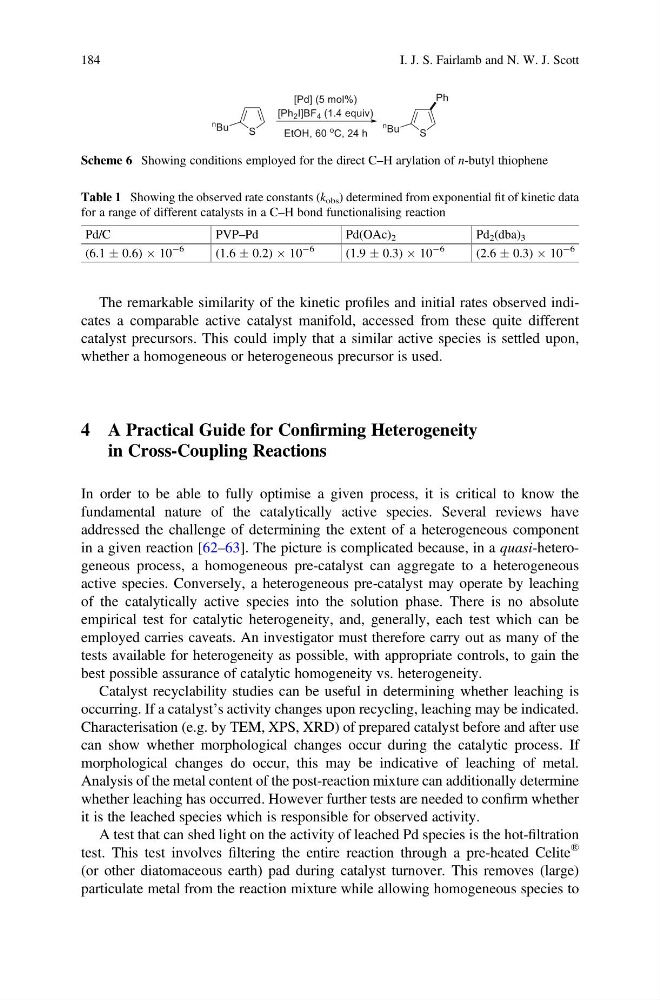
The remarkable similarity of the kinetic profiles and initial rates observed indicates a comparable active catalyst manifold, accessed from these quite different
catalyst precursors. This could imply that a similar active species is settled upon,
whether a homogeneous or heterogeneous precursor is used.
4 A Practical Guide for Confirming Heterogeneity
in Cross-Coupling Reactions
In order to be able to fully optimise a given process, it is critical to know the
fundamental nature of the catalytically active species. Several reviews have
addressed the challenge of determining the extent of a heterogeneous component
in a given reaction [62–63]. The picture is complicated because, in a quasi-heterogeneous process, a homogeneous pre-catalyst can aggregate to a heterogeneous
active species. Conversely, a heterogeneous pre-catalyst may operate by leaching
of the catalytically active species into the solution phase. There is no absolute
empirical test for catalytic heterogeneity, and, generally, each test which can be
employed carries caveats. An investigator must therefore carry out as many of the
tests available for heterogeneity as possible, with appropriate controls, to gain the
best possible assurance of catalytic homogeneity vs. heterogeneity.
Catalyst recyclability studies can be useful in determining whether leaching is
occurring. If a catalyst’s activity changes upon recycling, leaching may be indicated.
Characterisation (e.g. by TEM, XPS, XRD) of prepared catalyst before and after use
can show whether morphological changes occur during the catalytic process. If
morphological changes do occur, this may be indicative of leaching of metal.
Analysis of the metal content of the post-reaction mixture can additionally determine
whether leaching has occurred. However further tests are needed to confirm whether
it is the leached species which is responsible for observed activity.
A test that can shed light on the activity of leached Pd species is the hot-filtration
test. This test involves filtering the entire reaction through a pre-heated Celite
®
(or other diatomaceous earth) pad during catalyst turnover. This removes (large)
particulate metal from the reaction mixture while allowing homogeneous species to
Scheme 6 Showing conditions employed for the direct C–H arylation of n-butyl thiophene
Table 1 Showing the observed rate constants (k obs ) determined from exponential fit of kinetic data
for a range of different catalysts in a C–H bond functionalising reaction
Pd/C
PVP–Pd
Pd(OAc) 2
Pd 2 (dba) 3
(6.1 Æ 0.6) Â 10
À6
(1.6 Æ 0.2) Â 10
À6
(1.9 Æ 0.3) Â 10
À6
(2.6 Æ 0.3) Â 10
À6
184
I. J. S. Fairlamb and N. W. J. Scott
catalyst precursors. This could imply that a similar active species is settled upon,
whether a homogeneous or heterogeneous precursor is used.
4 A Practical Guide for Confirming Heterogeneity
in Cross-Coupling Reactions
In order to be able to fully optimise a given process, it is critical to know the
fundamental nature of the catalytically active species. Several reviews have
addressed the challenge of determining the extent of a heterogeneous component
in a given reaction [62–63]. The picture is complicated because, in a quasi-heterogeneous process, a homogeneous pre-catalyst can aggregate to a heterogeneous
active species. Conversely, a heterogeneous pre-catalyst may operate by leaching
of the catalytically active species into the solution phase. There is no absolute
empirical test for catalytic heterogeneity, and, generally, each test which can be
employed carries caveats. An investigator must therefore carry out as many of the
tests available for heterogeneity as possible, with appropriate controls, to gain the
best possible assurance of catalytic homogeneity vs. heterogeneity.
Catalyst recyclability studies can be useful in determining whether leaching is
occurring. If a catalyst’s activity changes upon recycling, leaching may be indicated.
Characterisation (e.g. by TEM, XPS, XRD) of prepared catalyst before and after use
can show whether morphological changes occur during the catalytic process. If
morphological changes do occur, this may be indicative of leaching of metal.
Analysis of the metal content of the post-reaction mixture can additionally determine
whether leaching has occurred. However further tests are needed to confirm whether
it is the leached species which is responsible for observed activity.
A test that can shed light on the activity of leached Pd species is the hot-filtration
test. This test involves filtering the entire reaction through a pre-heated Celite
®
(or other diatomaceous earth) pad during catalyst turnover. This removes (large)
particulate metal from the reaction mixture while allowing homogeneous species to
Scheme 6 Showing conditions employed for the direct C–H arylation of n-butyl thiophene
Table 1 Showing the observed rate constants (k obs ) determined from exponential fit of kinetic data
for a range of different catalysts in a C–H bond functionalising reaction
Pd/C
PVP–Pd
Pd(OAc) 2
Pd 2 (dba) 3
(6.1 Æ 0.6) Â 10
À6
(1.6 Æ 0.2) Â 10
À6
(1.9 Æ 0.3) Â 10
À6
(2.6 Æ 0.3) Â 10
À6
184
I. J. S. Fairlamb and N. W. J. Scott